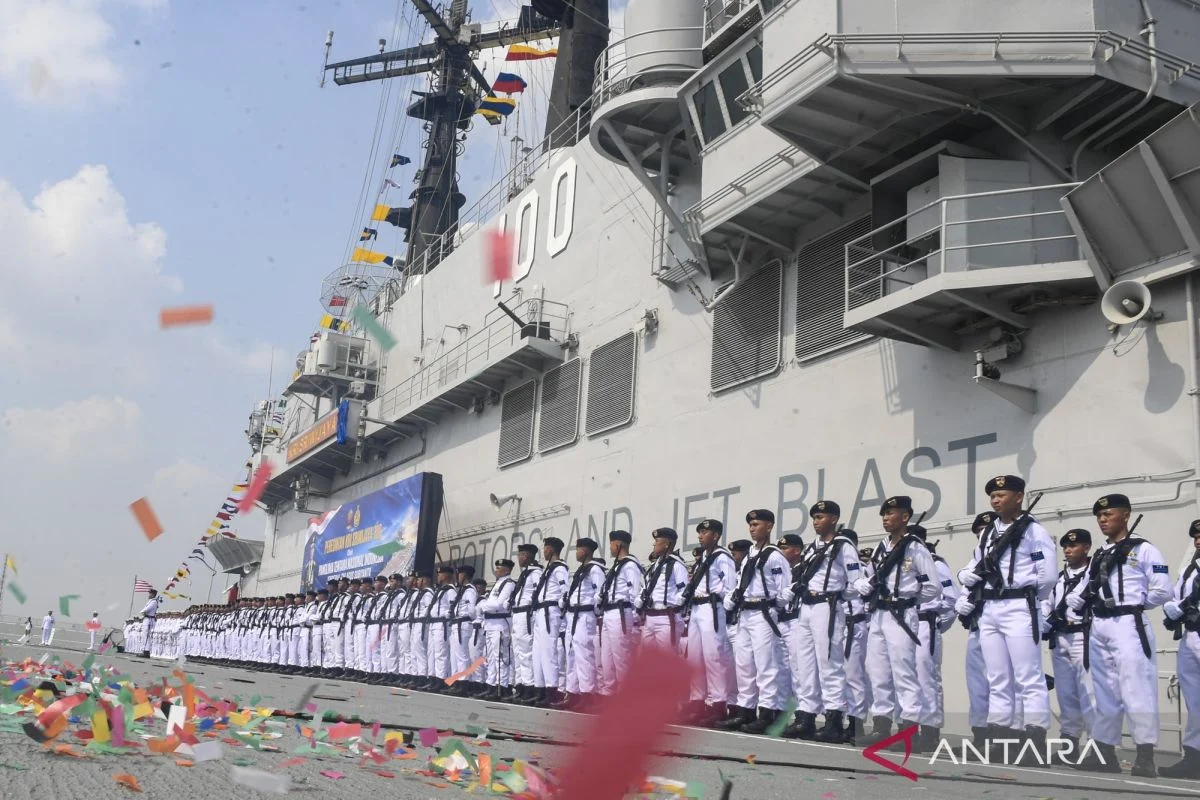
The arrival of the former Italian Navy aircraft carrier ITS Giuseppe Garibaldi at Pier 107 of Tanjung Priok Port in North Jakarta marks a historic turning point for the Indonesian National Armed Forces-Navy (TNI AL). Docking on Friday, September 18, 2026, this significant military asset—granted to Indonesia by the government of Italy—is set to become the very first aircraft carrier in the history of the Indonesian naval fleet. Once the official handover and flag-change ceremony take place on September 24, 2026, the vessel will officially be recommissioned as the KRI Sriwijaya, carrying the hull number C551 into a new chapter of maritime defense.
This acquisition has instantly revitalized national and international discourse regarding the strategic utility, operational capabilities, and broader geopolitical implications of operating a true sovereign aircraft carrier. As an archipelagic nation spanning thousands of islands, Indonesia’s defense strategy relies heavily on projecting power, ensuring maritime security, and maintaining rapid response capabilities across vast oceanic domains. The introduction of KRI Sriwijaya is expected to profoundly reshape the operational reach of TNI AL, shifting paradigms in regional naval deterrence, power projection, and humanitarian disaster relief.
Chronology and Background of the Acquisition
The journey toward acquiring the ITS Giuseppe Garibaldi began through sustained bilateral defense diplomacy between Jakarta and Rome. Discussions intensified over prior years as the Indonesian Ministry of Defense and TNI AL sought versatile, high-capacity platforms to modernize and expand the archipelagic state’s blue-water navy capabilities. The Italian Navy, transitioning newer multi-role amphibious assault ships and carriers into service, offered the vessel as part of a strategic defense partnership.
Following months of technical inspections, crew training, and logistical preparations, the warship embarked on its landmark voyage from European waters to Southeast Asia. Its arrival at Tanjung Priok Port on September 18, 2026, drew immense public attention, media coverage, and high-level interest from state officials. The upcoming formal commissioning ceremony on September 24, 2026, will symbolize the official transfer of sovereignty, raising the Red and White flag over the newly minted KRI Sriwijaya. State Secretary officials have also confirmed that the President of the Republic of Indonesia is scheduled to receive a high-level delegation from the Italian Navy to commemorate the historic defense milestone, underscoring the strong diplomatic ties underpinning the transfer.
Deconstructing the Floating Airbase: What is an Aircraft Carrier?
To understand the magnitude of KRI Sriwijaya joining the fleet, one must examine the defining characteristics of an aircraft carrier. In naval terms, an aircraft carrier is fundamentally a large combat vessel designed with a primary mission: serving as a mobile, sovereign airbase on the high seas.
Unlike traditional surface combatants—such as frigates, corvettes, and destroyers—whose primary offensive and defensive capabilities rely on surface-to-surface missiles, torpedoes, and naval artillery, an aircraft carrier integrates a full-length flight deck and subterranean hangars. This architectural design enables the continuous launch, recovery, maintenance, and command of fixed-wing aircraft, vertical takeoff and landing (VTOL) jets, and specialized maritime helicopters.
By operating as a movable airfield, an aircraft carrier liberates air power from the fixed geographical constraints of land-based airstrips. This capability allows naval task forces to project tactical aviation deep into contested waters or remote areas lacking established aviation infrastructure. Navies worldwide, including the United States Navy, utilize carriers for a spectrum of missions ranging from maritime strike operations and sea-control to power projection and humanitarian assistance.
Distinguishing True Carriers from Helipad-Equipped Warships
A common point of confusion among civilian observers is the distinction between a dedicated aircraft carrier and standard warships equipped with aviation facilities. Many modern frigates and destroyers possess helicopter landing pads and hangars; however, their foundational architecture is not built around aviation operations.
Conversely, a true aircraft carrier is explicitly engineered around its aviation ecosystem. This includes specialized flight decks capable of high-tempo launch and recovery cycles, extensive internal hangars for comprehensive aircraft maintenance, aviation fuel storage farms, armories for ordnance, and advanced air traffic control command centers.
Furthermore, aircraft carriers are not monolithic in size or function. While global superpowers operate massive nuclear-powered supercarriers capable of housing dozens of conventional fixed-wing strike fighters, lighter carriers—such as the ITS Giuseppe Garibaldi class—are optimized for flexibility, operating rotary-wing assets and vertical or short takeoff and landing (VSTOVL) aircraft. Measuring roughly 180 meters in length with a displacement of over 13,000 tons, the Giuseppe Garibaldi was originally designed by Italy to operate AV-8B Harrier II strike fighters alongside anti-submarine and utility helicopters, presenting an ideal balance of capability and operational economy for regional navies.
Strategic Redirection: Prioritizing Operations Other Than War (OMSP)
Despite its heritage as a light fleet carrier capable of fixed-wing combat aviation, the integration of KRI Sriwijaya into the Indonesian Navy will not immediately mirror the offensive strike postures of Western superpowers. Chief of Staff of the Navy (KSAL) Admiral Muhammad Ali has articulated a deliberate, pragmatic approach to the vessel’s future operational profile.
Upon arrival, the ship is slated to undergo extensive physical refits, machinery overhauls, and structural adaptations tailored specifically to the strategic doctrines of the TNI AL. Crucially, the Indonesian military leadership has emphasized that KRI Sriwijaya will heavily prioritize Operations Other Than War (OMSP / Operasi Militer Selain Perang).
While the navy maintains aspirations to eventually integrate vertical takeoff aircraft—with leadership openly expressing a desire for compatible VSTOL aviation assets—the immediate focus remains centered on non-combatant roles, strategic deterrence, logistical transport, and disaster management. This dual-use capability aligns seamlessly with Indonesia’s unique geographic reality as a sprawling maritime nation vulnerable to natural disasters.
A Floating Hub for Humanitarian Assistance and Disaster Relief (HADR)
As an archipelago prone to earthquakes, volcanic eruptions, tsunamis, and extreme weather events, Indonesia frequently faces catastrophic scenarios where traditional land transportation networks are severed. In such emergencies, timely delivery of medical supplies, heavy equipment, and relief personnel is paramount.
KRI Sriwijaya offers an unprecedented solution for Humanitarian Assistance and Disaster Relief (HADR). With its expansive flight deck and cavernous internal storage, the ship can function as a floating logistics hub and forward-deployable medical center. Helicopters operating from the vessel can bypass damaged bridges and blocked roads to evacuate victims, distribute food and medicine, and insert emergency rescue teams directly into isolated disaster zones.
Additionally, defense analysts note the vessel’s prospective utility in modernizing disaster response through the integration of unmanned aerial vehicles (drones). By serving as a floating command and control node for both manned helicopters and reconnaissance drones, KRI Sriwijaya can map disaster areas, monitor maritime safety, and coordinate complex multi-agency rescue efforts across remote maritime borders.
Implications for Indonesian Defense and Regional Geopolitics
The commissioning of KRI Sriwijaya carries profound implications for Indonesia’s defense posture. By crossing the threshold into aircraft carrier operation, Indonesia joins an elite group of nations capable of projecting aviation power from the sea.
From a tactical perspective, the vessel enhances the TNI AL’s blue-water capabilities, providing an effective mobile command center for maritime security operations across the exclusive economic zone (EEZ) and vital sea lanes of communication (ALKI). It reinforces fleet air defense, anti-submarine warfare coordination, and rapid regional crisis response.
From a diplomatic and geopolitical standpoint, the acquisition signals Indonesia’s growing commitment to safeguarding regional stability and maritime order. It enhances interoperability with regional partners and demonstrates a sophisticated understanding of modern naval warfare and statecraft. As the Red and White flag officially rises over KRI Sriwijaya on September 24, 2026, Indonesia’s naval capabilities enter a transformative era—one that balances sovereign defense readiness with vital humanitarian utility across the world’s largest archipelagic state.