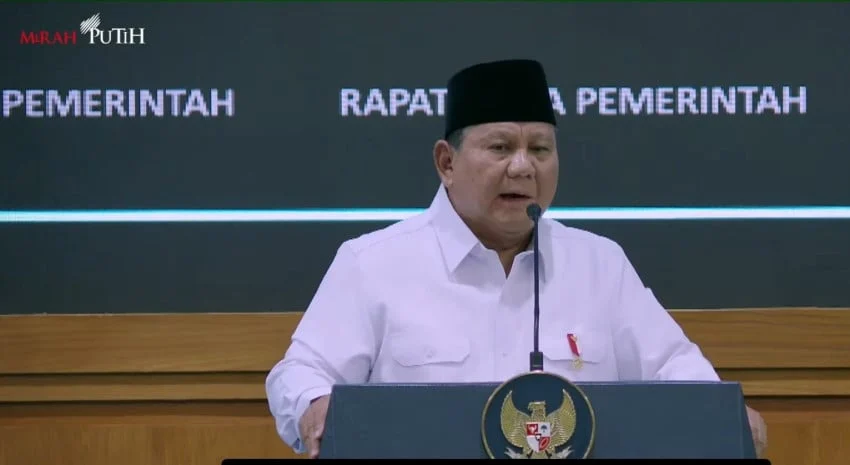
JAKARTA — Public policy analyst Said Didu has issued a stark warning to Indonesian President Prabowo Subianto regarding escalating societal grievances, identifying six specific areas of public anger that he believes could be exploited by opportunistic political actors seeking to orchestrate a regime change. Speaking on the prominent television talk show Rakyat Bersuara, broadcast on iNews under the theme Bisik-Bisik Percepatan Pemilu, Siapa Mengusik? (Whispers of Early Elections, Who is Interfering?), Said stressed the urgent need for heightened vigilance within the executive branch. To effectively counter these destabilizing threats, he suggested that President Prabowo look to Russian President Vladimir Putin as a strategic model for consolidating state control and maintaining political stability in the face of domestic discontent.
The televised forum, which convened political analysts, policymakers, and public figures to discuss rumors surrounding potential early election maneuvers and underlying political tensions, served as a platform for Said to elaborate on the vulnerabilities facing the current administration. According to the analyst, systemic frustrations among the populace represent a combustible political environment if left unaddressed through decisive and empathetic governance.
The Six Sources of Public Grievance
Elaborating on his assessment during the broadcast, Said Didu outlined the precise flashpoints that he argues could be weaponized by political rivals or rogue factions aiming to unseat the administration.
The first and most critical vulnerability, according to Said, stems from the deep-seated frustration of impoverished citizens who feel that the current administration has yet to deliver tangible improvements to their standard of living or provide a clear vision for economic upliftment. This socio-economic disenfranchisement creates a fertile ground for radical opposition rhetoric.
The second major source of anger identified by the policy analyst revolves around resource scarcity, specifically pointing to potential instabilities in the distribution and availability of subsidized and non-subsidized fuel (BBM). Energy scarcity has historically served as an immediate catalyst for widespread civil unrest in Indonesia, capable of mobilizing diverse segments of the population against the ruling government almost overnight.
While the provided forum excerpt detailed the initial two points—impoverished populations lacking hope and anxieties surrounding fuel scarcity—analysts and observers note that systemic economic pressures, inflation, uneven regional development, and unmet campaign promises typically complete the broader spectrum of domestic vulnerabilities in developing democracies. These compounding factors create an environment where public dissatisfaction can easily morph into organized political resistance.
Drawing Parallels: Why Said Didu Suggested the "Putin Model"
In offering a preventative strategy, Said Didu urged President Prabowo to study the governance and security framework utilized by Russian President Vladimir Putin. While Putin’s political methods are frequently criticized by Western democracies for authoritarianism and the suppression of political dissent, Said’s reference centered primarily on the Russian leader’s absolute grip on state apparatuses, proactive neutralization of internal security threats, and the suppression of externally funded or opportunistically driven destabilization campaigns.

In the context of Indonesian politics, adopting a "Putin-esque" approach implies a zero-tolerance policy toward disruptive political machinations, strict oversight of subversive movements, and a consolidation of executive power designed to insulate the state from premature electoral agitation. However, political scientists caution that applying such a model within Indonesia’s democratic architecture—which was forged following the 1998 Reformasi movement—could risk alienating civil society and rolling back hard-won democratic freedoms.
The Political Backdrop: Rumors of Early Elections and Political Accommodation
The warnings delivered by Said Didu come amid a backdrop of simmering political speculation in Jakarta regarding whispers of early election maneuvers and parliamentary maneuvering. Political observers have noted an undercurrent of tension as various political factions adjust their alignments following the transition of power to President Prabowo Subianto.
In a separate but related statement delivered prior to the iNews appearance, Said Didu publicly advised President Prabowo that the window for traditional political accommodation—such as distributing cabinet positions or state-owned enterprise board seats to appease former political rivals—had effectively closed. He argued that attempts to co-opt potential opposition figures through power-sharing arrangements would no longer suffice to guarantee political stability and could instead dilute the administration’s reform agenda. Instead, Said maintains that the administration’s survival depends on direct, radical delivery of public welfare and an uncompromising stance against destabilization efforts.
Broader Implications for the Prabowo Administration
The implications of Said Didu’s warnings extend far beyond television commentary, touching upon the core governance challenges confronting the Prabowo-Gibran administration. As Indonesia navigates complex global economic headwinds, fluctuating commodity prices, and domestic fiscal pressures, maintaining public trust is paramount.
Economists and political risk analysts point out that the administration’s focus on flagship programs, such as the free nutritive meal initiative for school children and downstream mineral processing, represents an effort to address foundational welfare and economic sovereignty. However, the operational execution of these programs must be swift and equitable to mitigate the exact vulnerabilities highlighted by critics.
Furthermore, the warning touches upon a delicate balance within Indonesia’s presidential system: the tension between maintaining democratic openness and ensuring state security against opportunistic subversion. Security analysts note that while the state must remain vigilant against unlawful efforts to subvert a democratically elected government, it must do so within the boundaries of the constitution and the rule of law to avoid triggering the very backlash it seeks to prevent.
As the political year unfolds, the administration faces mounting pressure to address grassroots economic anxieties while navigating the treacherous waters of elite political maneuvering. Whether President Prabowo will heed the advice of analysts like Said Didu or chart a distinct course rooted in traditional Indonesian democratic consensus remains one of the defining questions of the current political era.