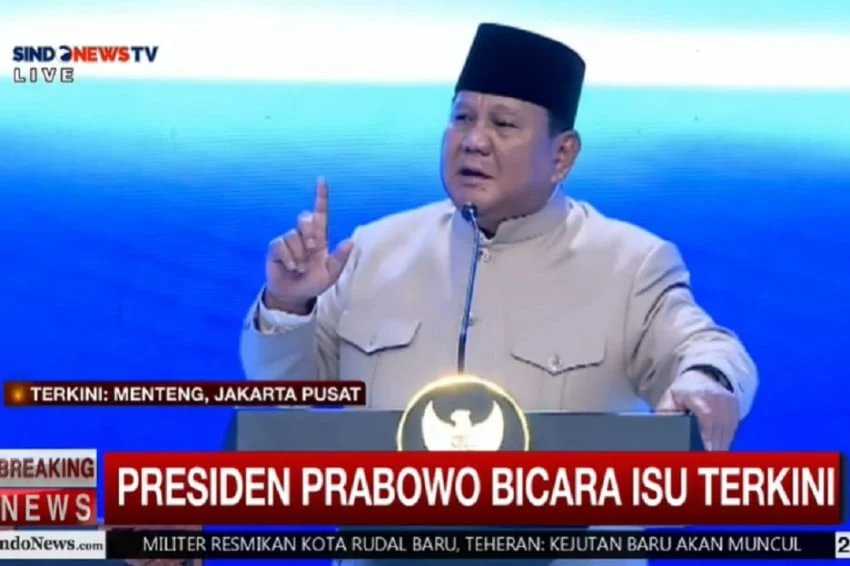
JAKARTA — President Prabowo Subianto has forcefully rejected the pessimistic narrative surrounding the nation’s future, commonly referred to in public discourse as "Indonesia Gelap" (Dark Indonesia). Speaking before a packed auditorium during the celebration of the 15th anniversary of the NasDem Party in Jakarta on Wednesday, November 11, 2026, the Head of State characterized the pessimistic viewpoint as a deliberate creation by malicious actors whose identities, he claimed, are already known to the government.
The President’s remarks form part of a broader discourse on national optimism, economic resilience, and political stability in the world’s third-largest democracy. Addressing party cadres, government officials, and supporters, President Prabowo emphasized that Indonesia possesses abundant natural resources and structural wealth, rendering defeatist narratives both factually incorrect and politically motivated.
Main Facts and the Presidential Address
During his address, President Prabowo did not mince words regarding the origin and intent behind the "Indonesia Gelap" rhetoric. He urged the Indonesian public to maintain confidence in the country’s trajectory and reject attempts to undermine national morale through systemic pessimism.
"Saudara-saudara sekalian, demikian filosofi yang saya ajak. Bangsa kita kaya, percaya sama saya. Itu narasi Indonesia Gelap, itu adalah jahat! Dan itu dibuat oleh orang jahat. Dan orang jahat sudah ketahuan, Saudara-saudara," stated President Prabowo, asserting that the architects behind these narratives have been identified by intelligence and administrative monitoring.
The President further exhorted citizens not to succumb to despair when confronting socioeconomic challenges or political noise. He argued that prolonged lamentation offers no practical solutions to the nation’s hurdles, reinforcing a philosophy of active resilience, productivity, and collective self-reliance. This messaging aligns closely with his administration’s ongoing campaigns to foster domestic economic participation and safeguard strategic national assets.
Chronology and Event Context
The context of the President’s statement dates back to rising political dynamics and public debates concerning economic indicators, governance transparency, and social welfare programs. The phrase "Indonesia Gelap" has occasionally surfaced across digital platforms and political forums, utilized by critics to highlight perceived governance shortcomings, regulatory bottlenecks, or economic pressures faced by the working class.
The setting of the declaration—the 15th anniversary of the NasDem Party—is significant within Indonesia’s contemporary political landscape. The NasDem Party, a key component of the ruling coalition supporting the Prabowo administration, has traditionally positioned itself as a proponent of progressive nationalism and structural reform.
In the days leading up to the anniversary event, President Prabowo’s public engagements had already captured media attention due to candid remarks regarding heightened political dynamics and domestic security concerns. Observers noted that the President’s speech at the NasDem gathering served as both a political rallying cry and a policy defense, aimed at consolidating internal coalition support ahead of upcoming legislative milestones and regional policy implementations.
Background Context: The Rise of Socio-Political Narratives
In modern Indonesian political communications, the battle of narratives has become a defining characteristic of electoral and post-electoral periods. Terms like "Indonesia Gelap" or utopian counter-narratives are frequently weaponized in digital spaces, amplified by social media algorithms, influencer networks, and partisan think tanks.
Political analysts note that the Prabowo administration has consistently pushed back against pessimistic framings, particularly those targeting macroeconomic stability, food security initiatives, and infrastructure continuity. By labeling the narrative as the product of "malicious actors," the administration seeks to delegitimize coordinated disinformation campaigns while reassuring foreign investors and domestic markets of the country’s macroeconomic fundamentals.
Indonesia’s macroeconomic indicators for late 2026 reflect moderate growth, steady foreign direct investment, and ongoing fiscal discipline managed by the central bank and the Ministry of Finance. Despite global geopolitical uncertainties, supply chain disruptions, and fluctuating commodity prices, national growth projections have remained within targeted governmental thresholds. Consequently, the administration maintains that pessimistic projections lack empirical backing and serve narrow political objectives rather than public interest.
Supporting Data and Economic Realities
To understand the weight of President Prabowo’s assertions regarding national wealth, it is essential to examine Indonesia’s structural economic position. As an emerging market powerhouse within the G20, Indonesia continues to leverage its vast reserves of critical minerals—most notably nickel, bauxite, and copper—alongside its agricultural bounty.
- Economic Growth: Indonesia’s GDP growth has hovered around 5% annually, positioning it as one of the more resilient economies in the Asia-Pacific region amidst global inflationary pressures.
- Downstreaming Policy: The ongoing downstreaming (hilirisasi) policy, initiated under the previous administration and expanded under President Prabowo, aims to increase the domestic value of raw commodities rather than exporting them unprocessed. This policy has attracted tens of billions of dollars in foreign and domestic industrial capital, particularly in Central Sulawesi and North Maluku.
- Foreign Reserves: Bank Indonesia reports that the country’s official reserve assets remain robust, providing a reliable buffer against external economic shocks and maintaining currency stability.
Despite these positive metrics, structural challenges persist. Income inequality, regional development disparities, and formal versus informal employment ratios remain focal points of public debate. Critics argue that while macroeconomic numbers appear strong, the distribution of wealth requires more aggressive intervention, which often fuels the critical rhetoric that the administration seeks to counter.
Official Responses and Political Reactions
The President’s remarks at the NasDem anniversary triggered swift reactions across the political spectrum, drawing commentary from coalition members, opposition figures, and civil society organizations.
Representatives from the NasDem Party praised the President’s firm stance, framing it as a necessary defense of national dignity. Party executives underscored the importance of unity in achieving the government’s long-term vision, often referred to as "Golden Indonesia 2045" (Indonesia Emas 2045), which envisions the nation emerging as a top global economy by its centenary of independence.
Conversely, political opposition groups and certain civil society organizations offered measured critiques of the administration’s rhetoric. Some opposition lawmakers argued that labeling critical socioeconomic narratives as "evil" or malicious risks stifling legitimate public discourse and constructive criticism. They maintained that expressions of public anxiety regarding inflation, employment, and cost of living should be addressed through policy adjustments rather than political dismissals.
Meanwhile, academic and political communication experts have pointed out that modern governance increasingly relies on narrative management. In an era dominated by digital connectivity, the ability of a head of state to define the national narrative directly influences consumer confidence, investor sentiment, and social cohesion.
Broader Impact and Implications
The ongoing friction between government-led optimism and critical public narratives carries significant implications for Indonesia’s sociopolitical stability and economic trajectory.
From an economic perspective, maintaining investor confidence is paramount. Capital markets react sensitively to political stability and leadership rhetoric. By decisively challenging pessimistic outlooks, the administration aims to prevent self-fulfilling prophecies of economic downturns that could be triggered by unwarranted panic or negative sentiment.
From a governance perspective, the administration’s approach highlights the delicate balance between protecting national morale and respecting freedom of expression. As Indonesia approaches subsequent legislative and administrative milestones, the capacity of the state to constructively address citizen grievances while combating coordinated disinformation will remain a critical test for democratic maturity.
Ultimately, President Prabowo’s declaration at the NasDem anniversary serves as a reminder of the high-stakes battle over public perception in contemporary Indonesia. As the government continues to roll out its strategic agenda, the discourse surrounding the nation’s future will undoubtedly remain a central theme in national politics, shaping both policy formulation and public trust in the years ahead.