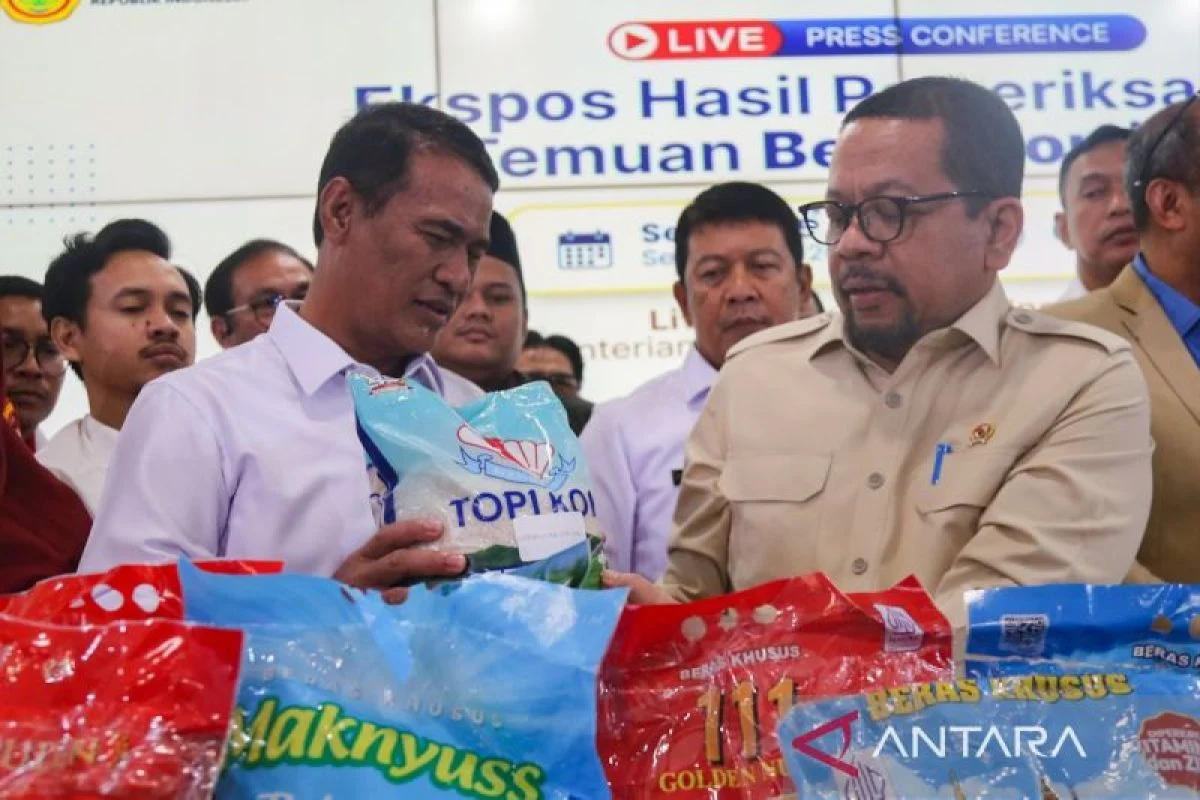
Jakarta — In a sweeping regulatory enforcement action that has sent shockwaves through Indonesia’s agricultural and consumer goods sectors, the Indonesian government has ordered the immediate nationwide recall of 25 commercial brands of fortified rice. The unprecedented crackdown follows rigorous laboratory examinations revealing that the vast majority of tested products failed to meet mandated nutritional standards and bore misleading labeling, deceiving millions of consumers who relied on the specialized grain for vital health benefits.
The findings were officially announced by Minister of Agriculture and Head of the National Food Agency (Bapanas), Andi Amran Sulaiman, during a high-profile press conference in Jakarta. According to the minister, comprehensive inspections were conducted across 27 commercial brands of fortified rice available on the domestic market. Out of these, a staggering 25 brands—representing roughly 92 percent of the sample pool—were found to be in non-compliance with statutory requirements regarding vitamin and mineral enrichment, nutrient composition, and product quality.
The scandal has drawn urgent interventions from multiple state apparatuses, including the Ministry of Trade, the National Food Agency, local food safety authorities, and the National Police’s Food Task Force (Satgas Pangan). As regulatory bodies move swiftly to contain the fallout, the case highlights persistent vulnerabilities in food supply chain oversight, consumer protection, and the standardization of functional foods designed for vulnerable segments of the population.
Rigorous Laboratory Testing and SNI Standards Compliance
The impetus for the government’s intervention originated from growing consumer complaints and preliminary market monitoring regarding the actual efficacy and content of heavily marketed fortified rice products. To establish definitive scientific proof, Bapanas commissioned independent evaluations through four accredited and highly reputable testing facilities: the Bogor Agricultural University (IPB) Laboratory, the Rice Research and Development Center (BRMP), Saraswanti Indo Genetech (SIG), and Eurofins Angler Biochemlab.
The laboratory protocols evaluated the samples against strict national benchmarks, specifically the Indonesian National Standard (SNI) 9314:2024 for fortified rice kernels and SNI 9372:2025 for finished fortified rice products. These standards dictate precise concentrations of essential micronutrients—such as iron, zinc, folic acid, and various B-complex vitamins—that must be homogeneously blended or coated onto the grains.
Out of the 27 brands subjected to this rigorous scientific scrutiny, only two brands met the strict compositional criteria outlined by the SNI. The remaining 25 brands displayed significant discrepancies between the nutritional values claimed on their product packaging and the actual chemical composition detected in the laboratories. In many cases, the essential fortificants were either severely diluted, improperly integrated, or entirely absent, rendering the products functionally identical to standard, unfortified commercial rice while commanding premium prices.
Understanding Fortified Rice and Its Critical Role for Vulnerable Groups
Fortified rice is fundamentally distinct from standard premium or medium-grain table rice. It is engineered through sophisticated industrial processes—often involving the extrusion of broken rice flour mixed with vitamin and mineral premixes into kernel shapes (known as ultra-rice or kernel fortification) that mimic natural grains.
The primary public policy objective behind introducing fortified rice to the market is not to replace everyday premium rice varieties consumed by the general populace, but rather to serve as a targeted nutritional intervention. The Indonesian government actively promotes fortified rice to combat chronic micronutrient deficiencies, particularly among high-risk and vulnerable demographics. These target groups include low-income households, pregnant women, nursing mothers, young children under five, and communities suffering from systemic malnutrition or stunting.
Because these consumers rely on specialized nutritional enhancement to supplement their daily caloric intake with crucial developmental micronutrients, any deviation from established labeling standards constitutes a direct threat to public health. When a product marketed as fortified fails to deliver its promised nutritional value, it undermines national stunting reduction initiatives and compromises the health outcomes of society’s most vulnerable members.
The Scale of the Deception: Economic Impact and Price Anomalies
Beyond the alarming nutritional deficiencies, the investigation uncovered severe economic exploitation within the marketing and pricing structures of the implicated products. Government investigators revealed a massive discrepancy between the production realities of fortified rice and retail pricing strategies observed in the open market.
While regulatory cost assessments and production economics place the fair market value of fortified rice within a reasonable bracket of Rp13,000 to Rp13,500 per kilogram, investigators discovered certain fraudulent brands being aggressively marketed and sold to consumers at exorbitant prices reaching up to Rp57,000 per kilogram. By leveraging misleading health claims, organic branding, and specialized nutritional labels, unscrupulous producers were able to artificially inflate profit margins by several hundred percent.
Bapanas has calculated the potential cumulative economic loss suffered by Indonesian consumers due to this pricing malpractice and nutritional non-compliance to be approximately Rp89 trillion. While this figure serves as an initial macro-level estimation derived from market penetration data and pricing differentials, it underscores the staggering financial scale of the consumer fraud involved.
Comprehensive List of Implicated Brands and Regulatory Action
In the interest of public transparency, the government released the complete inventory of the 25 brands identified during the investigation as failing to meet regulatory compliance. The listed brands include Idola Fortifikasi, Idola High Quality Whole Grain Rice, Idola Long Grain Rice, Ikan Mas Cupang, AAA Wijaya Kusuma, Cantik Manis, Penari Bangkok, Topi Koki Short Grain, Topi Koki Setra Royale, Topi Koki Long Grain Crystal, HOK-1 Gohan, Maknyuss Pulen Gizi, Anak Raja Fortifikasi, Anak Raja Nusantara, Top Anak Raja, PMS Induk Ayam, Sumo, Rasvit, FS Nutri Rice, Pelikan, Rice Rojolele, Super Kepala Beras Premium 111, 111 Golden Number, Putri Koki, and Wellfarm Beras Diabet.
Additionally, official documentation from the Ministry of Agriculture referenced these entities using specific internal acronym initials—namely WFO, TKS, IMF, NUR, TKL, HOK, BRV, IMR, IHJ, IAK, PBK, GNB, DTR, TKR, WJK, PLK, MKY, IMC, PTK, ARP, ARN, SKM, GNM, TAR, and CMS. Regulatory authorities have cautioned that this comprehensive roster reflects the current scope of products under administrative investigation and active recall, rather than a final criminal conviction by a court of law.
Swift Enforcement, Production Halts, and Market Supply Stability
In response to the findings, the Ministry of Agriculture and Bapanas initiated an immediate enforcement pipeline. All 25 implicated business entities were formally ordered to cease the production of their respective fortified rice lines instantly. Furthermore, the Regional Food Security Competent Authorities (OKKPD) across various provinces were mobilized to oversee the physical withdrawal of non-compliant stocks from retail distribution networks.
Data compiled by Bapanas indicates that by the first week of September 2026, twelve of the 25 implicated brands had successfully removed their inventories from commercial shelves, while operations for the remaining brands were undergoing aggressive administrative tracing and forced market sweeps. Official warning letters have been issued to 11 primary business operators holding the 25 distribution licenses in question.
Amid public anxieties that a sweeping recall of staple grains might trigger market shortages or price volatility, the Ministry of Trade issued prompt reassurances. Minister of Trade officials confirmed that national strategic food reserves remain entirely safe, stable, and well-distributed. Because fortified rice represents a niche category distinct from the broader national stocks of medium and premium rice, the removal of these specific brands is not expected to disrupt broader household food security or consumer availability.
Criminal Investigations and Legal Proceedings
The administrative penalties enforced by Bapanas and the Ministry of Agriculture represent only the initial phase of accountability. The National Police’s Food Task Force (Satgas Pangan) has formally stepped in to initiate a comprehensive criminal investigation into the manufacturers, distributors, and quality control supervisors involved in the mislabeling conspiracy.
Head of Satgas Pangan Polri, Brigadier General Pol. Ade Safri Simanjuntak, confirmed that law enforcement agencies are actively gathering evidence through rigorous scientific verification, laboratory cross-examinations, and expert testimony from food technology specialists. Investigators are probing whether the widespread non-compliance was the result of systemic manufacturing negligence, accidental processing degradation, or a deliberate, premeditated fraudulent scheme to pass off sub-standard grain as a premium health product.
The government has reiterated its zero-tolerance stance toward food fraud that endangers public health. Authorities have stated that any corporate entity or individual found legally culpable through formal judicial proceedings will face maximum administrative sanctions, including the permanent revocation of business licenses, corporate dissolution, and severe criminal prosecution under consumer protection and food safety laws.
Broader Implications for Indonesia’s Food Safety Ecosystem
The 2026 fortified rice scandal serves as a critical watershed moment for Indonesia’s regulatory landscape. It exposes structural vulnerabilities in pre-market approvals, post-market surveillance, and the enforcement of quality assurance standards within the processed and functional food sectors.
Experts and consumer advocacy groups have emphasized that the incident must prompt structural reforms rather than isolated punitive measures. Strengthening the capabilities of regional food safety laboratories, increasing unannounced audits of industrial food processors, and establishing transparent, blockchain-traceable certification pathways for nutritional claims are viewed as essential steps to restore market integrity.
As the legal proceedings unfold and the remaining non-compliant stocks are systematically purged from the commercial supply chain, the government’s decisive action sends an unequivocal message to the agricultural and manufacturing sectors: public health and consumer trust are non-negotiable, and fraudulent commercial practices will be met with uncompromising state authority.