BERLIN — In a political earthquake that has reverberated across Europe and beyond, voters in the German capital delivered a historic victory on Sunday to Elif Eralp, a human rights activist and prominent figure of Turkish descent. Eralp’s sweeping electoral performance has positioned her as a strong contender to become the first-ever migrant-background mayor of Germany’s most prominent city-state.
The extraordinary surge by Die Linke (The Left Party), spearheaded by Eralp, has completely reshaped the local political landscape. Capturing 25.7% of the total vote share, the democratic socialist party more than doubled its support compared to municipal elections held three years prior. The outcome represents a staggering reversal of fortunes for a political formation that languished in the mid-teens in public opinion polls as recently as the spring. Analysts and pollsters view the unprecedented leap not merely as a temporary fluctuation, but as definitive proof that Eralp has successfully captured the public mood, earning the profound trust of Berlin’s diverse electorate.
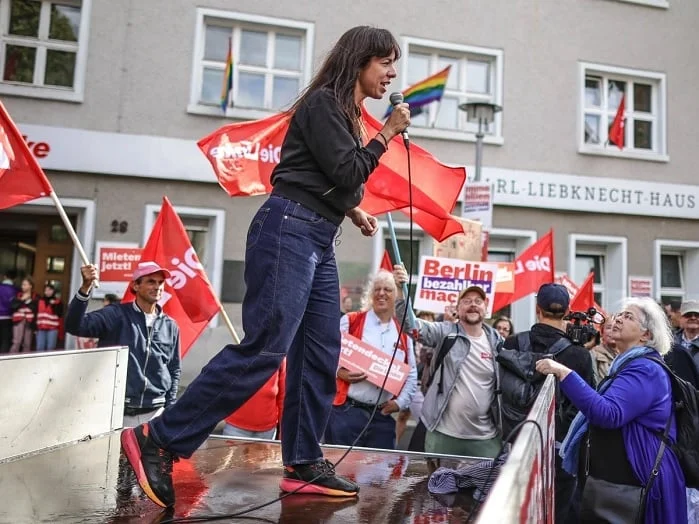
Addressing a roaring crowd of jubilant supporters late Sunday evening, Eralp struck a conciliatory yet triumphant tone. "Berliners, thank you—thank you for your trust," she declared. "Together, we made history today. Starting from this moment, we are going to change Berlin—together." Emphasizing the core tenets of her campaign, she asserted that "love and justice" had decisively overcome "hate."
The Groundbreaking Rise of Elif Eralp
The triumph of the 44-year-old politician is the culmination of decades of grassroots activism, legal advocacy, and a deeply personal understanding of the migrant experience in Germany. Born in Munich in 1981, Eralp is the daughter of parents who fled to Germany from Turkey in the wake of the tumultuous 1980 military coup. Her formative years were defined by geographic mobility and early encounters with systemic adversity, growing up in the cities of Dortmund and Hamburg before ultimately settling in Berlin, where she has resided for the past sixteen years.
Eralp’s journey toward political prominence was forged in the crucible of personal and societal observation. She has frequently recounted how witnessing instances of injustice and discrimination during her childhood served as the primary catalyst for her decision to pursue a career in law. Furthermore, her worldview was profoundly shaped during her primary school years, when she directly confronted the wave of violent, far-right extremism that targeted migrant communities across reunified Germany throughout the early 1990s. These harrowing experiences cemented her commitment to human rights advocacy, laying the intellectual and moral foundation for her eventual entry into radical municipal politics.
The Zohran Mamdani Comparison and Campaign Strategy
In the months leading up to the election, political commentators, international media outlets, and grassroots organizers drew striking parallels between Eralp’s insurgent political rise and the landmark 2025 mayoral victory of Zohran Mamdani in New York City. Eralp herself actively embraced the comparison during the grueling final weeks of the campaign, recognizing the shared ideological DNA and neighborhood-level organizing tactics between the two campaigns.
"I hope what is possible in Manhattan, New York, can also be realized here in Berlin," Eralp stated in an interview with the Anadolu news agency just days before the polls opened. "Mamdani focused on social demands, and that is precisely what we are doing. He also succeeded in uniting various communities—a major achievement—and that is what we are striving for as well."
Mirroring Mamdani’s populist yet pragmatic platform, Eralp placed the pressing economic realities of daily life at the absolute center of her campaign. Rather than getting bogged down in abstract ideological debates, her platform zeroed in on the acute crises weighing heavily on working-class Berliners: skyrocketing residential rental costs, escalating public transportation tariffs, and deteriorating municipal services, including urban sanitation and street-cleaning backlogs.
To reach voters disillusioned with mainstream political parties, Eralp’s campaign team executed a relentless, door-to-door ground game. Activists canvassed diverse neighborhoods across the capital, deliberately bypassing traditional safe havens to engage voters directly in areas known for supporting the anti-immigration Alternative for Germany (AfD) party. This boots-on-the-ground approach proved remarkably effective at piercing political echo chambers and building cross-demographic coalitions.
Policy Proposals and Economic Reform Agenda
Eralp’s platform offers concrete, interventionist solutions to Berlin’s most entrenched systemic problems, particularly the housing affordability crisis that has plagued the city for over a decade. Her proposed legislative measures include the implementation of strict price ceilings on municipal government-owned residential apartments, a policy designed to stem the relentless tide of gentrification.
Additionally, she has proposed the creation of a specialized government oversight agency dedicated to investigating and penalizing illegal rent hikes by private landlords. Perhaps most ambitiously, Eralp has vowed to revive stalled public initiatives aimed at the municipal expropriation of large corporate housing conglomerates, bringing vast residential portfolios back into public ownership. Through these measures, she insists that a Left-led Berlin administration can systematically dismantle structural inequality and ensure the city remains economically viable for working-class families, students, and artists.
Chronology of a Political Upsurge
The path to Sunday’s historic victory was marked by strategic recalibration and disciplined execution by Die Linke under Eralp’s direction:
- Spring: Public opinion polls place Die Linke in the mid-teens, reflecting voter apathy and fractures within the broader German left.
- Summer: Eralp shifts the campaign narrative away from national geopolitics toward hyper-local economic grievances, directly targeting housing and cost-of-living pressures.
- Early Autumn: Intensification of door-to-door canvassing operations, expanding outreach into outer districts and working-class neighborhoods traditionally contested by conservative and far-right factions.
- Final Week: International comparisons to New York’s Zohran Mamdani gain traction in media coverage, boosting volunteer enthusiasm and campaign momentum.
- Sunday: Voters deliver a stunning 25.7% mandate to Die Linke, more than doubling its previous electoral footprint and positioning Eralp as a leading candidate for the capital’s mayoral office.
Broader Implications and Political Reactions
The outcome in Berlin has sent shockwaves through Germany’s federal political establishment, raising urgent questions about the changing dynamics of urban electorates in Western Europe. Political analysts note that the result reflects a growing disillusionment with traditional centrist governance, particularly among younger urban voters and migrant communities who feel excluded from economic prosperity.
While supporters celebrate the result as a triumph of multiculturalism and progressive social democracy, establishment parties have responded with cautious trepidation. Moderate conservatives and market-liberal politicians have expressed alarm over Eralp’s interventionist housing policies, warning that measures such as rent caps and corporate expropriation could deter vital private investment in real estate and municipal infrastructure.
Conversely, labor unions, tenant advocacy groups, and social justice organizations have hailed the election outcome as a long-overdue mandate for economic redistribution and social equity. As coalition negotiations loom and the practical realities of forming a governing majority begin to set in, all eyes will remain fixed on Berlin to see whether Elif Eralp can successfully translate her revolutionary rhetoric into sustainable, effective urban governance.