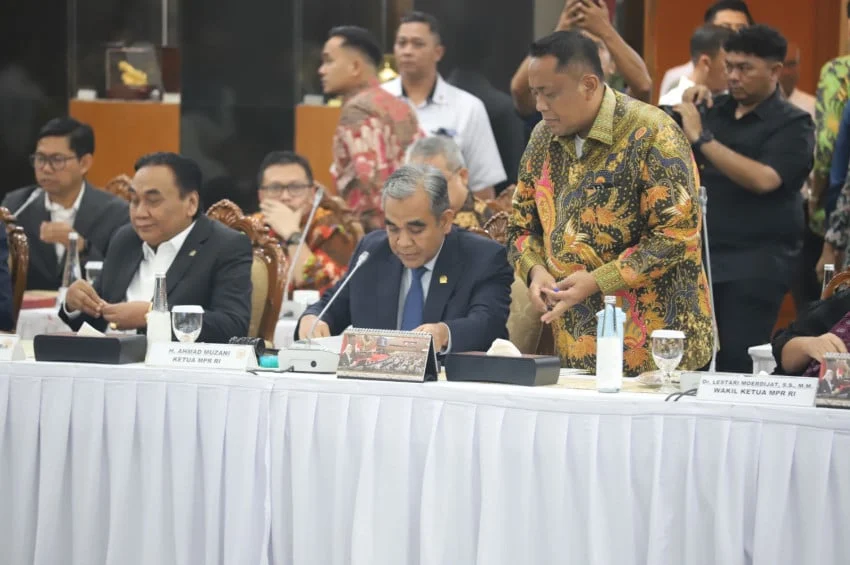
JAKARTA — The People’s Consultative Assembly of the Republic of Indonesia, commonly known as MPR RI, is facing mounting pressure from constitutional law experts and political analysts to revise its scheduled timeline for electing a new vice president. The controversy centers on conflicting interpretations of statutory deadlines governing the submission of candidates by the executive branch. Originally slated for December 9, 2026, the election aims to fill the vacancy left following the departure of former Vice President Gibran Rakabuming Raka. However, a growing consensus among legal scholars suggests that adhering to the current calendar could violate procedural mandates embedded within national legislation.
The debate came to the forefront following a series of critical analyses from prominent legal minds, including constitutional law expert Prof. Juanda, electoral reform advocate Titi Anggraini, and former Coordinating Minister for Political, Legal, and Security Affairs Mahfud MD. These figures argue that the MPR’s current deadline for President Prabowo Subianto to nominate two vice-presidential candidates—set for November 25, 2026—fails to properly account for the legal definition of "days" under Indonesian law.
Background Context and the Statutory Controversy
The underlying framework governing the replacement of a vice president in Indonesia involves a delicate interplay between the 1945 Constitution, the Law on the People’s Consultative Assembly, House of Representatives, Regional Representative Council, and Regional House of Representatives (UU MD3), as well as the internal rules of procedure (Tata Tertib) of the MPR.
Under the existing schedule established by the MPR leadership—led by MPR Speaker Ahmad Muzani during a joint meeting at the parliamentary complex in Senayan, Jakarta—the plenary session to elect and inaugurate the new vice president was locked in for December 9, 2026. To facilitate this, the assembly mandated that President Prabowo Subianto submit his two official nominees no later than 14 days prior to the plenary session, translating to November 25, 2026, based on a standard calendar day calculation.
However, legal experts have pointed out a crucial technicality that threatens to invalidate the entire proceeding. According to Article 46, paragraph (2) of Law No. 17 of 2014 concerning MD3 (along with its subsequent amendments), the formal proposal for candidates must be submitted no later than 14 days before the plenary session. The critical point of contention lies in Article 1, point 9 of the same law, which explicitly defines a "day" as a working day, excluding weekends and national holidays. This exact definition is mirrored in Article 1, point 22 of the MPR’s Rules of Procedure (Tatib MPR No. 1 of 2024).
When factoring in weekends and intervening public holidays during the late November period, a strict interpretation of "working days" pushes the actual deadline for candidate submission much earlier than November 25. By miscalculating this timeframe and treating them as calendar days, critics argue that the MPR risks running afoul of statutory requirements, potentially rendering any resulting election legally vulnerable and procedurally flawed.
Chronology of the Legislative and Procedural Impasse
The sequence of events leading up to the current procedural dispute highlights the rapid timeline under which the legislature has attempted to stabilize the executive branch following the vacancy:
- October – Early November 2026: Discussions regarding the vacancy left by Gibran Rakabuming Raka necessitate a constitutional succession process within the MPR. Consultations begin among faction leaders in the parliament.
- November 16, 2026: MPR Speaker Ahmad Muzani chairs a high-level Joint Rapat Gabungan (Joint Meeting) of the MPR at the parliamentary complex in Senayan, Jakarta. The assembly formally decides on December 9, 2026, as the date for the plenary session to elect and inaugurate the new vice president. Concurrently, the administration of President Prabowo Subianto is given a deadline of November 25, 2026, to submit two candidates.
- Late November 2026: Constitutional scholars and election watchdogs, including Titi Anggraini and Mahfud MD, publicly flag the discrepancy regarding the calculation of the 14-day statutory notice period, emphasizing that the law mandates working days rather than calendar days.
- November 21, 2026: Speaking on a televised legal analysis program, Prof. Juanda asserts that the MPR retains the authority to correct its timeline by convening another joint meeting to formally adjust the schedule, warning that proceeding with a flawed timeline risks the legal legitimacy of the entire election.
Expert Opinions and Legal Implications
The core argument presented by Prof. Juanda is that the procedural integrity of the MPR is paramount. During his media appearance, he emphasized that amending the schedule is logistically straightforward and does not require an exhaustive legislative overhaul.
"It is actually not difficult to change that schedule," Juanda stated. "Hold another Joint Meeting, and establish a new consensus for postponement."
He further cautioned that if the legislative body insists on maintaining the December 9 date despite a procedural breach, the ultimate decision could be deemed legally void. In administrative and constitutional law, actions taken outside of established statutory mandates are inherently susceptible to judicial review, political challenges, and institutional paralysis. A compromised election could cast a long shadow over the legitimacy of the incoming vice president, undermining public trust and creating friction within the executive-legislative partnership.
Adding to the legal weight, Titi Anggraini detailed the specific statutory anchors that support the working-day interpretation. By highlighting Article 46 of the MD3 Law alongside the assembly’s own internal rulebook, electoral observers have placed the onus squarely on the parliamentary leadership to demonstrate strict adherence to the rule of law.
Political Reactions and Strategic Considerations
Beyond the strict legal definitions, the selection process carries immense political weight. Representatives from major political parties have begun articulating their expectations for the incoming vice president. Notably, spokespersons from parties such as the Indonesian Democratic Party of Struggle (PDI-P) have emphasized the need for absolute harmony within the executive branch, cautioning against internal friction or competing power centers—colloquially referred to in Indonesian political discourse as the phenomenon of "twin suns" (matahari kembar)—and warning against internal vulnerabilities.
The administration of President Prabowo Subianto now finds itself navigating a delicate balancing act. While the executive is prepared to put forward candidate names in accordance with the state’s governance needs, the timeline remains contingent upon how the MPR leadership responds to the mounting legal critiques.
Broader Impact and Future Outlook
The current standoff serves as a stress test for Indonesia’s constitutional mechanisms and legislative compliance. As the MPR weighs its options, the assembly faces two primary paths:
- Proceed with the Original Schedule: Risk potential legal challenges, accusations of procedural shortcuts, and diminished institutional legitimacy if the 14-day working-day rule is legally validated by courts or further challenged by legal coalitions.
- Reschedule the Plenary Session: Convene an urgent Joint Meeting to amend the calendar, pushing back the election date to ensure full compliance with the statutory working-day requirements, thereby insulating the transition from legal vulnerabilities.
Observers note that while rescheduling may cause a minor delay in filling the vice-presidential vacancy, it provides a much higher degree of legal certainty. As discussions continue within the parliamentary complex in Jakarta, all eyes remain on Speaker Ahmad Muzani and the MPR leadership to determine whether they will heed the warnings of the nation’s foremost legal scholars and recalibrate their path forward.