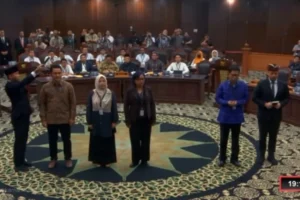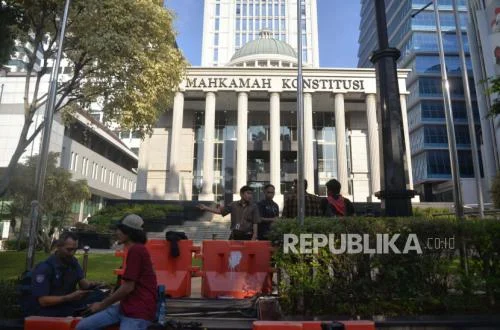
The atmosphere at the Constitutional Court (Mahkamah Konstitusi or MK) in Jakarta took a dramatic and chaotic turn on Wednesday, May 29, 2024, when an emotional confrontation erupted involving the family of a key witness. The incident occurred during the ongoing hearings for the 2024 Legislative Election Results Dispute (PHPU Pileg), specifically regarding a case filed by the Democratic Party (Partai Demokrat). The proceedings, which are intended to be somber and orderly judicial events, were interrupted by the arrival of individuals claiming to be the family members of Sulaiman, a witness presented by the Democratic Party to testify in a high-stakes legal battle over parliamentary seats.
The commotion began around the time Sulaiman arrived at the Constitutional Court Building I on Jalan Medan Merdeka Barat. Accompanied by a legal representative from the Democratic Party, Sulaiman was seen entering the premises wearing an all-black outfit with his face obscured by a medical mask. This appearance, intended perhaps for privacy or security, preceded an immediate backlash from individuals waiting outside the courtroom area.
The Confrontation and Allegations of Coercion
As Sulaiman was escorted into the building, a man and a woman, who identified themselves as Sulaiman’s siblings, began shouting and demanding to see him. The woman, dressed in yellow with a black headscarf, became visibly distressed, crying out to security personnel and onlookers that the situation was unjust. She claimed that her brother had been taken from their home under duress and had been missing for several days prior to his appearance at the court.
"I am his sister! Don’t you know? Everything is unfair! There is coercion involved!" she screamed as she attempted to bypass the security cordon to reach Sulaiman. Her efforts to force her way into the restricted areas of the court were ultimately thwarted by the Mahkamah Konstitusi security detail, who maintained a perimeter to ensure the safety of the witnesses and the sanctity of the legal proceedings.
Following the initial outburst, the family members were questioned by court officials to ascertain the nature of their grievances. The sister alleged a troubling timeline regarding Sulaiman’s whereabouts. According to her statement, Sulaiman had been "picked up" from his residence on Friday, May 24, 2024. Since that day, the family claimed they had lost all contact with him. They asserted that there was no prior agreement or clear explanation given as to why he was being taken or where he would be staying. The family’s primary concern was that Sulaiman was being held against his will or pressured into providing specific testimony for the Democratic Party’s case.
Case Profile: PHPU Pileg 2024 Number 196
The witness, Sulaiman, was scheduled to testify in the case registered as Number 196-01-14-22/PHPU/DPR-DPRD-XXII/2024. In this specific dispute, the Democratic Party acts as the Petitioner (Pemohon), challenging the election results certified by the General Elections Commission (KPU), which serves as the Respondent (Termohon). The National Awakening Party (PAN) is also involved in the case as a Related Party (Pihak Terkait).
This case is part of a broader wave of litigation following the 2024 Indonesian General Elections. The Democratic Party, led by Agus Harimurti Yudhoyono, has filed numerous petitions across various electoral districts (Dapil), alleging administrative errors, vote-counting discrepancies, and "structured, systematic, and massive" (TSM) fraud in certain regions. The specific details of Case 196 involve disputes over legislative seats where the margin between the Democratic Party and PAN was thin, making the testimony of witnesses like Sulaiman critical to the court’s final determination.
Chronology of Events Leading to the Incident
To understand the gravity of the family’s claims, it is necessary to look at the timeline of the 2024 election dispute process:
- February 14, 2024: Indonesia holds its largest-ever single-day election, including the Presidential and Legislative (DPR, DPD, and regional DPRD) elections.
- March 20, 2024: The KPU officially announces the election results. Following this, political parties are given a three-day window to file disputes with the Constitutional Court.
- April 22, 2024: The Constitutional Court delivers its landmark ruling on the Presidential Election Dispute (PHPU Pilpres), dismissing the challenges brought by rival candidates and confirming the victory of Prabowo Subianto and Gibran Rakabuming Raka.
- May 2024: The court shifts its focus to the hundreds of legislative disputes. This phase involves evidentiary hearings where parties present witnesses and physical evidence (C1 forms, etc.).
- May 24, 2024 (Friday): According to his family, Sulaiman is taken from his home by representatives associated with the legal case.
- May 24 – May 29, 2024: The family claims Sulaiman is unreachable and his whereabouts are unknown to them.
- May 29, 2024 (Wednesday morning): Sulaiman appears at the MK building under the protection of the Democratic Party’s legal team. The family stages a protest, alleging he is being coerced.
The Role of Witnesses and Judicial Integrity
In the context of Indonesian electoral law, witnesses play a pivotal role in the PHPU process. Unlike the Presidential dispute, which often relies on broad constitutional arguments and high-level data analysis, legislative disputes frequently hinge on "bottom-up" evidence. Witnesses are often local poll watchers or party operatives who claim to have witnessed irregularities at the polling station (TPS) or sub-district (Kecamatan) levels.
The allegations made by Sulaiman’s family raise significant questions about witness protection and the ethical boundaries of witness preparation. While it is standard practice for legal teams to "quarantine" or brief witnesses before a high-profile hearing to ensure they understand the proceedings and can present their testimony clearly, the line between preparation and coercion is strictly regulated by law.
If a witness is found to have been intimidated or forced into giving false testimony, it not only invalidates their statement but can also lead to criminal charges for the parties involved. The Constitutional Court judges, known for their rigorous questioning, typically scrutinize the consistency of witness statements to detect any signs of coaching or duress.
Official Responses and Security Measures
Following the incident, the Constitutional Court’s spokesperson and security administration emphasized that the court provides a neutral ground for all parties. While the court does not directly manage how political parties handle their internal witnesses before they enter the courtroom, the MK has strict protocols once a person enters the building.
The security personnel at the MK are tasked with maintaining a "sterile" environment. This means that once a witness is registered and brought into the waiting area, access is restricted to authorized personnel only. This is intended to prevent witness tampering or intimidation from opposing parties. However, in this instance, the "threat" perceived by the family was coming from the very party that brought the witness to the court.
Representatives from the Democratic Party have yet to release a comprehensive statement regarding the family’s specific allegations of kidnapping or coercion. Traditionally, parties in these disputes argue that they provide "lodging and security" for witnesses from remote areas to ensure they arrive at the court on time and are not intimidated by local rivals.
Broader Implications for the 2024 Election Results
The 2024 election cycle has been one of the most litigious in Indonesia’s democratic history. With over 250 cases filed regarding legislative results, the Constitutional Court is under immense pressure to deliver verdicts before the scheduled inauguration of new legislators.
Incidents like the one involving Sulaiman highlight the intense personal and political stakes involved. A single legislative seat can determine the balance of power in a regional council or contribute to a party’s ability to meet the parliamentary threshold at the national level. For the Democratic Party, which has seen its share of the vote fluctuate in recent years, every seat contested in the MK is vital for its political relevance over the next five years.
Furthermore, this incident underscores the need for a robust Witness and Victim Protection Agency (LPSK) involvement in political cases. While the LPSK usually handles criminal matters, the high-pressure environment of election disputes suggests that a more formalized system for protecting the rights and autonomy of political witnesses may be necessary to prevent families from feeling that their loved ones have been "disappeared" by political machines.
Conclusion and Next Steps
The Constitutional Court is expected to continue its examination of Case 196, including the testimony provided by Sulaiman, provided the judges are satisfied that he is testifying of his own free will. The court has the authority to order a private session or a psychological evaluation if there are credible signs of witness distress.
As the June deadline for the resolution of all legislative disputes approaches, the MK remains the final arbiter of Indonesia’s democratic will. The drama surrounding Sulaiman serves as a stark reminder that behind the dry legal arguments and piles of evidentiary documents are human stories and local tensions that continue to shape the nation’s political landscape. The integrity of the court’s final decision will depend not only on the evidence presented but also on the perceived fairness and transparency of the process that brought that evidence to the bench. For now, the "un公平" (unfairness) cried out by a sister in the hallways of the court remains a haunting note in the 2024 electoral saga.