The Chairperson of the Central Executive Board (DPP) of the Indonesian Unity Party (Perindo), Angela Tanoesoedibjo, attended the peak celebration of the 28th Anniversary (Harlah) of the National Awakening Party (PKB) held at the Jakarta Convention Centre (JCC) in Senayan, Central Jakarta, on Tuesday evening. The event, which served as a major gathering for political figures across the Indonesian spectrum, underscored a moment of significant inter-party diplomacy and national consolidation. Accompanied by the Secretary General of the Perindo Party, Ferry Kurnia Rizkiyansyah, Angela’s presence was marked by high-level interactions with prominent political leaders, including the Chairperson of PKB, Muhaimin Iskandar—affectionately known as Cak Imin—and the Daily Chairperson of the Gerindra Party, Sufmi Dasco Ahmad.
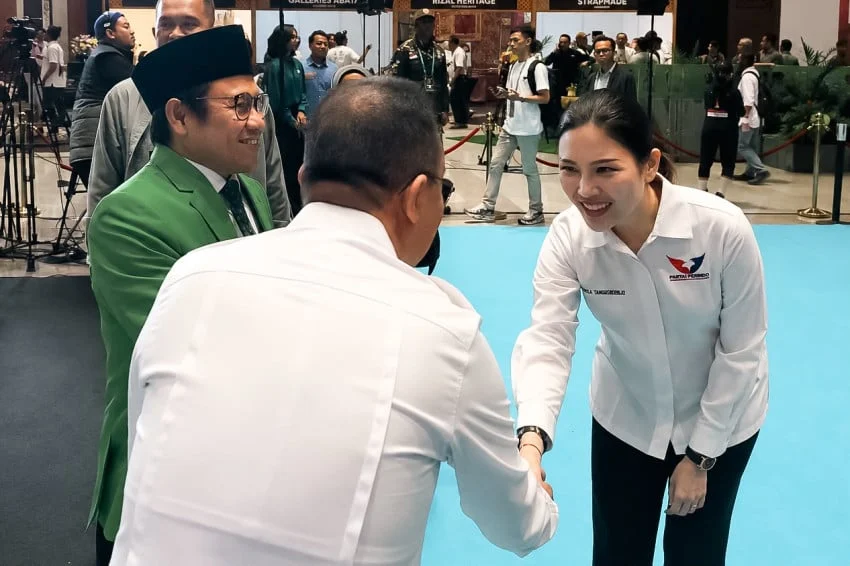
The arrival of the Perindo leadership at the venue was met with a cordial atmosphere, reflecting the spirit of "silaturahmi" or political friendship that is central to the Indonesian democratic process. Upon entering the JCC premises, Angela Tanoesoedibjo and Ferry Kurnia Rizkiyansyah were immediately greeted by Muhaimin Iskandar and Sufmi Dasco Ahmad. The interaction was characterized by a warm exchange of greetings and a firm handshake between Angela and Dasco, witnessed by Muhaimin Iskandar, signaling a collaborative rapport between the three political entities. This meeting is seen by observers as a symbolic gesture of unity as the nation navigates the complexities of the post-election landscape and prepares for future governance challenges.
A Night of Political Camaraderie at JCC Senayan
The 28th Harlah of the National Awakening Party was not merely a celebratory milestone for the party but also a strategic forum for national political figures to converge. The Jakarta Convention Centre, a historic venue for Indonesia’s most pivotal political events, provided the backdrop for an evening defined by formal ceremonies and informal dialogues. Angela Tanoesoedibjo, representing the younger generation of Indonesian political leadership, was seen engaging in light yet substantive conversation with her counterparts.
During the initial encounter, Angela expressed her congratulations to the PKB leadership on reaching their 28th year of contribution to the nation. "Congratulations, congratulations," Angela stated as she shook hands with Muhaimin Iskandar. The PKB Chairperson responded with equal warmth, expressing his gratitude for the attendance of the Perindo Party delegation. "Eh, thank you, thank you," Muhaimin replied, acknowledging the importance of Perindo’s presence at the event.
Following this initial greeting, the leaders were seen walking together toward the VIP transit room. This brief journey through the JCC corridors allowed for a more private exchange of views before they entered the main assembly hall to join thousands of PKB cadres and other invited dignitaries. The presence of Sufmi Dasco Ahmad, a key figure in the Gerindra Party and the current leadership of the House of Representatives (DPR), added a layer of strategic importance to the gathering, as Gerindra is poised to lead the incoming administration.
The Significance of PKB’s 28th Anniversary in the Post-Reformasi Era
The National Awakening Party (PKB) celebrates its 28th year at a time when the party has solidified its position as a major force in the Indonesian legislature. Founded on July 23, 1998, in the wake of the Reformasi movement, PKB has its roots deeply embedded in the socio-religious fabric of Nahdlatul Ulama (NU), the largest Islamic organization in Indonesia. Over nearly three decades, the party has evolved from a fledgling political vehicle into a consistent kingmaker in national elections.
Under the leadership of Muhaimin Iskandar, PKB has maintained a steady electoral performance, consistently securing a significant number of seats in the People’s Representative Council (DPR). The 28th anniversary serves as a moment of reflection on the party’s journey from the era of Abdurrahman Wahid (Gus Dur) to its current status as a pragmatic and influential participant in various government coalitions. For parties like Perindo, attending PKB’s anniversary is an acknowledgment of PKB’s enduring influence and a recognition of the shared values of nationalism and religious moderation that both parties champion.
Angela Tanoesoedibjo: Leading Perindo into a New Era of Political Diplomacy
Angela Tanoesoedibjo’s attendance at the PKB Harlah is part of a broader strategy to reposition the Perindo Party under her leadership. Having recently taken the helm from the party’s founder, Hary Tanoesoedibjo, Angela has focused on modernizing the party’s image and strengthening its diplomatic ties with both established and emerging political forces. Her leadership style is often described as inclusive and communicative, aimed at building bridges across the political divide.
By appearing alongside figures like Muhaimin Iskandar and Sufmi Dasco Ahmad, Angela is signaling that Perindo remains a relevant and proactive player in the national discourse. Despite the challenges faced in the most recent legislative elections, Perindo continues to maintain a robust organizational structure and a significant following, particularly among younger demographics and the business community. The presence of Secretary General Ferry Kurnia Rizkiyansyah, a veteran in electoral logistics and political strategy, further emphasized the party’s commitment to professional political engagement.
The Presence of Gerindra: Signs of National Consolidation
The involvement of Sufmi Dasco Ahmad in this meeting is particularly noteworthy. As the Daily Chairperson of Gerindra, Dasco represents the party of President-elect Prabowo Subianto. His interaction with Angela Tanoesoedibjo and Muhaimin Iskandar suggests a high level of coordination between the incoming administration and various political parties, including those that may have been in different coalitions during the presidential campaign.
In the Indonesian political context, such gatherings are essential for building a "grand coalition" or at least ensuring a stable political climate for the transition of power. The camaraderie displayed at the JCC indicates that the lines of communication remain open, and there is a mutual desire to prioritize national stability over partisan differences. The handshake between Angela and Dasco, in particular, highlights the potential for future cooperation between Perindo and the Gerindra-led government.
Chronology of the Event: A Detailed Timeline
The evening’s proceedings followed a structured timeline that emphasized both formal protocol and personal rapport:
- 19:00 WIB: Guests and PKB cadres began to fill the main hall of the Jakarta Convention Centre. Security was heightened as various high-ranking officials and party leaders were expected.
- 19:30 WIB: Angela Tanoesoedibjo and Ferry Kurnia Rizkiyansyah arrived at the JCC main entrance. They were greeted by the PKB organizing committee and escorted toward the VIP reception area.
- 19:45 WIB: The Perindo delegation met Muhaimin Iskandar and Sufmi Dasco Ahmad in a designated greeting area. This was the moment of the widely publicized handshake and the exchange of warm greetings.
- 20:00 WIB: The leaders moved to the VIP transit room. For approximately fifteen minutes, they engaged in a closed-door discussion, which observers suggest touched upon the current political situation and the upcoming regional elections.
- 20:20 WIB: The group entered the main plenary hall of the JCC to a standing ovation from the attendees. They took their seats in the front row, reserved for the nation’s top political elite.
- 20:30 WIB: The formal program of the 28th Harlah PKB commenced, featuring traditional performances, a report from the organizing committee, and a keynote speech by Muhaimin Iskandar.
Analyzing the Impact on the Upcoming Regional Elections (Pilkada)
While the event was primarily an anniversary celebration, the underlying political implications are tied to the 2024 Regional Head Elections (Pilkada). Across Indonesia, political parties are currently in the process of forming alliances to nominate governors, regents, and mayors. The meeting between Perindo, PKB, and Gerindra at the JCC could serve as a precursor to local-level coalitions.
Perindo, with its strong media presence and grassroots programs, offers a valuable partnership for larger parties like PKB and Gerindra in specific regions. Conversely, aligning with PKB allows Perindo to tap into a well-established network of traditional and religious voters. The "warm atmosphere" described by witnesses at the JCC suggests that negotiations for the Pilkada may be proceeding with a high degree of mutual understanding.
Official Responses and Political Sentiments
In the hours following the event, spokespersons from the respective parties released statements echoing the sentiments of the meeting. The Perindo Party emphasized its commitment to national unity and its support for the democratic milestones of all political entities. "Chairperson Angela Tanoesoedibjo believes that the success of one party in maintaining its existence for 28 years, like PKB, is a victory for Indonesian democracy as a whole," a Perindo representative stated.
From the PKB camp, the focus was on the inclusivity of the Harlah. The party’s leadership expressed that the 28th anniversary was intended to be a "home for all," welcoming friends from across the political aisle to discuss the future of the nation. Sufmi Dasco Ahmad, representing Gerindra, noted that such interactions are vital for maintaining the "coolness" (kesejukan) of the political climate, ensuring that competition does not lead to polarization.
Supporting Data: The Landscape of Party Representation
To understand the weight of this meeting, one must look at the current political data. PKB remains one of the top-performing parties in Indonesia, consistently hovering around 9-10% of the national vote. Perindo, while still working toward the parliamentary threshold at the national level, holds hundreds of seats in Regional Legislative Councils (DPRD) across the country, making them a significant "swing" factor in local politics.
Gerindra, as the winner of the presidential election, currently holds the most significant leverage in the formation of the next government. The synergy between these three parties—one representing the established religious-nationalist base (PKB), one representing the incoming executive power (Gerindra), and one representing a modern, media-savvy nationalist vision (Perindo)—creates a formidable political triangle that could shape policy and governance for the next five years.
Conclusion: Building a Unified Political Vision
The attendance of Angela Tanoesoedibjo at the 28th Harlah of PKB at the JCC Senayan serves as a testament to the evolving nature of Indonesian politics. It highlights a shift toward more collaborative and communicative leadership styles, where personal rapport between party heads can pave the way for strategic national alliances.
As Indonesia prepares for the transition to a new administration and the upcoming regional elections, the images of Angela, Muhaimin, and Dasco sharing a light moment together offer a sense of optimism. It suggests that despite the inherent competition of a multi-party system, there is a shared commitment to the stability and progress of the Republic. The 28th anniversary of PKB thus became more than just a celebration of the past; it became a window into the potential future of Indonesian political cooperation.