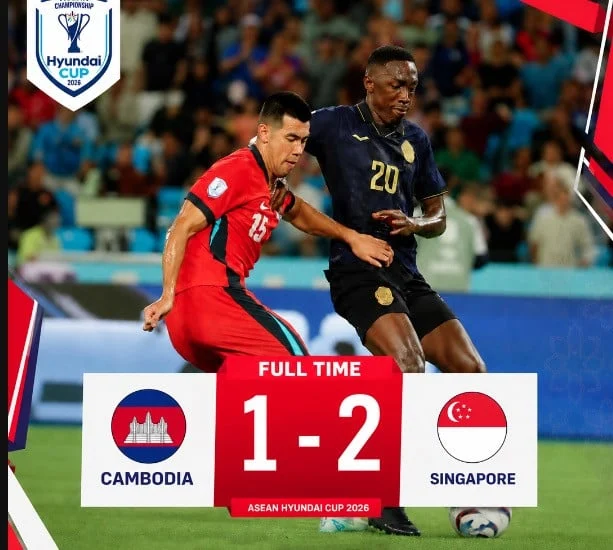
The Singapore national football team, affectionately known as The Lions, launched their 2026 AFF Cup campaign with a pulsating 2-1 victory over Cambodia at the Morodok Techo National Stadium in Phnom Penh. In a match defined by high intensity, tactical maneuvering, and late-game drama, Ilhan Fandi emerged as the hero for the visitors, scoring a spectacular overhead kick deep into injury time to silence a raucous home crowd. The victory provides Singapore with a crucial three points in Group A, though they currently sit in second place behind regional powerhouses Vietnam, who dominated Timor Leste in a concurrent fixture. The encounter on Friday, July 24, 2026, served as a testament to the growing competitiveness of Southeast Asian football, where traditional hierarchies are increasingly challenged by emerging nations like Cambodia.
First Half Dominance and the Opening Breakthrough
The match began under the humid conditions typical of Phnom Penh in July, with both teams looking to establish rhythm early on. Singapore, under the tactical guidance of their coaching staff, opted for a disciplined 4-3-3 formation, focusing on quick transitions and exploiting the pace of their wingers. Cambodia, buoyed by the vocal support of over 30,000 fans, attempted to control possession through short passing sequences, a hallmark of their developmental philosophy over the last several years.
Despite Cambodia’s early attempts to press high, Singapore’s defensive line remained resolute. The breakthrough for the Lions came in the 22nd minute through a moment of individual brilliance and collective precision. Defender Lionel Tan, demonstrating vision from the back, delivered a perfectly weighted through-ball that bypassed the Cambodian midfield and split the defensive pairing. Shawal Anuar, timed his run to perfection, ghosting behind the last defender to latch onto the pass. Showing immense composure, Anuar rounded the Cambodian goalkeeper before slotting the ball into an empty net.
The goal shifted the momentum firmly in Singapore’s favor for the remainder of the first half. The Lions controlled the tempo, with Song Ui-young orchestrating the midfield and neutralizing Cambodian counter-attacks before they could develop into genuine threats. Cambodia struggled to find a creative spark in the final third, often forced into speculative long-range efforts that failed to trouble the Singaporean custodian. As the referee blew for halftime, Singapore held a deserved 1-0 lead, though the narrow margin suggested the contest was far from over.
The Cambodian Revival and Tactical Adjustments
The second half witnessed a rejuvenated Cambodian side. The "Angkor Warriors" emerged from the tunnel with renewed aggression, pushing their fullbacks higher up the pitch to create overloads in the wide areas. This tactical shift bore fruit in the 55th minute, sending the Morodok Techo National Stadium into a state of euphoria.
Following a period of sustained pressure, the ball fell to Sovann Ouk just outside the penalty area. With minimal backlift, Ouk unleashed a powerful right-footed strike that swerved and dipped, finding the top-left corner of the net. The strike was unstoppable, leaving the Singaporean goalkeeper rooted to the spot. The equalizer at 1-1 changed the complexion of the game, as Cambodia began to believe an upset was within reach.
For the next twenty minutes, Singapore found themselves on the back foot. The humidity appeared to take a toll on the visitors, leading to unforced errors and a loss of midfield control. Cambodia nearly took the lead in the 70th minute when a header from a corner narrowly missed the far post. Recognizing the shift in momentum, the Singaporean bench introduced fresh legs, bringing on attacking reinforcements to regain a foothold in the match.
VAR Drama and the Final Minutes
The closing stages of the match were marked by high tension and the intervention of technology. In the 88th minute, it appeared that Singapore had found the winning goal. Ilhan Fandi, who had been a constant nuisance to the Cambodian defense since his introduction, tapped the ball home following a goalmouth scramble. However, the celebrations were short-lived. The Video Assistant Referee (VAR), which has become a standard fixture in the AFF Cup to ensure sporting integrity, flagged a potential offside. After a lengthy review that lasted nearly three minutes, the referee signaled that Fandi had been in an offside position during the initial phase of the attack. The goal was chalked off, much to the relief of the home supporters.
The disallowed goal seemed to ignite a final surge of energy from Singapore. As the fourth official signaled eleven minutes of added time—largely due to the VAR review and several injury stoppages—the Lions threw men forward in search of a winner.
In the 11th minute of injury time (90+11′), the moment of the match arrived. Song Ui-young, tireless in his efforts, delivered a lofted cross into the heart of the Cambodian box. Ilhan Fandi, marked closely by two defenders, showcased extraordinary athleticism by launching into a bicycle kick. The connection was clean, sending the ball past the stunned Cambodian keeper and into the back of the net. It was a goal worthy of winning any championship, sparking wild celebrations on the Singaporean bench and securing the 2-1 victory.
Historical Context and Head-to-Head Statistics
The rivalry between Singapore and Cambodia has historically been dominated by the Lions, but the gap has narrowed significantly over the last decade. Singapore, four-time winners of the AFF Cup (1998, 2004, 2007, 2012), has spent the last few years undergoing a rebuilding phase aimed at reclaiming their status as a regional powerhouse. Cambodia, meanwhile, has invested heavily in youth academies and infrastructure, turning the national team into a competitive outfit capable of challenging the "Big Four" of Southeast Asian football (Thailand, Vietnam, Indonesia, and Malaysia).
Prior to this 2026 encounter, the two nations had met on numerous occasions in the AFF Cup and international friendlies. Statistics show that while Singapore maintains a superior win-loss record, recent matches have often been decided by a single goal. The 2-1 result in Phnom Penh continues this trend of closely contested battles. For Singapore, the victory is a psychological boost, proving they can handle the pressure of an away environment and the complexities of VAR-influenced matches.
Group A Standings and Tournament Implications
While Singapore celebrates a hard-fought three points, the broader context of Group A remains challenging. In the other group fixture held on the same day, Vietnam delivered a statement of intent by thrashing Timor Leste 7-0. This result places Vietnam at the top of the table on goal difference (+7), with Singapore in second (+1).
The structure of the 2026 AFF Cup mandates that only the top two teams from each group advance to the semi-finals. With Thailand and Indonesia expected to dominate Group B, the battle in Group A is primarily seen as a three-way race between Vietnam, Singapore, and a resurgent Myanmar. Singapore’s victory over Cambodia was essential because dropping points against the lower-seeded teams often proves fatal in the quest for knockout stage qualification.
For Cambodia, the loss is a bitter pill to swallow given their spirited second-half performance. However, their ability to compete on level terms with Singapore for the majority of the match suggests they could play the role of "spoiler" in the group, potentially taking points off other favorites in their upcoming fixtures.
Tactical Analysis: The Impact of Ilhan Fandi and Song Ui-young
Analyzing the match from a tactical perspective, Singapore’s success can be attributed to two key players: Ilhan Fandi and Song Ui-young. Fandi’s role as a "super-sub" proved decisive. His physical presence in the box forced the Cambodian defenders into deep positions, creating space for late runs from midfield. His winning goal was not just a feat of athleticism but also a demonstration of elite positioning and confidence.
Song Ui-young acted as the engine room for the Lions. Throughout the 100-plus minutes of play, his work rate remained consistent. He provided the defensive cover necessary to allow Lionel Tan to venture forward and was the architect of the final winning play. In the modern era of the AFF Cup, where matches are often won in the final fifteen minutes, having players with the stamina and technical quality of Song is a significant advantage for Singapore.
On the Cambodian side, the performance of Sovann Ouk highlighted the technical proficiency of their midfield. Cambodia’s ability to transition from defense to attack was impressive, but they lacked a clinical finisher to convert their periods of dominance into more goals. The tactical reliance on wing play was effective in stretching the Singaporean defense, but the lack of aerial threat in the box meant many crosses were easily cleared by the taller Singaporean defenders.
Post-Match Reactions and Official Statements
While official post-match press conferences are often filled with diplomatic rhetoric, the emotions in Phnom Penh were palpable. Sources close to the Singaporean camp indicated a sense of massive relief. The coaching staff reportedly praised the "never-say-die" attitude of the squad, emphasizing that winning away in Cambodia is no longer a guaranteed feat for any Southeast Asian nation.
"We knew it would be a difficult environment," a representative from the Singaporean delegation noted. "The atmosphere was incredible, and Cambodia played with a lot of heart. But our players showed maturity, especially after the VAR decision. To stay focused and find a winner in the 101st minute speaks volumes about the character of this team."
The Cambodian camp expressed disappointment but also pride. Local media outlets reflected a sentiment that the national team is on the right path, despite the heartbreaking result. "We showed today that we can go toe-to-toe with the best in the region," a Cambodian team official was overheard saying. "Football is decided by small margins, and today those margins went against us. But our fans saw a team that fought until the very last second."
Looking Ahead: The Path to the Semi-Finals
The 2026 AFF Cup schedule is unforgiving, with matches occurring every few days. Singapore must now recover quickly before their next fixture, which will likely be a defining moment in their campaign. Their upcoming clash against Vietnam will be the ultimate litmus test for their championship aspirations. A positive result against the Golden Star Warriors would almost certainly guarantee a spot in the semi-finals.
For the organizers, the match in Phnom Penh was a success for the tournament’s brand. The high drama, the use of VAR to ensure fairness, and the spectacular quality of the winning goal provide perfect marketing material for the AFF Cup. As the tournament progresses, the focus will remain on whether Singapore can maintain this momentum and if their aging stars and rising talents like Ilhan Fandi can find the consistency required to lift the trophy for a fifth time.
In conclusion, Singapore’s 2-1 victory over Cambodia was more than just a win; it was a statement of resilience. In a region where footballing standards are rising rapidly, the Lions proved that they still possess the clinical edge and the mental fortitude to navigate the most challenging of circumstances. As Group A unfolds, this dramatic night in Phnom Penh will likely be remembered as the moment Singapore’s 2026 campaign truly took flight.