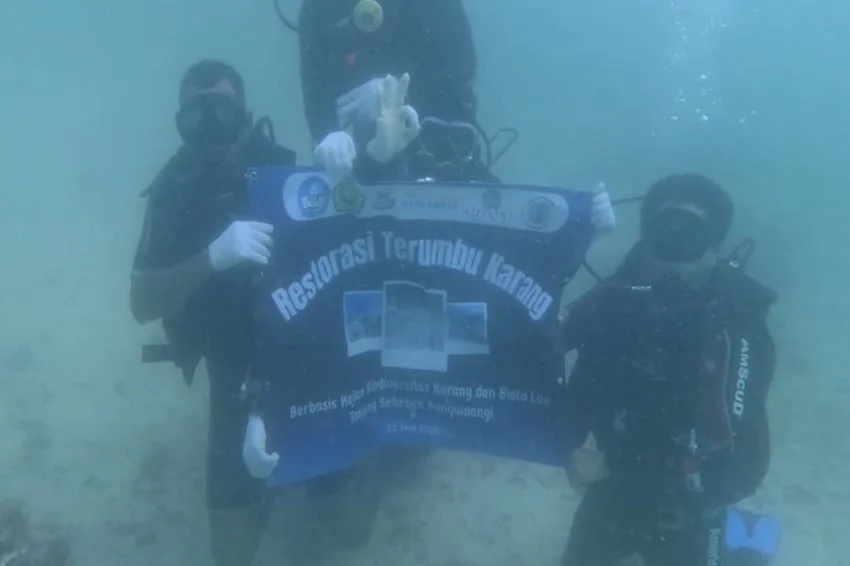
University of Jember and Strategic Partners Achieve Significant Success in Coral Reef Restoration Project at Tanjung Sekeben Banyuwangi. Two months following the intensive planting of 750 coral seedlings in the waters of Tanjung Sekeben, Banyuwangi, a collaborative marine conservation initiative spearheaded by the Faculty of Mathematics and Natural Sciences (FMIPA) of the University of Jember (UNEJ) has begun to yield measurable ecological dividends. Recent monitoring reports indicate a high survival rate among the transplanted coral fragments, signaling a robust recovery for an ecosystem that was previously decimated by destructive fishing practices. This restoration project, which integrates academic expertise, corporate social responsibility, and military logistical support, serves as a critical model for community-based marine rehabilitation in East Java.
The initiative is part of a long-term Community Service Program (Pengabdian kepada Masyarakat) led by Ratna Dewi Syarifah of FMIPA UNEJ. The project is a tripartite collaboration involving PT Autore Pearl Culture—an Australian-based foreign investment company specializing in high-quality pearl cultivation—and the Indonesian Navy’s Banyuwangi Base (LANAL Banyuwangi). On May 21, 2026, these entities joined forces to deploy 750 coral seedlings across the seabed of Tanjung Sekeben, an area that had suffered significant structural and biological loss. The latest assessment conducted by a team of professional divers and marine biologists confirms that the seedlings have successfully calcified and attached to their artificial substrates, with local marine biota, including various species of reef fish and invertebrates, beginning to repopulate the site.
Historical Context and the Crisis of Destructive Fishing
Tanjung Sekeben was once renowned as a vibrant marine sanctuary, characterized by dense coral cover and a high degree of species richness. However, in recent years, the area became a target for illegal and unsustainable fishing activities. The degradation was primarily driven by the use of potassium cyanide and improvised explosives, commonly known as "fish bombs." These methods, while yielding high short-term catches for unscrupulous actors, cause catastrophic and often irreversible damage to the physical structure of the reef.
Potassium cyanide is used to stun fish, making them easier to capture for the live reef food fish trade or the aquarium industry. However, the chemical is a potent toxin that kills the delicate polyps of the coral and poisons the surrounding water column. Similarly, fish bombing shatters the calcium carbonate skeletons of the reefs, turning complex three-dimensional habitats into desolate fields of rubble. Without the structural integrity of the reef, the ecosystem loses its ability to support fish populations, protect coastlines from erosion, and sustain local industries such as tourism and pearl farming.
The intervention by FMIPA UNEJ was born out of this ecological crisis. Academic surveys conducted prior to the restoration effort highlighted a significant decline in live coral cover, prompting a call for immediate action. The project was designed not only to replace lost coral but to create a stable foundation upon which a self-sustaining ecosystem could eventually flourish.
Technical Methodology and the Restoration Timeline
The restoration process employed at Tanjung Sekeben utilized a combination of proven coral transplantation techniques. On May 21, 2026, the team deployed 750 seedlings, primarily focusing on fast-growing branching species such as Acropora. These species were selected for their ability to quickly establish structural complexity, which is essential for providing shelter to juvenile fish.
The chronology of the project began in early 2026 with site selection and environmental impact assessments. Researchers from UNEJ analyzed water quality parameters, including temperature, salinity, and light penetration, to ensure the site was suitable for the specific coral species chosen. Following the initial planting in May, the project entered a "maintenance and monitoring" phase.
During the two-month check-up in July 2026, divers recorded the growth rates and health of each transplant. The "survival rate" is a critical metric in marine biology, and the preliminary findings in Tanjung Sekeben have exceeded expectations. The success is attributed to the careful selection of "mother" colonies for fragmentation and the strategic placement of the seedlings in areas with optimal current flow, which provides the necessary nutrients while preventing the accumulation of sediment.
The Role of Strategic Partnerships
The success of the Tanjung Sekeben project is largely attributed to its multi-stakeholder approach. Each partner provided unique resources and expertise that were vital to the project’s execution:
-
FMIPA Universitas Jember (UNEJ): As the academic lead, FMIPA provided the scientific framework. Under the leadership of Ratna Dewi Syarifah, the university handled the biological monitoring, data analysis, and the technical training of the divers involved. This project also serves as a "living laboratory" for students and researchers, allowing them to study reef resilience in the face of climate change and anthropogenic pressure.
-
PT Autore Pearl Culture: As a major stakeholder in the local maritime economy, PT Autore has a vested interest in maintaining pristine water quality. Pearl oysters are highly sensitive to environmental changes and pollution. By supporting coral restoration, the company is practicing "blue" corporate social responsibility, ensuring that the surrounding waters remain healthy enough to support their pearl cultivation operations. Their involvement included providing logistical funding and technical equipment.
-
LANAL Banyuwangi: The Indonesian Navy provided essential security and logistical support. Their presence ensures that the restoration site is protected from further illegal fishing activities. Furthermore, Navy divers participated in the planting process, demonstrating a commitment to environmental defense as a component of national maritime security.
Supporting Data and National Marine Trends
The restoration effort in Banyuwangi reflects a broader national trend in Indonesia to protect its "Coral Triangle" heritage. Indonesia holds approximately 18% of the world’s coral reefs, yet a significant portion is classified as being in poor or fair condition. According to data from the Indonesian Institute of Sciences (LIPI), only about 6-7% of Indonesia’s reefs are in "excellent" condition.
Projects like the one in Tanjung Sekeben are vital for reversing these statistics. Data from similar restoration sites in Bali and North Sulawesi suggest that successful coral transplantation can increase fish biomass by up to 300% within three to five years. By planting 750 seedlings, the UNEJ-led team has created a catalyst for a much larger recovery. If the current survival rate holds, these 750 fragments will eventually expand, spawning and naturally recruiting new larvae to adjacent degraded areas.
Socio-Economic Implications and Future Outlook
The recovery of the coral reefs in Tanjung Sekeben carries profound implications for the local community in Banyuwangi. Beyond the immediate environmental benefits, a healthy reef system is an economic engine.
- Fisheries: As the reef recovers, it acts as a nursery for commercially important fish species. Local traditional fishermen, who have suffered from dwindling catches due to reef destruction, stand to benefit from the "spillover effect" where fish populations move from the protected restoration site into surrounding fishing grounds.
- Sustainable Tourism: Banyuwangi has positioned itself as a premier destination for eco-tourism. The restoration of Tanjung Sekeben adds a new site for responsible snorkeling and diving tourism, diversifying the local economy and creating jobs for guides and hospitality workers.
- Climate Resilience: Coral reefs act as natural breakwaters. By restoring the reef structure, the project enhances the coastal defense of the Tanjung Sekeben area, protecting inland infrastructure from storm surges and rising sea levels.
Ratna Dewi Syarifah and her team have emphasized that the two-month milestone is only the beginning. The commitment of FMIPA UNEJ involves continued monitoring for at least the next two years. This will include periodic cleaning of the coral frames to prevent algae overgrowth and the replacement of any seedlings that do not survive.
The project also aims to engage the local coastal community in "reef guardianship." By educating former practitioners of destructive fishing about the long-term value of a healthy ocean, the program seeks to ensure that the 750 seedlings planted in May 2026 grow into a sprawling reef that defines the landscape for generations to come.
In conclusion, the restoration of Tanjung Sekeben is a testament to what can be achieved when academic rigor, corporate resources, and government authority align toward a common environmental goal. As the corals of Banyuwangi continue to grow, they serve as a beacon of hope for marine conservation efforts across the Indonesian archipelago, proving that even the most damaged ecosystems can be brought back to life through dedicated intervention and collaborative stewardship.