The Indonesian Communist Party (Partai Komunis Indonesia, or PKI) remains one of the most polarizing and extensively studied political entities in modern Southeast Asian history. Before its catastrophic dissolution and official banning in 1966, the PKI evolved from a modest colonial-era socialist movement into one of the largest and most influential communist parties in the world outside of the Soviet Union and the People’s Republic of China. Its trajectory over half a century encapsulates the volatile interplay of imperialism, nationalism, parliamentary democracy, authoritarianism, and deadly ideological conflict.
Understanding the legacy of the PKI requires examining a complex timeline spanning its early 20th-century origins, the revolutionary upheavals of the 1940s, its remarkable democratic resurgence in the 1950s under President Sukarno’s Guided Democracy, and its dramatic, bloody collapse following the events of September 30, 1965. Today, historians, archivists, and human rights organizations continue to scrutinize the multifaceted archives surrounding the party, attempting to separate documented facts, state-sanctioned narratives, and ongoing historical debates.
Early Roots and Colonial Resistance (1914–1945)
The genesis of Indonesian communism can be traced back to the Dutch East Indies during the early 20th century. In May 1914, Dutch socialist Hendrik Sneevliet and a group of local labor activists established the Indische Sociaal-Democratische Vereeniging (ISDV), translating to the Indies Social Democratic Association. The organization initially operated as a small intellectual circle within the colonial infrastructure but quickly recognized the potential of harnessing anti-colonial sentiment among the indigenous populace.
By May 1920, the ISDV transformed locally, changing its name to the Perserikatan Komunis di Hindia (PKH), before officially adopting the name Partai Komunis Indonesia (PKI) in 1924. Operating under the influence of the Communist International (Comintern), the party sought to mobilize the burgeoning proletariat and agrarian workforce against Dutch colonial hegemony.
However, the party’s early radicalism precipitated severe state repression. In 1926, the PKI orchestrated a series of uprisings against the Dutch colonial administration in western Java and western Sumatra. The revolts, poorly coordinated and lacking adequate military preparation, were swiftly and brutally suppressed by colonial security forces. Thousands of party members and suspected sympathizers were arrested, executed, or exiled to the notorious Boven Digoel concentration camp in remote Papua. Consequently, the PKI was effectively driven underground or forced into exile for the remainder of the colonial era, limiting its public visibility until the Japanese occupation and the subsequent proclamation of Indonesian independence in August 1945.
The 1948 Madiun Affair and Early Republican Crises
Following the declaration of independence, the PKI re-emerged from the shadows, actively participating in the Indonesian National Revolution against Dutch attempts to reclaim their former colony. The party positioned itself as a vanguard of the anti-imperialist struggle, attracting various labor unions, peasant associations, and youth groups.
Nevertheless, ideological fractures within the nationalist coalition quickly deepened. By 1948, tensions between the republican government—led by President Sukarno and Vice President Mohammad Hatta—and radical left-wing factions reached a breaking point. The Front Demokrasi Rakyat (FDR), a coalition incorporating the PKI, socialist elements, and labor organizations, increasingly opposed Hatta’s cabinet, particularly regarding its economic policies and the rationalization of the republican armed forces.
On September 18, 1948, the crisis culminated in the Madiun Affair. Radical left-wing elements, spearheaded by prominent leftist leaders, proclaimed the establishment of a "Soviet Republic of Indonesia" in Madiun, East Java, igniting an armed conflict with the official republican military. President Sukarno swiftly mobilized public support against the rebellion, broadcasting a famous appeal urging citizens to choose between him and Hatta or the leftist leaders.
The republican military, under the command of General Abdul Haris Nasution, launched a decisive counter-offensive. Within a few months, the rebellion was entirely crushed. Several key leaders, including Musso, were killed, and thousands of communist cadres were captured or executed. The Madiun Affair left deep scars within the political consciousness of the newly born republic, casting the PKI as an existential threat to the state in the eyes of the military and conservative religious factions.
Parliamentary Resurrection and Electoral Success in the 1950s
Despite the near-total destruction of its organizational infrastructure in 1948, the PKI underwent a remarkable political resurrection during the 1950s. Under the stewardship of a pragmatic and charismatic new leadership cadre, most notably Dipa Nusantara (D.N.) Aidit, the party systematically rebuilt its foundations. Aidit shifted the party’s strategic approach, emphasizing peaceful, legal political participation within Indonesia’s nascent parliamentary democracy rather than immediate armed revolution.
The PKI strategically anchored its appeal in everyday economic grievances, championing land reform for impoverished peasants, advocating for workers’ rights, and opposing foreign corporate dominance. This populist platform struck a profound chord among the Indonesian masses, who were grappling with post-independence economic instability and corruption.
The true extent of the party’s resurgence became undeniable during the historic 1955 legislative elections—Indonesia’s first democratic national poll. According to official data from the General Elections Commission (KPU), the PKI secured an astonishing 6,179,914 votes, translating to 16.36 percent of the national total and capturing 39 seats in the People’s Representative Council (DPR). This placed the PKI fourth nationally, just behind the Indonesian National Party (PNI), Masyumi, and Nahdlatul Ulama (NU).
Furthermore, in the elections for the Constituent Assembly tasked with drafting a permanent constitution, the party garnered roughly 6.23 million votes, securing 80 seats. By the mid-1950s, the PKI had successfully transformed itself back into a major institutional actor within Indonesia’s political mainstream.
The Era of Guided Democracy and Nasakom (1959–1965)
The landscape of Indonesian politics shifted dramatically on July 5, 1959, when President Sukarno issued a presidential decree abolishing the provisional constitution, returning to the 1945 Constitution, and inaugurating the era of "Guided Democracy." This political architecture concentrated vast executive powers in the hands of Sukarno, while significantly curtailing parliamentary influence and elevating the political weight of the military, particularly the Indonesian Army.
To maintain a delicate equilibrium between competing domestic forces, Sukarno championed the ideological concept of Nasakom—an acronym uniting Nasionalisme (Nationalism), Agama (Religion), and Komunisme (Communism). The PKI eagerly embraced the Nasakom framework, positioning itself as Sukarno’s most loyal and steadfast ideological ally. By aligning closely with the president, the party gained unprecedented access to state apparatuses, expanded its mass organizations (such as the peasant union BTI and labor federation SOBSI), and boasted a membership numbering in the millions.
However, the growing influence of the PKI provoked deep alarm within the military hierarchy and conservative Islamic organizations, notably Nahdlatul Ulama and the modernist Masyumi (which had been banned in 1960). The political arena became a high-stakes arena characterized by intense ideological polarization, land disputes stemming from the aggressive implementation of agrarian reform laws, and fierce competition for institutional dominance. By the early 1960s, tensions between the PKI and the Army had pushed the nation to the brink of a systemic crisis.
The Watershed of September 30, 1965 (G30S)
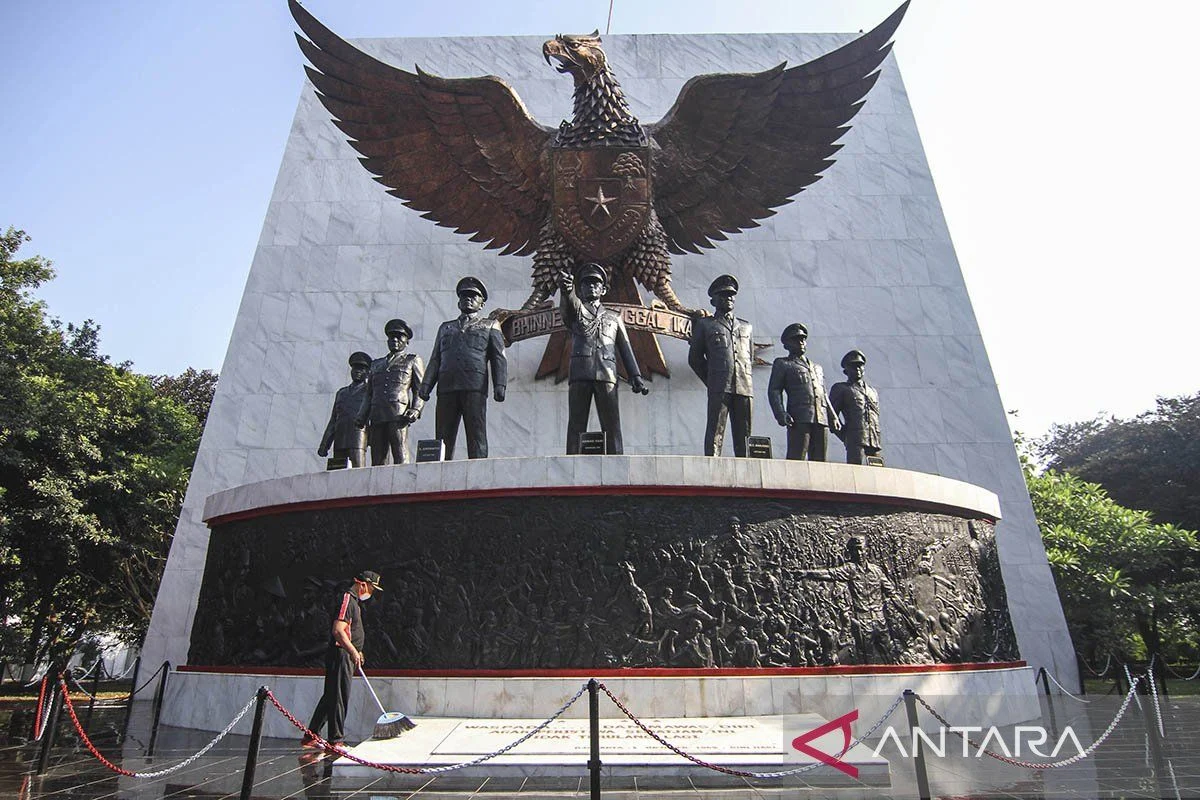
The fragile equilibrium of Guided Democracy shattered overnight between September 30 and October 1, 1965. A faction of military personnel, calling themselves the September 30 Movement (G30S) and led by Lieutenant Colonel Untung Syamsuri of the Presidential Guard, carried out a coordinated operation in Jakarta. The movement abducted and assassinated six senior Army generals—alongside several others—and dumped their bodies in a well at Lubang Buaya on the outskirts of the capital.
The stated objective of the movement was to preempt an alleged coup d’état against President Sukarno by a secretive "Council of Generals." However, the operation quickly collapsed due to poor coordination, strategic miscalculations, and a rapid counter-offensive led by Major General Suharto, commander of the Army’s Strategic Reserve Command (Kostrad).
The events of G30S remain one of the most intensely debated subjects in modern historiography. While the official narrative promoted during President Suharto’s New Order regime unequivocally blamed the PKI as the sole mastermind behind the killings, subsequent historical research, declassified diplomatic archives, and oral histories have introduced multiple interpretations regarding the precise degree of organizational involvement, internal party factions, and external geopolitical influences.
To this day, institutions like the National Archives of Republic Indonesia (ANRI) emphasize the importance of consulting diverse international and domestic archival collections—spanning Indonesian, American, and Japanese sources—to fully grasp the multifaceted nature of the 1965 crisis. Similarly, the Indonesian National Commission on Human Rights (Komnas HAM) has documented the initial political murders of the generals as the immediate trigger for a much wider sequence of systemic human rights violations.
Systemic Crackdown and the Fall of the PKI
In the immediate wake of the failed G30S movement, the political landscape of Indonesia underwent a violent, permanent transformation. Major General Suharto capitalized on the crisis to consolidate control over the state apparatus and neutralize the left wing. The military initiated a systematic campaign targeting the PKI, its affiliated mass organizations, and anyone suspected of harboring communist sympathies.
Between late 1965 and 1966, Indonesia descended into a period of mass violence. According to investigations by Komnas HAM and numerous independent historians, the crackdown resulted in widespread human rights abuses, including mass extrajudicial killings, forced displacement, arbitrary detentions, torture, sexual violence, and enforced disappearances. Hundreds of thousands of individuals—estimates frequently range from 500,000 to over a million—were killed or imprisoned without trial. The violence devastated not only the upper echelons of the party leadership but also ordinary rank-and-file members, agrarian activists, trade unionists, educators, artists, and their families.
The political demise of the party was cemented through legal and administrative edicts. On March 12, 1966, General Suharto issued a presidential decree officially banning the PKI and all its subordinate mass organizations, declaring them illegal entities across the entire Indonesian archipelago. This decree was subsequently reinforced and granted constitutional permanence by the Provisional People’s Consultative Assembly (MPRS) through MPRS Decree No. XXV/MPRS/1966, enacted on July 5, 1966.
This historic decree explicitly outlawed the PKI nationwide and prohibited any activities aimed at propagating or developing the teachings of Communism, Marxism, and Leninism—a legal prohibition that remains active within contemporary Indonesian statutory law.
End of an Era and Historical Implications
The legal dissolution of the PKI in 1966 marked the definitive termination of organized communism as a legal political force in Indonesia. Simultaneously, the sweeping political realignment accelerated the decline of President Sukarno’s authority. Suharto assumed effective executive control, culminating in his appointment as acting president in 1967 and full presidential inauguration in 1968, which inaugurated the authoritarian, military-backed New Order regime that governed Indonesia until 1998.
For over six decades, the legacy of the PKI, the tragedy of G30S, and the subsequent violence of 1965–1966 have occupied a central space in Indonesian historical discourse, social memory, and transitional justice debates. While the official state stance maintained for decades emphasized the absolute culpability of the PKI in attempting to subvert the state, contemporary historians, civil society groups, and legal scholars continue to advocate for transparent historical documentation, archival openness, and the acknowledgment of historical human rights violations.
Efforts by institutions such as ANRI to release and contextualize source archives underscore a growing scholarly commitment to rigorous, evidence-based historical inquiry. By examining the continuum of the movement—from its tentative origins under Dutch colonialism, through the ashes of the Madiun Affair, the dizzying heights of democratic popularity in the 1950s, to its cataclysmic destruction in the mid-1960s—researchers continue to map how ideological extremism and systemic polarization can fundamentally reshape a nation’s destiny. Ultimately, the history of the PKI serves as a sobering reminder of the fragile nature of democratic institutions and the enduring necessity of historical accuracy, justice, and reconciliation.