
The transition from the 18th to the 19th century marked a pivotal shift in the colonial administration of the Indonesian archipelago. Following the bankruptcy and subsequent dissolution of the Dutch East India Company (VOC) in 1799, the Dutch government assumed direct control over its territories. This era, characterized by the pursuit of "Pax Nederlandica"—the ambition to unite the entire archipelago under Dutch administrative hegemony—met with fierce and protracted resistance from local kingdoms and indigenous populations. From the highlands of Sumatra to the volcanic landscapes of Java and the coastal strongholds of Maluku, the 19th century became a theater of relentless warfare, driven by economic grievances, religious fervor, and the defense of ancestral sovereignty.
The Padri War: Religious Reform and Colonial Intrusion (1803–1838)
The Padri War in West Sumatra stands as one of the longest-running conflicts in Indonesian history, evolving from an internal religious dispute into a unified anti-colonial struggle. Initially, the conflict erupted between the Padri (Muslim clerics seeking to purify Islamic practice) and the Adat (traditionalists who maintained indigenous customs, including gambling and cockfighting).
The first phase (1803–1821) saw the Padri dominate the Minangkabau highlands. However, the trajectory changed in 1821 when the Adat leaders, facing defeat, signed a treaty with the Dutch in Padang, ceding sovereignty in exchange for military assistance. This intervention allowed the Dutch to establish a foothold in the interior of Sumatra.

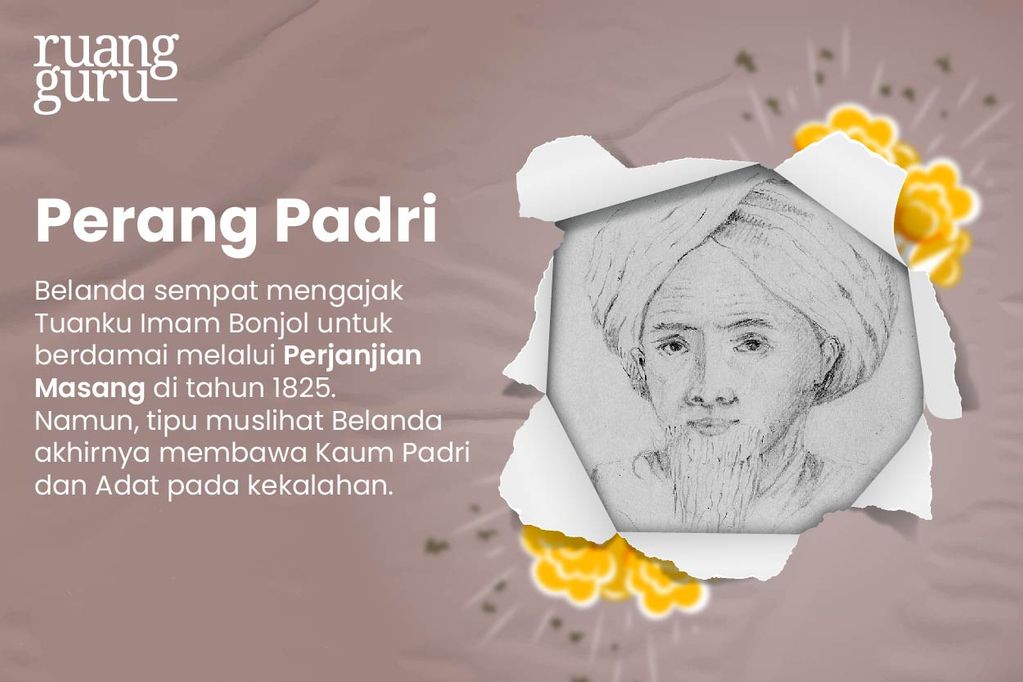
By 1833, the nature of the war shifted. Recognizing that the Dutch intended to subjugate both factions, the Adat and Padri forces—under the leadership of Tuanku Imam Bonjol—united against the colonial "infidels." This second phase was characterized by grueling mountain warfare. Despite the unification of local forces, the Dutch eventually triumphed due to their superior logistics and the fall of the Bonjol stronghold in 1837. The conflict concluded in 1838, resulting in total Dutch control over West Sumatra and the exile of Imam Bonjol to various locations, eventually dying in Minahasa.
The Pattimura Rebellion: Economic Resistance in the Moluccas (1817)
In the eastern archipelago, the return of Dutch rule after a brief British interregnum (1811–1816) sparked immediate unrest. The Dutch sought to reinstate the strict spice monopoly and forced labor policies that the British had partially relaxed. This economic pressure, combined with the dismissal of local teachers and soldiers, led to a localized but intense uprising in Saparua, Maluku.
Led by Thomas Matulessy, known as Pattimura, the rebels successfully captured Fort Duurstede in May 1817, killing the Dutch Resident and his family. Pattimura, a former sergeant in the British colonial army, utilized his military training to organize a disciplined resistance. However, the Dutch response was overwhelming. By mobilizing massive naval reinforcements from Batavia, the colonial government systematically reclaimed the islands. Pattimura was captured and executed in December 1817, followed by the arrest of the teenage heroine Martha Christina Tiahahu, who died at sea while being deported. The rebellion’s failure cemented Dutch control over the lucrative spice trade for the remainder of the century.
The Java War: The Great Insurgency of Pangeran Diponegoro (1825–1830)
The Java War, or the Diponegoro War, represents the most significant challenge to Dutch authority on the island of Java. The conflict was rooted in deep-seated grievances within the Yogyakarta Sultanate, including the erosion of court prestige, high taxation, and the Dutch decision to build a road across the burial grounds of Pangeran Diponegoro’s ancestors.
Diponegoro, a charismatic prince and religious figure, framed the struggle as a "Jihad" (Holy War) against the "Kafir" (infidel) Dutch. He drew support from the peasantry, the clergy, and significant portions of the Javanese aristocracy. For five years, the Dutch were pushed to the brink of bankruptcy.
To counter Diponegoro’s effective guerrilla tactics, General Hendrik Merkus de Kock implemented the Benteng Stelsel (Fortress System) in 1827. This strategy involved building a network of interconnected forts across Central Java to restrict the movement of rebel forces and isolate them from the civilian population. The war finally ended in 1830 through a controversial act of treachery; the Dutch invited Diponegoro to Magelang for peace negotiations, only to arrest him upon arrival.
The implications of the Java War were profound. It cost the lives of an estimated 200,000 Javanese and 8,000 European soldiers. Economically, the Dutch were nearly bankrupted, leading to the implementation of the Cultuurstelsel (Cultivation System), a period of forced agricultural labor that devastated the Javanese peasantry but saved the Dutch treasury.
The Puputan of Bali and the Jagaraga War (1846–1849)
Dutch expansion into Bali was largely motivated by the desire to abolish the Hak Tawan Karang (Right of Salvage), a traditional Balinese law that allowed kingdoms to seize the cargo of ships wrecked on their shores. When the Dutch demanded the end of this practice and the recognition of Dutch sovereignty, the Balinese kingdoms, led by I Gusti Ketut Jelantik of the Buleleng Kingdom, refused to capitulate.

The resulting Jagaraga War saw the Balinese employ a "scorched earth" policy and the construction of elaborate fortifications. The Dutch launched three major military expeditions between 1846 and 1849. The final expedition involved nearly 15,000 troops and state-of-the-art artillery. Facing inevitable defeat, the Balinese warriors and royalty chose Puputan—a ritual mass suicide in battle—preferring death to the humiliation of surrender. This fierce resistance delayed full Dutch control over Bali, though the northern regions fell under colonial administration by 1849.
The Banjar War: Coal and Succession (1859–1905)
In South Kalimantan, the Banjar War was triggered by Dutch interference in the succession of the Sultanate and their desire to secure coal mines for their steamship fleet. The Dutch bypassed the legitimate heir, Pangeran Hidayatullah, in favor of a candidate more sympathetic to colonial interests.
This sparked a widespread revolt led by Pangeran Antasari and Hidayatullah. The resistance utilized the dense jungles of Kalimantan to conduct a prolonged guerrilla campaign. Despite the capture and exile of Hidayatullah in 1862, Antasari continued the fight until his death from disease later that year. Small pockets of resistance persisted for decades, with the war officially ending only in 1905. The conflict highlighted the Dutch shift toward securing industrial resources, moving beyond the traditional spice trade.
The Aceh War: The Thirty-Year Conflict (1873–1904)
The Aceh War was the bloodiest and most difficult military campaign in Dutch colonial history. Triggered by the 1871 Treaty of Sumatra, which gave the Dutch a free hand in northern Sumatra, the invasion of Aceh began in 1873. The Dutch expected a quick victory, but they encountered a population unified by a militant interpretation of Islam and a fierce tradition of independence.

Led by figures such as Teuku Umar, Cut Nyak Dien, and Panglima Polim, the Acehnese waged a relentless guerrilla war. The Dutch were forced to retreat to a "concentrated line" of defense for years, unable to control the interior. The tide turned only after the Dutch employed the advice of Dr. Snouck Hurgronje, an Islamic scholar who lived in Aceh undercover. He advised the military to distinguish between religious leaders and the nobility, and to use mobile "Marsose" (counter-insurgency) units to pursue the rebels relentlessly.
Under General J.B. van Heutsz, the Dutch launched a brutal "pacification" campaign. By 1903, the major leaders were either killed or surrendered, and the "Short Declaration" (Korte Verklaring) was imposed on local rulers, stripping them of their autonomy. However, sporadic resistance continued until the Dutch exit from Indonesia in 1942.
The Batak Resistance: The Fall of the Priest-King (1878–1907)
In North Sumatra, the Batak people, led by their priest-king Sisingamangaraja XII, resisted Dutch encroachment for nearly 30 years. The conflict was fueled by the Dutch attempt to integrate the Batak lands into the colonial administration and the rapid spread of Christian missions, which Sisingamangaraja viewed as a threat to traditional Batak spiritual and political authority.
Utilizing the rugged terrain of the Lake Toba region, Sisingamangaraja conducted hit-and-run attacks on Dutch outposts. However, the superior firepower of the Dutch Marsose units eventually trapped his forces. In 1907, Sisingamangaraja XII was killed in an ambush in the Dairi forests, marking the end of organized Batak resistance and the complete annexation of North Sumatra.

Broader Impact and Historical Implications
The series of wars across the 19th and early 20th centuries proved that Dutch colonial rule was never passively accepted. While the Dutch eventually achieved their goal of a unified "Netherlands East Indies" by 1910, the cost was staggering in terms of human life and financial resources.
From a strategic perspective, these conflicts forced the Dutch to evolve from a mercantile company into a modern colonial state with a centralized military and bureaucracy. Conversely, for the people of the archipelago, these regional struggles laid the psychological foundation for the National Awakening of the early 20th century. Although the 19th-century resistance failed to expel the Dutch, the shared experience of colonial oppression and the legends of heroes like Diponegoro and Cut Nyak Dien became the unifying myths that would eventually fuel the modern Indonesian independence movement. The transition from physical warfare to political organization marked the next chapter in Indonesia’s long road to sovereignty.