The Indonesian Ministry of Primary and Secondary Education (Kemendikdasmen) has officially released the comprehensive operational guidelines for the 2026 Academic Competency Test, commonly known as Tes Kemampuan Akademik (TKA). Scheduled to take place between October and November 2026, the TKA serves as a pivotal assessment designed to evaluate the academic achievements of students at the Senior High School (SMA), Vocational High School (SMK), and Madrasah Aliyah (MA) levels. This standardized examination is positioned not merely as a test of knowledge but as a critical validator for school report card grades, which have historically faced scrutiny regarding consistency and objectivity across different regions.
The introduction of TKA 2026 marks a significant evolution in the national assessment landscape following the abolition of the National Examination (UN) several years ago. By implementing this test, the government aims to provide a more reliable benchmark for student performance, which will subsequently be utilized as a supplementary metric in the selection process for state universities (PTN) and other higher education pathways.
Historical Context and the Necessity of Academic Validation
Since the removal of the National Examination, the Indonesian education system has relied heavily on school-based assessments and report cards for student evaluation and university admissions. However, data from the Ministry and various educational observers suggested a growing disparity in grading standards. The phenomenon often referred to as "grade inflation" or "nilai katrol" became a concern, where schools might inadvertently or intentionally elevate grades to maintain institutional prestige or ensure higher graduation rates.

Without a centralized benchmark, the Ministry noted that report cards alone could not objectively compare a student’s capability in a remote province with one in an urban center. TKA was developed to bridge this gap. As a standardized instrument, it provides an objective "sanity check" on the grades awarded by teachers. If a student holds a high GPA but scores significantly lower on the TKA, it signals a need for curriculum alignment or a review of school-level assessment integrity. Conversely, high TKA scores can bolster a student’s profile, proving that their high school grades are backed by genuine academic proficiency.
Official Timeline and Chronology of Implementation
The Ministry has outlined a rigorous schedule to ensure that schools, students, and proctors are adequately prepared for the high-stakes environment of the TKA. The process begins nearly four months before the actual examination window.
According to the official decree, the registration phase for TKA 2026 is slated to commence on July 27, 2026. This early start allows schools to synchronize their student databases with the central Ministry system. Following registration, the Ministry has scheduled a series of preparatory phases:
- Simulation Phase: Conducted in the months leading up to October, simulations are designed to familiarize students with the Computer-Based Test (CBT) interface. This phase focuses on the user experience, ensuring students understand how to navigate between questions, use digital tools, and manage their time within the software.
- Gladi Bersih (Full Rehearsal): This stage involves a comprehensive test of the technical infrastructure. It includes the distribution of login credentials, the stability of local servers, and the synchronization of data between schools and the national data center.
- Main Examination Window: The actual TKA will be administered in October and November 2026.
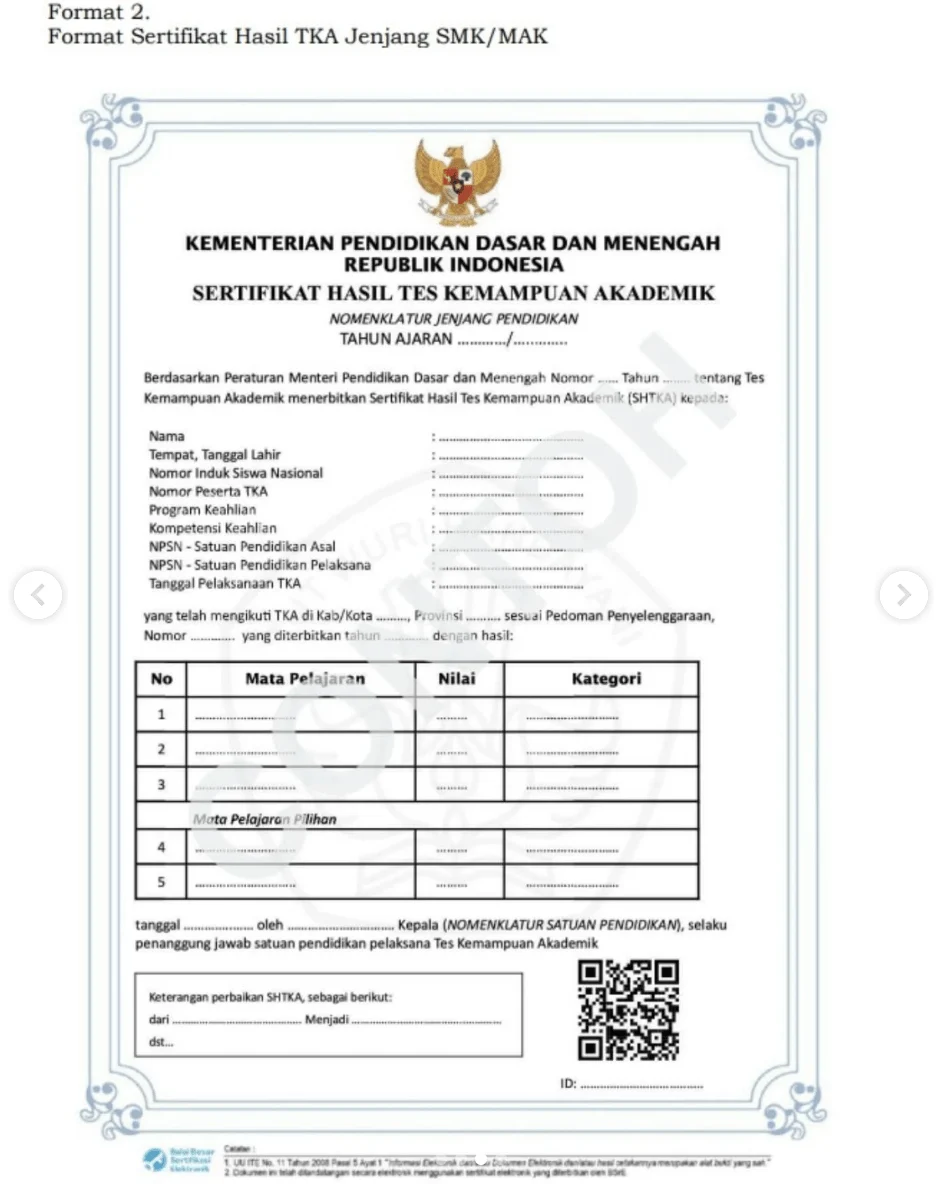
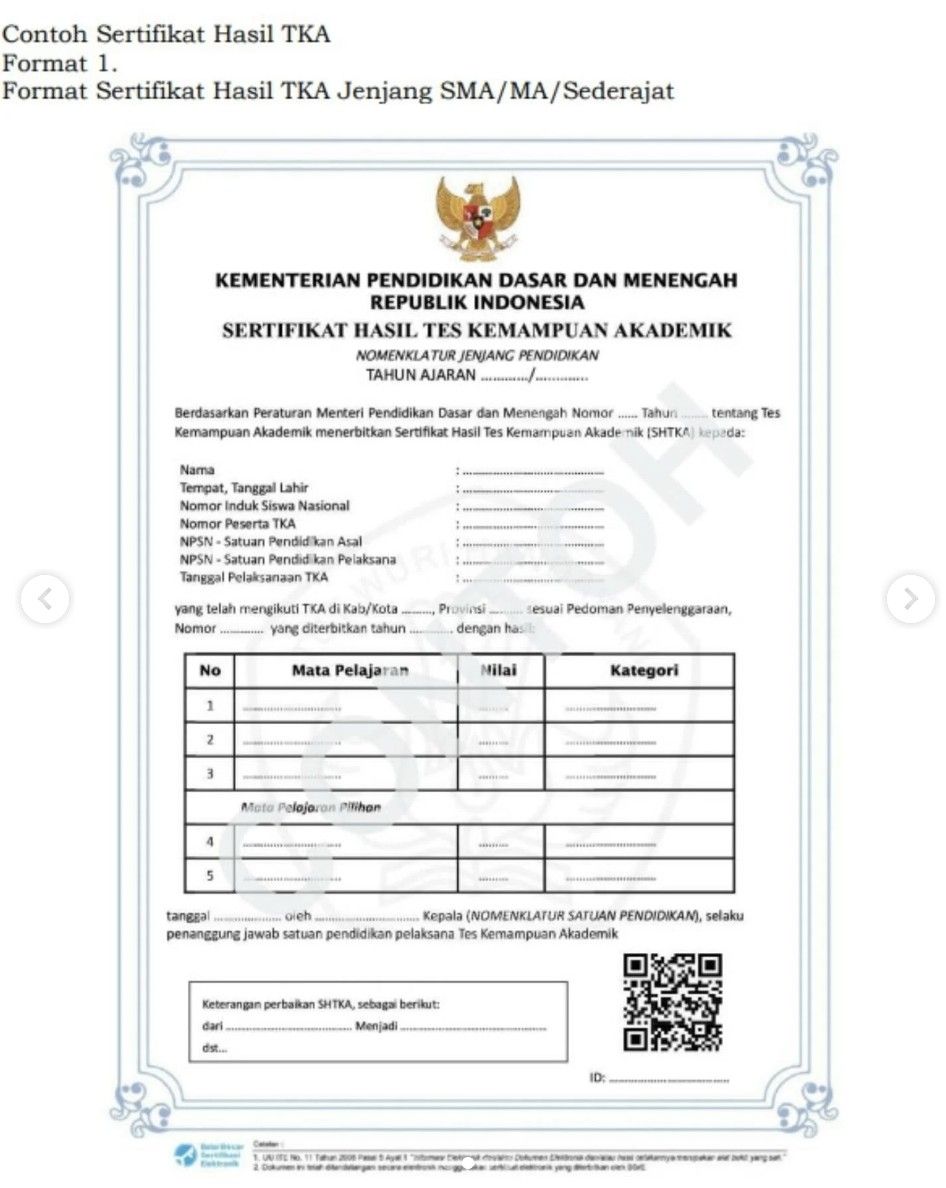
- Results and Certification: Following the completion of the test, the Ministry will process the scores and issue official TKA Certificates, which students can then use for university applications and employment portfolios.
Examination Structure and Subject Distribution
The TKA 2026 is structured to be completed over a period of two days. The curriculum focus is divided into "Mandatory Subjects" and "Elective Subjects," reflecting the flexibility of the Kurikulum Merdeka (Independent Curriculum) while remaining compatible with the 2013 Curriculum.

Day 1: Mandatory Subjects (Literacy and Numeracy)
The first day focuses on core competencies that are essential for all students regardless of their future specialization. The mandatory session lasts for 150 minutes and covers:
- Mathematics: Focusing on numerical reasoning, data interpretation, and problem-solving.
- Indonesian Language: Emphasizing reading comprehension, analytical writing, and linguistic logic.
- English Language: Assessing global communication skills, text analysis, and vocabulary in context.
Day 2: Elective Subjects (Specialization)
On the second day, students are required to choose two subjects that align with their academic interests or intended university majors. This session is 130 minutes long. The available choices include:
- Natural Sciences (IPA): Physics, Chemistry, and Biology.
- Social Sciences (IPS): Economics, History, Sociology, and Geography.
- Vocational/Other: Specific subjects tailored for SMK students or specialized MA tracks.
The Ministry has emphasized that the questions are developed using High-Order Thinking Skills (HOTS) principles. This means students will encounter fewer rote-memorization questions and more scenarios requiring logic, deduction, and the application of theories to real-world problems.
Technical Execution and Question Formats
The TKA 2026 will be entirely computer-based. To provide a more nuanced assessment of student capability, the Ministry has moved beyond the traditional single-choice multiple-choice format. The 2026 exam will feature:
- Simple Multiple Choice: Selecting one correct answer from several options.
- Complex Multiple Choice: Questions where more than one answer may be correct, or where students must determine the truth of several statements.
- Matching (Menjodohkan): Connecting related concepts or data points across two columns.
This diversity in question types is intended to reduce the "guessing factor" and provide a clearer picture of a student’s cognitive depth. Per Regulation of the Head of the Agency for Standards, Curriculum, and Education Assessment Number 045/H/AN/2025, the framework for these assessments remains consistent across both the 2013 Curriculum and Kurikulum Merdeka, focusing on cross-curricular competencies.
Registration Workflow and Eligibility
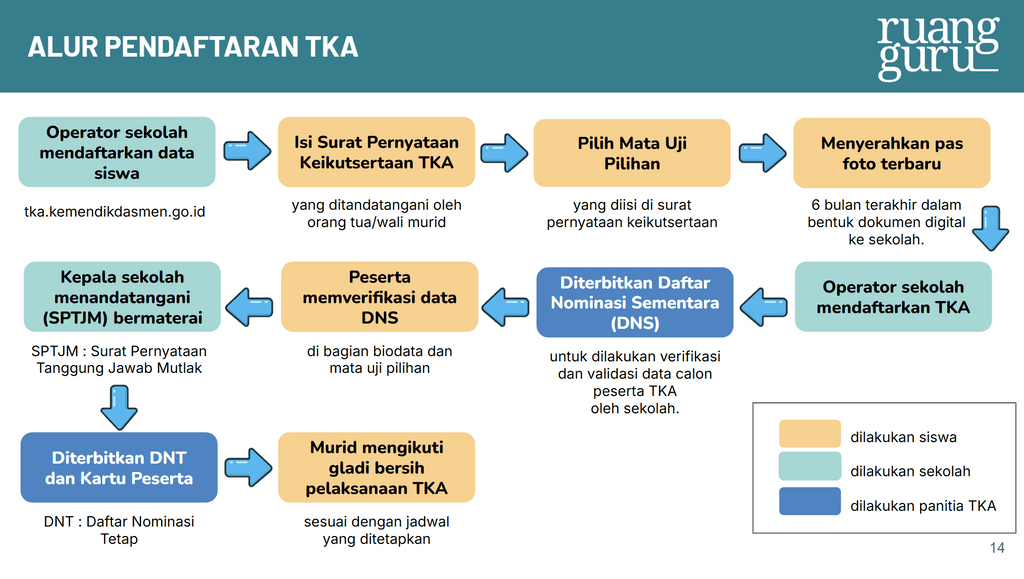
The registration for TKA 2026 is a school-coordinated effort. Students cannot register individually without the endorsement of their educational institution. The workflow involves:
- Data Verification: Schools verify student data through the national education database (Dapodik/EMIS).
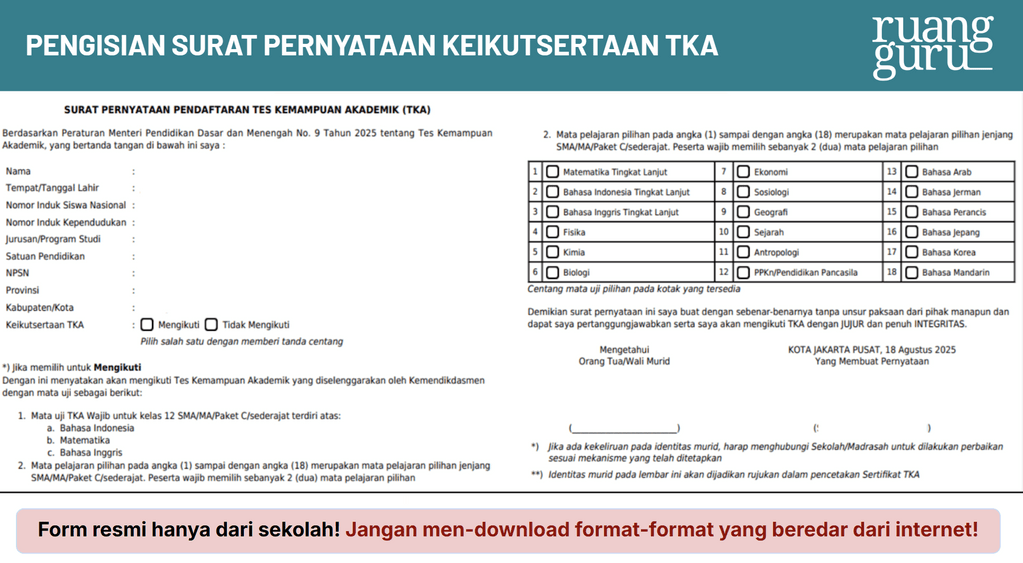
- Subject Selection: Students choose their two elective subjects through the school’s administrative portal.
- Parental Consent: A unique feature of the 2026 cycle is the requirement for a signed statement of intent/consent from the student or guardian, acknowledging the voluntary but highly recommended nature of the test.
- Card Distribution: Once verified, schools print and distribute "Login Cards" which contain the credentials necessary for the CBT platform.
Eligibility is primarily extended to final-year students (Grade 12 or Grade 13 for four-year vocational programs). However, provisions are also made for "Package C" (equivalent) students and certain gap-year students looking to validate their academic standing for upcoming university entrance cycles.
Implications for Higher Education and the Workforce
The results of the TKA are expected to have a profound impact on the transition from secondary to higher education. Most state universities in Indonesia have indicated that TKA scores will be integrated into the SNBP (National Selection Based on Achievement) and potentially the SNBT (National Selection Based on Testing).
For the SNBP, which traditionally relies on report cards, the TKA score acts as a weighting factor. A student with a high TKA score may see their report card grades "valued" more highly by university admissions officers compared to a student with similar grades but no TKA validation. Furthermore, the TKA certificate is designed to be a "portable credential." In the professional world, particularly for SMK graduates, this certificate serves as an objective proof of academic competence for entry-level positions in industries that value literacy and numeracy.
Reactions from Educational Stakeholders
The announcement of the TKA 2026 guidelines has prompted a variety of responses from the educational community. School administrators have generally welcomed the move, noting that it provides a clear target for instructional quality. "It gives us a mirror," said one principal from a Jakarta-based high school. "It allows us to see if our internal grading is truly reflective of national standards."
However, some student advocacy groups have raised concerns regarding the "testing burden." With the UTBK (University Entrance Test) and various school exams already on the calendar, there are worries about student burnout. In response, the Ministry has clarified that the TKA is designed to be "low-stress" compared to the old National Exams, as it focuses on mapping and validation rather than being a sole determinant of graduation.
Educational analysts suggest that the success of TKA 2026 will depend on the Ministry’s ability to ensure digital equity. Schools in remote areas must have the same level of server stability and internet access as those in major cities to ensure the "Academic Competency" being measured isn’t actually "Digital Access."
Conclusion: A Step Toward Educational Integrity
As Indonesia moves toward its "Golden Indonesia 2045" vision, the TKA 2026 represents a critical infrastructure project in the realm of human capital development. By moving away from the high-stakes "pass-fail" nature of the old UN and toward a sophisticated, multi-format validation system, Kemendikdasmen is attempting to foster a culture of academic honesty and standardized excellence.
Students are encouraged to utilize the remaining months to engage with the provided "Assessment Frameworks" and participate in simulations. While the TKA is a measure of past learning, its role in opening future doors—be it in prestigious universities or the modern workforce—cannot be understated. The 2026 cycle will likely serve as the definitive blueprint for how Indonesia assesses its youth in the decades to come.