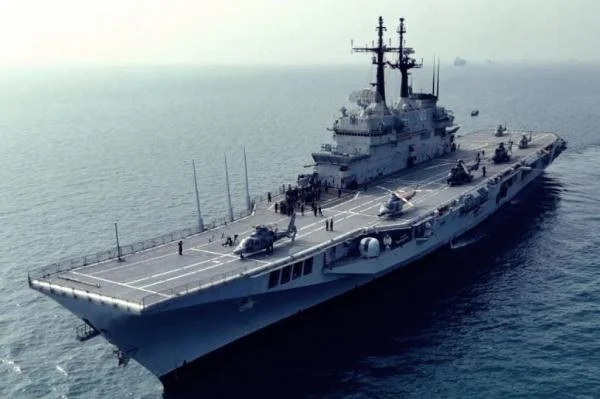
The Indonesian Navy (TNI AL) recently conducted a comprehensive, large-scale disaster mitigation exercise centered on the prevention and suppression of forest and land fires (karhutla), utilizing the advanced capabilities of the nation’s first aircraft carrier, KRI Sriwijaya-100. The operation, which took place on Saturday, November 7, 2026, around Pulau Edam and the surrounding waters of the Teluk Jakarta, marked a significant milestone in Indonesia’s military preparedness for non-combat disaster management operations. With a total of 275 joint personnel deployed, the exercise served as a rigorous test of the interoperability between naval and air force units in responding to environmental threats that have historically plagued the Indonesian archipelago.
Operational Scope and Tactical Execution
The exercise was executed in the form of a Field Maneuver (Manlap), designed to simulate real-world crisis scenarios where rapid, multi-dimensional response is critical. The primary objective was to evaluate the combat-readiness and technical proficiency of personnel in handling large-scale fires that threaten ecological stability and public health. By moving beyond traditional maritime defense roles, the Indonesian Navy underscored its evolving doctrine: that the maritime force must act as a versatile instrument of national security, capable of transitioning seamlessly from defense to humanitarian and environmental crisis management.
The tactical composition of the exercise was extensive, reflecting the high priority placed on this drill. The naval contingent featured the formidable KRI Sriwijaya-100 acting as the primary floating base, supported by the KRI Surik-645. The aerial support was particularly robust, comprising a fleet of four AS 565 MBe Panther helicopters, two Bell 412 helicopters, one CN-235 maritime patrol aircraft, and one NC 212 Casa aircraft. The synergy was further bolstered by the Indonesian Air Force (TNI AU), which deployed two Caracal helicopters, specifically chosen for their high-capacity water-bombing capabilities and long-range transport efficiency.
Chronology of the Deployment
The operation commenced in the early hours of November 7, 2026. The staging area, Pulau Edam, provided a challenging environment that mirrored the rugged terrain often encountered during wildfire incidents in remote regions of Sumatra or Kalimantan.
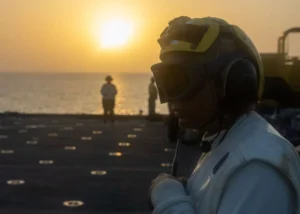
The arrival of the Chief of Staff of the Indonesian Navy (KSAL), Admiral Muhammad Ali, signaled the start of the high-intensity phase of the maneuvers. Admiral Ali arrived at the floating headquarters of KRI Sriwijaya-100 via an AS 565 MBe Panther helicopter. Upon landing on the flight deck, the Admiral conducted a meticulous inspection of the air assets and provided a direct, high-level briefing to the flight crews and ground personnel. This direct oversight ensured that the protocols for aerial fire-suppression—which require precise coordination between ground-based naval units and airborne firefighting assets—were strictly adhered to.
The maneuver progressed through several phases: initial detection, perimeter securing, aerial reconnaissance, and the primary suppression phase involving water-bombing sorties. By utilizing the KRI Sriwijaya-100 as a command-and-control hub, the Navy demonstrated how a carrier platform can function as a centralized mobile logistics base, providing medical support, fuel, and command infrastructure in areas where existing land-based infrastructure may be incapacitated by disasters.
The Strategic Role of KRI Sriwijaya-100
The integration of KRI Sriwijaya-100 into this exercise is of particular strategic importance. As Indonesia’s first aircraft carrier, its deployment in humanitarian and environmental operations represents a paradigm shift in how the state utilizes high-value assets. Traditionally, aircraft carriers are viewed strictly through the lens of power projection; however, in the context of the Indonesian archipelago, where geography poses significant hurdles to disaster response, the KRI Sriwijaya-100 serves as a "floating fortress" for rescue and recovery.
Its ability to serve as a mobile base for helicopters and specialized surveillance aircraft allows the military to project humanitarian power into isolated areas within hours of an incident. The vessel’s internal capabilities, including its medical bay and disaster response logistics, make it an essential asset for long-term operations where traditional landing strips might be compromised.
Inter-Service Synergy: TNI AL and TNI AU
A recurring theme in modern Indonesian military doctrine is the concept of "jointness." The collaboration between the TNI AL and the TNI AU in this exercise is a tangible example of this policy in action. The Caracal helicopters from the Air Force provided the heavy-lift capacity required for large-scale water dropping, while the Navy’s Panther and Bell helicopters provided tactical observation, reconnaissance, and personnel transport.
This cross-branch integration is critical. Wildfires often cross maritime and terrestrial boundaries; therefore, the ability of both branches to communicate on unified frequencies and operate under a single command structure—as demonstrated by Admiral Ali’s leadership during the exercise—is essential for minimizing response times. By training together in a controlled environment, the two branches reduce the risk of friction during actual, high-pressure emergency situations.
Analysis of Implications for National Security
The implications of this exercise are twofold: ecological and security-related. Environmentally, the Indonesian government has faced significant international pressure to address the perennial issue of forest fires, which cause significant carbon emissions and transboundary haze. By dedicating military resources to this cause, the government is signaling that it treats ecological health as a matter of national security.

From a security perspective, the ability to deploy a carrier-led strike group for domestic disaster mitigation strengthens the social contract between the military and the public. In times of crisis, the presence of the military as a stabilizing force, providing logistics, health, and logistical support, is vital for maintaining public order and ensuring the continuity of regional governance.
Furthermore, this exercise serves as a deterrent and a demonstration of capability. By showing that the TNI can mobilize a large, technologically sophisticated task force to address a localized disaster, the military also demonstrates its ability to move rapidly and sustain operations in diverse operational theaters, which is a key component of territorial defense.
Future Outlook and Official Stance
While the Ministry of Defense has not yet released the full data from the post-exercise report, officials have suggested that this will become the new standard for annual training cycles. The success of the November 7 operation confirms that the procurement of major platforms like KRI Sriwijaya-100 was not merely for blue-water naval combat, but for multi-purpose utility across the Indonesian archipelago.
Admiral Muhammad Ali, in his closing remarks during the debriefing aboard the carrier, emphasized the necessity of agility. He noted that the environment is rapidly changing and that the military must adapt its training to include climate-driven threats. He praised the performance of the aircrews and the coordination of the surface units, noting that the speed with which the fleet moved from "general training" to "simulated combat-fire suppression" met the highest standards of the Indonesian Navy.
As Indonesia continues to modernize its military, the focus will likely remain on this dual-use capability. The ability to defend the nation’s sovereignty is inextricably linked to the ability to protect its land and citizens from the devastating impacts of climate-driven disasters. Through exercises like the one held in Jakarta Bay, the TNI is positioning itself as a modern, versatile force ready to meet the challenges of the 21st century.
Conclusion: A Foundation for Resilient Operations
The exercise at Pulau Edam concludes on a high note, proving that the synergy between air and sea power is the most effective tool for combatting the complex threat of forest fires. The personnel involved, from the deck crews on the KRI Sriwijaya-100 to the pilots navigating the thick, simulated smoke of the exercise, have demonstrated a high level of technical mastery. As the nation looks toward future challenges, the institutional knowledge gained from these maneuvers will prove invaluable, ensuring that the Indonesian Navy remains at the forefront of disaster mitigation and national security, ready to serve whenever the nation faces crisis.