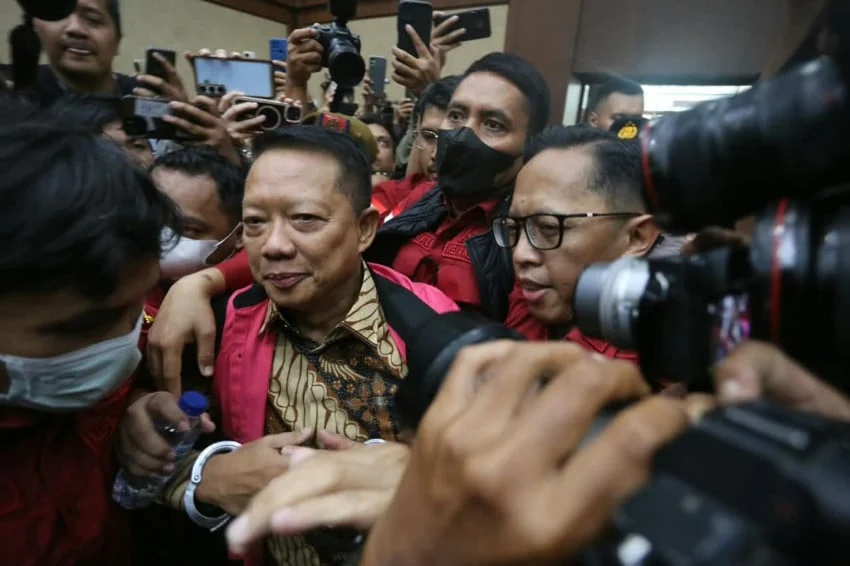
The rejection of the exception or memorandum of defense submitted by former Junior Attorney General for Special Crimes Febrie Adriansyah by the panel of judges at the Jakarta Corruption Court has established a crucial turning point in one of the most high-profile legal proceedings involving a high-ranking Indonesian law enforcement official. This judicial decision clears the path for the trial to advance into its core phase: the rigorous examination of material evidence. Consequently, the Attorney General Office now faces an intense institutional and professional litmus test to substantiate its complex construction of alleged extortion and money laundering charges through unassailable, concrete evidentiary standards before the court.
The dismissal of the defense plea indicates that the initial indictments presented by the public prosecutors meet the formal statutory requirements mandated by Indonesian criminal procedure law. However, legal analysts and governance experts emphasize that surviving the preliminary exception phase is merely procedural and does not prejudge the ultimate outcome of the litigation. The prosecution must now transition from legal drafting to concrete substantiation, carrying the heavy burden of proof required to link the accused directly to the alleged financial flows and illicit asset integration constituting the core of the Tindak Pidana Pencucian Uang, or Money Laundering Crime (TPPU) statutes.
Chronology of the Legal Proceedings and Procedural Milestones
The trajectory of the case against Febrie Adriansyah has developed through a series of escalating administrative and judicial steps that have captured public and institutional attention across Indonesia. The initial scrutiny began amidst internal investigations within the broader enforcement landscape, eventually culminating in formal suspect designation and subsequent detention by investigative authorities.
Following the completion of the investigation dossier, the case was transferred to the Jakarta Corruption Court, where prosecutors formally filed their multi-layered indictment. The charges encompass distinct counts of alleged extortion, abuse of authority during his tenure as a senior prosecutor, and subsequent attempts to disguise or conceal the origins of allegedly ill-gotten wealth through asset laundering mechanisms.
In response to the indictment, the legal defense team for Febrie Adriansyah filed an exception—a preliminary objection arguing that the indictment was legally flawed, vague, or improperly constructed, and therefore should be dismissed before entering the evidentiary stage. However, during the interlocutory decision hearing, the presiding panel of judges formally rejected the defense arguments. The court ruled that the indictment complied with the provisions of Article 143 paragraph (2) of the Criminal Procedure Code (KUHAP), thereby ordering the trial to proceed to the examination of witnesses and evidence. This procedural juncture sets the stage for months of intensive legal battles as both the prosecution and the defense present their respective witnesses, expert testimonies, and documentary evidence.
Expert Perspectives on the Burden of Proof and Evidentiary Challenges
The transition from the procedural exception phase to the evidentiary stage has elicited extensive commentary from legal scholars, criminologists, and political analysts. Iwan Setiawan, Director of the Indonesia Political Review (IPR), noted that while the rejection of the exception demonstrates the legal viability of the indictment, it carries no implication regarding the ultimate guilt or innocence of the accused.
According to Setiawan, the court’s decision simply validates that the indictment is sufficient to warrant a full judicial inquiry. Yet, this milestone serves as a stern test for the prosecution team. The state must now present clear, material proof connecting the defendant to the specific financial transactions outlined in the money laundering charges. In white-collar and corruption cases of this magnitude, establishing the predicate offense is only the first step; proving the intricate layering and integration phases of money laundering demands meticulous forensic accounting and irrefutable documentary trails.
Legal practitioners point out that prosecuting a high-ranking former law enforcement official involves unique complexities. The defense is expected to rigorously challenge the provenance of every financial record, asset transfer, and witness statement introduced by the state. The prosecution must demonstrate not only that funds changed hands improperly, but also that the defendant maintained control over these assets and intentionally acted to obscure their illicit origins.
Contextual Background and Institutional Implications
The prosecution of Febrie Adriansyah unfolds against a broader backdrop of ongoing institutional reforms and accountability measures within Indonesia’s legal and judicial architecture. As a former high-ranking official who once led the special crimes division—the very unit tasked with prosecuting major corruption cases—the involvement of Adriansyah in criminal proceedings represents a significant moment for the Attorney General Office.
The case places the institutional integrity of the prosecution service under public scrutiny. Observers note that the Attorney General Office has actively sought to project an image of internal cleansing and uncompromising enforcement of the law, regardless of the institutional rank or historical affiliation of the accused. Prosecuting a former Junior Attorney General demonstrates a willingness to apply legal standards uniformly, yet it also exposes the institution to intense political and professional pressures.
The implications of the trial extend beyond the fate of the individual defendant. A successful prosecution backed by transparent, robust evidence could reinforce public confidence in the judicial system’s capacity to hold powerful figures accountable. Conversely, any evidentiary shortcomings or procedural missteps resulting in an acquittal could trigger widespread skepticism regarding the capability and impartiality of the state’s investigative and prosecutorial apparatus.
Financial Forensics and the Mechanics of the Money Laundering Charges
At the heart of the ongoing trial are the complex financial allegations involving extortion and money laundering. Under Indonesian law, particularly Law Number 8 of 2010 on the Prevention and Eradication of the Crime of Money Laundering, prosecutors must prove that assets derived from a predicate crime—in this case, corruption and extortion—were converted, transferred, concealed, or disguised to hide their true source.
To meet this legal standard, state prosecutors are expected to rely heavily on financial forensics, bank account statements, asset ownership registries, and testimonies from corporate entities or individuals allegedly pressured during the period in question. The challenge lies in establishing a direct, unbroken causal link between the alleged abuse of authority and the accumulation of disputed wealth. Financial tracing in high-level corruption cases often involves shell companies, nominee accounts, and complex cross-border transactions, requiring expert financial analysts to explain these mechanisms clearly to the bench.
During the upcoming evidentiary hearings, the court will hear cross-examinations of expert witnesses from institutions such as the Financial Transaction Reports and Analysis Center (PPATK). These testimonies will be critical in determining whether the financial flows identified by investigators truly represent illicit proceeds or can be accounted for through legitimate income sources, as the defense is likely to argue.
Broader Socio-Political and Legal Impact on Anti-Corruption Efforts
The unfolding trial of Febrie Adriansyah serves as a bellwether for the current state of Indonesia’s anti-corruption campaigns. As public demand for transparency and accountability grows, the judiciary faces heightened expectations to deliver impartial, evidence-based verdicts free from external influence.
The handling of this case will likely set precedents for how allegations against elite law enforcement officials are adjudicated in the future. It underscores the vital importance of maintaining strict adherence to due process, ensuring that the rights of the accused are fully respected while simultaneously empowering the state to pursue illicit assets relentlessly.
As the Jakarta Corruption Court schedules subsequent sessions for witness testimonies and the presentation of material evidence, all eyes remain fixed on the courtroom. The coming weeks will reveal whether the state can successfully bridge the gap between preliminary allegations and definitive judicial proof, ultimately determining the legal fate of one of the nation’s most prominent former legal officials.