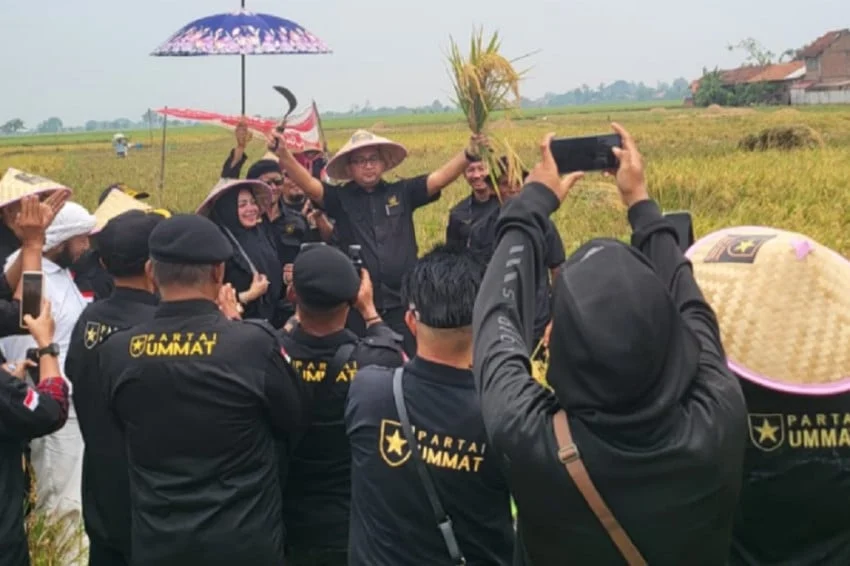
The pursuit of national food security and the economic empowerment of grassroots agricultural communities took center stage in West Java as senior political figures gathered for a major harvest celebration. Heikal Safar, Daily Chairman of the Central Executive Board (DPP) of the Ummat Party, spearheaded a grand harvest event known locally as a panen raya, alongside a community outreach initiative providing free midday meals. The gathering, which brought together hundreds of local farmers, agricultural advocates, and regional party functionaries, took place in Sukamulya Village, located within the Sukatani District of Bekasi Regency.
The initiative was designed not only to celebrate agricultural yields but also to spotlight the critical need for systemic improvements in farmer welfare, technological modernization, and sustainable community empowerment. As Indonesia navigates the complexities of global supply chains and climate unpredictability, events like the one in Bekasi serve as a micro-level barometer of the nation’s broader agricultural ambitions and the ongoing challenges faced by smallholder farmers.
Comprehensive Gathering of Agricultural and Political Stakeholders
The grand harvest event in Sukamulya Village transcended a standard political appearance, functioning instead as a collaborative forum for agricultural stakeholders, community leaders, and party officials. Joining Heikal Safar at the event was Nofalia Heikal Safar, Chair of the Commission for Economic Empowerment of the DPP Partai Ummat, signaling the party’s institutional focus on economic self-sufficiency and localized financial growth.
The delegation also included high-ranking regional representatives, notably Firdaus, a key functionary from the Regional Executive Board (DPD) of Partai Ummat for Bekasi Regency and Bekasi City. Prominent local figures were also present, including Bekasi community leader Ustaz Haryono, alongside broader administrative cadres from the central (DPP), provincial (DPW), and regional (DPD) levels of the party. Crucially, the event was heavily attended by local residents, independent farmers, and specific agricultural cooperatives operating under the direct mentorship of Partai Ummat’s agrarian development programs.
The inclusion of free midday meals for hundreds of participating farmers added a tangible social welfare component to the gathering. This element reflected a growing national emphasis on nutritional support programs, directly aligning grassroots community engagement with broader discussions surrounding human capital development and food accessibility.
Bridging the Welfare Gap: The Reality of Indonesian Agriculture
During the proceedings, Heikal Safar addressed the gathered crowds and media representatives, offering a candid assessment of the current state of Indonesian agriculture. He emphasized that despite the country’s fertile landscapes and strategic focus on agricultural productivity, the economic welfare of farmers across various regions remains alarmingly uneven.
Safar pointed out that while national macroeconomic indicators often reflect positive trends in food production and reserve stockpiles, the micro-level economic reality for individual smallholder farmers frequently involves razor-thin profit margins, high input costs, and vulnerability to market fluctuations. He stressed that Indonesia’s agricultural sector urgently requires structural reinforcement to remain competitive globally.
Specifically, Safar drew comparisons to the rapid technological advancements witnessed in neighboring regional powerhouses such as Thailand and Vietnam. Both nations have made substantial strides in modernizing their rice production, supply chain logistics, and export capabilities through aggressive technological integration and state-supported agricultural infrastructure. For Indonesia to maintain its competitive edge and secure long-term food sovereignty, Safar argued that domestic agricultural policies must pivot toward aggressive modernization, enhanced access to affordable capital, and comprehensive technological training for the younger generation of farmers.
The Broader Context of National Food Security and Rice Reserves
The panen raya in Bekasi unfolds against the backdrop of an intensive, multi-year national campaign to achieve complete food self-sufficiency. Over the preceding two years, Indonesian agricultural policies have placed a paramount focus on boosting domestic production across multiple primary commodities. Government data and agricultural sector reports indicate that strategic interventions have led to increased production outputs across at least eight major food commodities, resulting in stabilized or abundant domestic rice reserves.
Achieving and maintaining these reserves requires continuous, labor-intensive efforts at the local level. Districts like Bekasi—historically significant as agricultural buffers surrounding the sprawling urban expanse of Greater Jakarta—play a vital role in sustaining regional food supplies. However, these peri-urban agricultural zones face unique pressures, including the rapid conversion of agricultural land into residential and industrial real estate, water resource management challenges, and environmental degradation.
By organizing the harvest celebration in Sukatani, the organizers sought to draw attention to the frontline producers who shoulder the burden of national food security. While national policies set the framework for swasembada pangan (food self-sufficiency), the actual realization of these goals depends entirely on the productivity and economic viability of local farming communities like those in Sukamulya Village.
Technological Disparities and Regional Competitiveness
A central theme of the discussions during the Bekasi harvest event was the urgent need to bridge the technology gap in farming practices. Modern agriculture increasingly relies on precision farming, high-yield seed varieties, automated irrigation systems, and data-driven supply chain management. In countries like Thailand and Vietnam, government-backed modernization programs have successfully transformed traditional farming into high-efficiency commercial enterprises.
In contrast, many Indonesian farming communities continue to rely on traditional, labor-intensive methods that offer lower yields per hectare and leave producers vulnerable to unpredictable weather patterns and climate change impacts. The high cost of modern agricultural machinery, fertilizers, and pest control agents often places advanced farming technology out of reach for independent smallholders.
Economic empowerment initiatives, such as those promoted by the Ummat Party’s Commission for Economic Empowerment led by Nofalia Heikal Safar, aim to address these disparities by introducing localized cooperative models. These cooperatives can pool resources to purchase modern equipment, negotiate better prices for agricultural inputs, and secure direct market access without relying heavily on exploitative intermediaries.
Policy Implications and Future Outlook
The convergence of political figures, community leaders, and agricultural workers at the Sukamulya Village harvest highlights the growing strategic importance of the agricultural sector in Indonesia’s socio-political landscape. As food security becomes an increasingly prominent national security issue, political parties and civil society organizations are channeling resources into direct grassroots engagement.
The implications of events like the Bekasi panen raya extend beyond immediate community relations. They serve as platforms for policy advocacy, pressuring local and national governments to prioritize agricultural subsidies, infrastructure development, and protective pricing mechanisms for domestic harvests. Furthermore, by integrating social welfare elements—such as free nutritional meals—into agricultural gatherings, organizers are linking economic productivity directly with human development metrics.
As Indonesia continues its legislative and administrative push toward absolute self-sufficiency in key staples, the success of these policies will ultimately be measured in the fields of districts like Sukatani. Ensuring that farmers receive fair compensation, modern technological support, and institutional protection remains the definitive test for national agricultural policy. The voices raised during the Bekasi harvest echo a broader national consensus: that true food sovereignty cannot be achieved without the sustained economic prosperity and empowerment of Indonesia’s farming population.