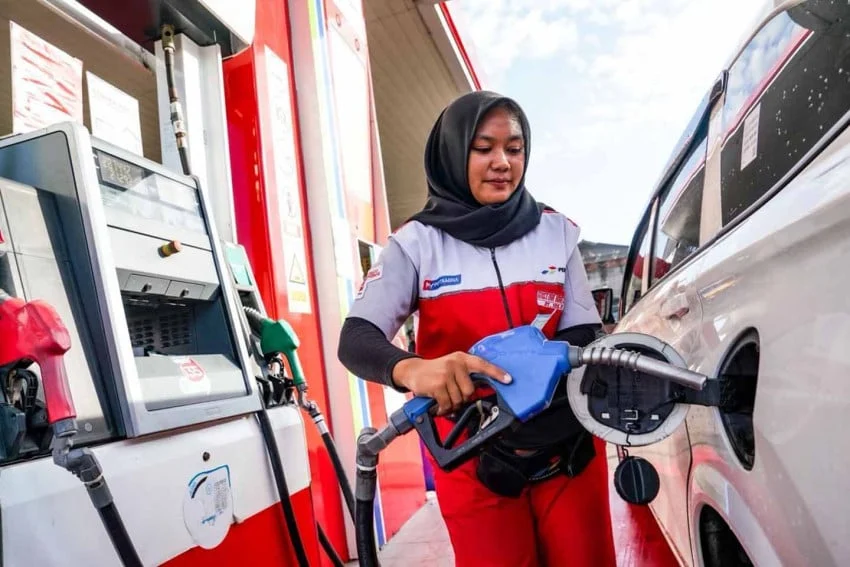
The energy landscape in Indonesia remains temporarily insulated from acute external pressures as PT Pertamina Patra Niaga, the downstream commercial subsidiary of state-owned energy giant PT Pertamina (Persero), officially announced that it would maintain prevailing price structures for its non-subsidized fuel portfolio. Effective November 1, 2026, Indonesian motorists and commercial transport operators will continue to purchase petroleum products at October price levels, offering a brief respite amid a volatile macroeconomic environment characterized by surging global crude oil benchmarks that have recently breached the psychological threshold of USD 100 per barrel.
The decision to hold prices steady at the beginning of November underscores a complex balancing act routinely managed by state energy enterprises. On one hand, Pertamina Patra Niaga must navigate the harsh economic realities of procuring refined petroleum products on the international market, where soaring geopolitical tensions and supply chain bottlenecks continue to drive up acquisition costs. On the other hand, the company bears a strategic mandate to support national economic stability, protect domestic purchasing power, and prevent inflationary shocks from cascading through the broader consumer economy. By absorbing the immediate financial impacts of high global energy prices for another monthly cycle, Pertamina continues to prioritize socio-economic equilibrium over immediate commercial margin realization.
Background Context: The Mechanics of Indonesian Fuel Pricing
To fully understand the significance of Pertamina’s stabilization strategy for November 2026, it is necessary to examine the regulatory and operational framework governing fuel distribution in Indonesia. Fuel products sold across the archipelago are broadly categorized into two distinct segments: subsidized and non-subsidized variants.
Subsidized fuels, namely Pertalite (Research Octane Number/RON 90) and Biosolar (Solar subsidized diesel), are heavily regulated by the central government. Their retail prices are fixed through strict ministerial decrees and are directly supported by state budget allocations (APBN) designed to protect lower-income households, micro-enterprises, and public transportation networks. As of November 1, 2026, Pertalite remains firmly priced at IDR 10,000 per liter, while Biosolar holds steady at IDR 6,800 per liter across all authorized distribution points nationwide.
Conversely, non-subsidized fuels—including Pertamax (RON 92), Pertamax Turbo (RON 98), Pertamax Green 95, Dexlite, and Pertamina Dex—operate under a more flexible commercial pricing formula. According to prevailing energy regulations, state and private distributors are permitted to adjust non-subsidized retail prices on a monthly basis. These adjustments are calculated by factoring in a basket of economic indicators, most notably the Mean of Platts Singapore (MOPS) price movements, foreign exchange rates—specifically the Indonesian Rupiah against the United States Dollar—and domestic logistics, distribution, and taxation costs (such as Motor Vehicle Fuel Tax and Value-Added Tax).
Despite the structural allowance for monthly revisions, Pertamina Patra Niaga retains the administrative discretion to hold prices constant if market assessments or strategic government directives dictate that stability is paramount. This dynamic has been observed on multiple occasions throughout 2026, where despite fluctuating international crude indexes, retail prices at domestic pumps have occasionally been frozen to maintain public confidence and consumer spending momentum.
Global Crude Oil Dynamics and the USD 100 Benchmark
The decision to maintain non-subsidized fuel prices entering November 2026 comes against a backdrop of severe turbulence in international energy markets. Throughout the third quarter of 2026, global crude oil benchmarks, including Brent and West Texas Intermediate (WTI), experienced sustained upward pressure. Factors contributing to this upward trajectory included persistent geopolitical friction in key oil-producing regions, deliberate supply constraint policies enacted by major producing alliances, and unexpectedly robust global demand during the transition toward the Northern Hemisphere winter heating season.
When international crude benchmarks cross the USD 100 per barrel threshold, the financial implications for net-oil-importing nations like Indonesia are profound. As domestic crude production has gradually declined over recent decades due to mature oilfield depletion, Indonesia relies heavily on crude oil imports and refined petroleum product imports to satisfy domestic consumption demands. Consequently, every incremental rise in global oil prices translates directly into higher acquisition costs for Pertamina.
Financial analysts monitoring the Indonesian energy sector have frequently noted that holding retail prices constant during periods of high global crude costs places substantial pressure on corporate cash flows. While the government occasionally provides compensation funds or subsidies to cover discrepancies for regulated products, non-subsidized segments rely entirely on commercial viability. The choice to freeze prices for November indicates that Pertamina’s corporate leadership, in alignment with overarching state objectives, has opted to absorb these elevated operational costs temporarily, relying on corporate financial buffers rather than passing the burden directly to consumers.
Comprehensive Regional Price Breakdown for November 2026
While national uniformity applies to subsidized products, non-subsidized fuel pricing in Indonesia exhibits regional variations based on local distribution costs, maritime logistics, regional taxation rates, and infrastructure readiness. Below is the detailed geographical breakdown of Pertamina’s non-subsidized fuel pricing structure effective November 1, 2026:
-
DKI Jakarta, Banten, Jawa Barat, Jawa Tengah, and Jawa Timur
This densely populated economic corridor represents the highest volume consumption market in the country. Owing to mature infrastructure and relatively lower logistical friction, pricing in these provinces serves as the baseline for Java.- Pertamax (RON 92): IDR 15,950 per liter
- Pertamax Turbo (RON 98): IDR 19,600 per liter
- Pertamax Green 95: IDR 19,150 per liter
- Dexlite (Diesel): IDR 23,700 per liter
- Pertamina Dex (High-grade Diesel): IDR 25,200 per liter
-
Bali, Nusa Tenggara Barat (NTB), and Nusa Tenggara Timur (NTT)
Spanning the lesser Sunda islands, pricing for conventional non-subsidized variants aligns with the Java baseline. However, specialized eco-friendly blends have narrower distribution footprints.- Pertamax: IDR 15,950 per liter
- Pertamax Turbo: IDR 19,600 per liter
- Pertamax Green 95: Not available in this region due to distribution infrastructure constraints
- Dexlite: IDR 23,700 per liter
- Pertamina Dex: IDR 25,200 per liter
-
Aceh, Sumatera Utara, Jambi, Bengkulu, Sumatera Selatan, Bangka Belitung, and Lampung
Encompassing the northern and southern corridors of Sumatra alongside adjacent island provinces, logistical challenges and inter-island shipping elevate the cost structure slightly above the Java baseline.- Pertamax: IDR 16,300 per liter
- Pertamax Turbo: IDR 20,000 per liter
- Dexlite: IDR 24,200 per liter
- Pertamina Dex: IDR 25,750 per liter
-
Sumatera Barat, Riau, and Kepulauan Riau
These regions frequently record some of the highest retail fuel prices in the western archipelago, driven by complex archipelagic geography and specialized distribution networks.- Pertamax: IDR 16,650 per liter
- Pertamax Turbo: IDR 20,450 per liter
- Dexlite: IDR 24,750 per liter
- Pertamina Dex: IDR 26,300 per liter
-
Kalimantan (West, Central, South, East, North) and Sulawesi (Gorontalo, Central, South, Southeast, West) as well as Papua
The vast geographical expanse of Kalimantan, Sulawesi, and the easternmost territories of Papua involves intricate riverine and overland logistics networks. Certain premium variants like Pertamax Turbo exhibit limited or negligible local availability.- Pertamax: IDR 16,300 per liter
- Pertamax Turbo: Not commercially distributed / IDR 0.00 (varies by specific remote terminal)
- Dexlite: IDR 24,200 per liter
- Pertamina Dex: Regional availability is limited, with pricing indexed to local supply chain costs.
Chronological Context: Stability Across Recent Months
Pertamina Patra Niaga’s decision to maintain prices on November 1, 2026, is consistent with its regulatory posture observed in the preceding months. A review of the chronological implementation of fuel prices throughout the latter half of 2026 illustrates a pattern of deliberate restraint.
On October 1, 2026, Pertamina similarly announced that it would forgo implementing upward price adjustments for its non-subsidized product lines, keeping prices identical to September levels. At that time, corporate communications emphasized that market evaluations were ongoing and that consumer purchasing power remained a critical focal point. By extending this freeze into November, the company has provided a continuous two-month window of price certainty for consumers utilizing RON 92 and higher fuels, shielding them from the immediate impacts of the aforementioned crude oil spike past the USD 100 mark.
Economic Implications and Stakeholder Reactions
The decision by Pertamina Patra Niaga to hold fuel prices steady has elicited widespread commentary from economic analysts, transport associations, and consumer advocacy groups across Indonesia.
From an inflationary perspective, the stability of fuel prices is universally viewed as a positive development. Energy costs act as a foundational input for virtually all economic activities, including manufacturing, agriculture, warehousing, and logistics. When fuel prices remain constant, transport tariffs and basic commodity prices are less susceptible to sudden inflationary spikes. This provides vital breathing room for the domestic retail sector, which has been steadily working to stimulate consumer spending amid broader global economic headwinds.
Transport associations, particularly those representing freight forwarders and public transport operators, have expressed relief regarding the November price freeze. High diesel and gasoline prices directly compress the operating margins of commercial fleets. Maintaining Dexlite, Pertamina Dex, and subsidized Biosolar at stable levels allows logistics companies to honor existing contracts without executing emergency rate hikes that could disrupt national supply chains.
However, financial analysts have also raised cautionary points regarding the medium-to-long-term sustainability of this policy. Sustained operations in an environment where global crude exceeds USD 100 per barrel while retail prices are artificially suppressed can strain corporate balance sheets. If geopolitical tensions in the Middle East or Eastern Europe continue to exert upward pressure on international energy markets, state-owned enterprises may eventually face a scenario where price adjustments become mathematically unavoidable to prevent structural deficits.
Corporate Outlook and Future Price Reviews
As Indonesia moves deeper into the fourth quarter of 2026, all eyes remain fixed on global crude oil trajectories and macroeconomic indicators. Pertamina Patra Niaga has consistently reiterated its commitment to transparency, assuring the public that any future adjustments to non-subsidized fuel prices will be communicated clearly and will strictly adhere to prevailing formulaic regulations.
For the time being, Indonesian motorists can fill their tanks at October rates, enjoying a temporary shield against global market volatility. Whether this stability can be extended into the final month of the year will depend largely on the stabilization of international crude benchmarks, foreign exchange resilience, and overarching strategic directives from the Indonesian government as the fiscal year draws to a close.