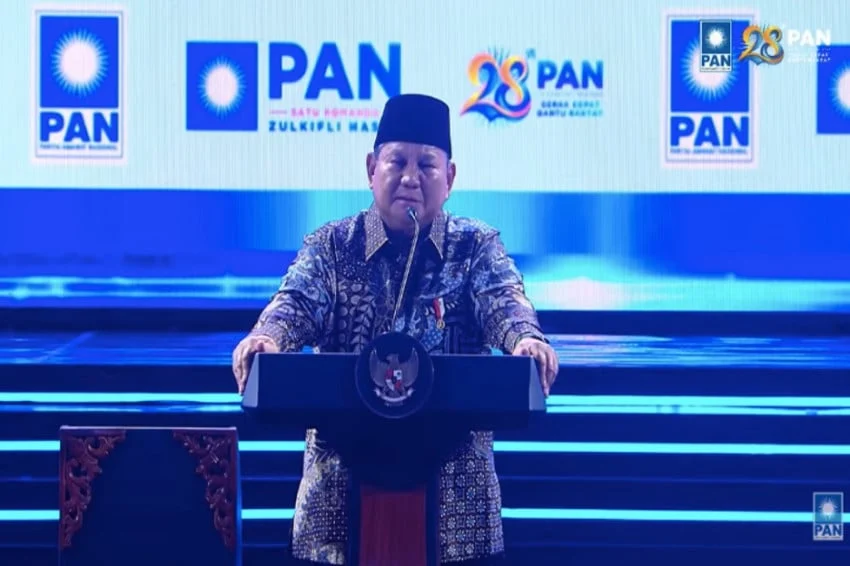
President Prabowo Subianto delivered a sharp critique against academic experts and commentators who frequently question government policies, arguing that certain criticisms have crossed the line into defamation and intellectual dishonesty. Speaking before thousands of cadres and officials at the 28th-anniversary celebration of the National Mandate Party (PAN) held at the Jakarta International Convention Center (JICC) in Jakarta, the Indonesian head of state addressed what he perceives as a pattern of politically and economically motivated attacks against his administration’s strategic initiatives.
The high-profile event, which brought together senior coalition leaders, lawmakers, and loyalists, served as a platform for the president to outline his broader political philosophy, defend his administration’s socio-economic roadmap, and issue a direct warning to critics whom he accused of prioritizing foreign interests over national welfare. By invoking religious scripture and emphasizing the core tenets of intellectual integrity, President Prabowo framed the ongoing policy debates not merely as routine democratic discourse, but as a critical battleground for Indonesia’s sovereignty and economic independence.
Context of the Address and Event Background
The 28th anniversary of the National Mandate Party (PAN) marked a significant milestone for one of Indonesia’s prominent political organizations, which has traditionally positioned itself as a modern, religious nationalist party. Founded in the wake of the 1998 Reformasi movement, PAN has maintained a consistent presence in Indonesia’s legislative landscape and currently holds a strategic position within the "Red and White Cabinet" coalition supporting the Prabowo-Gibran administration.
The gathering at the JICC was designed to project political solidarity and showcase the cohesion of the ruling coalition amid mounting global and domestic economic challenges. President Prabowo’s attendance underscored the strong alliance between the executive branch and PAN leadership. However, rather than limiting his remarks to standard anniversary felicitations and party praise, the president utilized the celebratory atmosphere to address mounting policy frictions between his administration and various academic institutions, think tanks, and independent policy analysts.
Over recent months, the government’s flagship programs—ranging from the nationwide free nutritious meal initiative for school children and pregnant women to large-scale infrastructure projects and downstreaming policies for natural resources—have faced rigorous scrutiny from economists, public health experts, and legal scholars. While supporters view these policies as transformative steps toward achieving the "Golden Indonesia 2045" vision, critics have repeatedly raised concerns regarding fiscal sustainability, budgetary allocations, administrative readiness, and long-term macroeconomic impacts. President Prabowo’s address at the JICC was widely interpreted by political analysts as a direct, unvarnished pushback against this growing chorus of academic dissent.
Escalation of Criticism into Defamation
In his keynote address, President Prabowo did not mince words regarding the tone and substance of the commentary directed at his administration. He asserted that constructive critique, which is essential for any functioning democracy, had in several instances degenerated into deliberate defamation and baseless allegations designed to undermine public trust in state institutions.
To articulate the gravity of these actions, the president drew upon religious teachings familiar to PAN’s core constituency, referencing Islamic scripture to underscore the moral weight of spreading falsehoods. Citing Surah Al-Baqarah, verse 191, which addresses severe transgressions and deception, the president remarked on the destructive nature of unwarranted attacks.
"PAN also has a religious base; if I am not mistaken, there is a teaching that defamation is more severe than murder, is that right? Surah Al-Baqarah verse 191, defamation is more severe than murder," President Prabowo stated during his speech. He elaborated that while certain intellectuals possess profound academic credentials, their expertise is occasionally weaponized to propagate misleading narratives.
Despite the sharp rebuke, the president adopted a measured stance regarding potential reconciliation, noting that his approach to political opposition remains pragmatic. "There are several experts, due to their profound expertise, who launch defamation, but let it be—we are a great nation, a strong nation. I simply take note; if they realize their mistakes, I forgive them," he added.
The Call for Intellectual Honesty and Allegations of Foreign Interests
A central theme of President Prabowo’s address was the ethical obligation of scholars, researchers, and public intellectuals. He emphasized that academic titles and advanced degrees carry a profound responsibility to truth, objectivity, and national interest. The president cautioned that true scholarship must remain untainted by personal ambition or external pressures.
"I remind you, if you have intelligence, if you have expertise, do not forget that a scholar must be honest—that is called intellectual honesty," Prabowo stressed.
Furthermore, the president raised serious concerns regarding the potential foreign influence infiltrating domestic policy debates. He cautioned intellectuals against serving foreign agendas or compromising national sovereignty for external validation or financial backing. The insinuation that certain domestic critics might be aligning with foreign interests introduces a complex geopolitical dimension to Indonesia’s internal policy discourse, reflecting growing sensitivity within the administration regarding international perceptions, foreign-funded think tanks, and global economic pressures on developing nations.
This rhetoric aligns with the broader "Asta Cita" agenda promoted by the Prabowo-Gibran administration, which places heavy emphasis on national self-sufficiency, food security, energy independence, and the protection of domestic industries from foreign exploitation. By framing academic dissent through the lens of national loyalty, the administration seeks to rally public sentiment around the defense of indigenous economic policies.
Reiteration of Pro-People Commitments and Historical Oath
Shifting focus from the friction with critics, President Prabowo reaffirmed his lifelong commitment to public service and the welfare of the Indonesian populace. He connected his current policy agenda directly to the personal oaths and sacrifices he undertook as a young military officer, framing his executive tenure as the culmination of decades dedicated to the nation.
"We want our people to be prosperous. Since I was young, I took an oath; at that time, I was ready to die for this country at 18 years old," Prabowo recalled, invoking his formative years in the Indonesian National Armed Forces (TNI).
The president articulated a vision of an equitable society where systemic poverty is eradicated, and basic human needs are comprehensively met. He underscored his determination to eliminate extreme poverty, ensure food security for every citizen, and alleviate the anxieties faced by ordinary families regarding essential services such as healthcare and education.
"I want to defend my nation, to see Indonesia respected one day, the Indonesian people prosperous, no hungry people in Indonesia, no fathers and mothers confused when their children fall sick," he declared to applause from the audience.
This emotive appeal served to anchor his administration’s controversial spending priorities—such as the massive fiscal allocations required for social safety net programs—within a moral imperative of poverty alleviation and human capital development.
Broader Political and Economic Implications
President Prabowo’s remarks at the PAN anniversary event carry significant implications for the broader political landscape and the state of democracy in Indonesia.
From a governance perspective, the direct confrontation between the chief executive and the academic community highlights an ongoing tension regarding the role of independent oversight. While civil society organizations, universities, and policy institutes view rigorous critique as a cornerstone of democratic accountability, executive leadership increasingly perceives such opposition as an impediment to rapid policy execution. Indonesia faces formidable economic hurdles, including global inflation, supply chain vulnerabilities, and the ongoing necessity to spur post-pandemic growth. In this high-stakes environment, the administration appears eager to minimize administrative gridlock and bureaucratic friction.
Economically, the administration’s aggressive defense of its policies signals that despite external warnings from fiscal conservatives and international financial institutions regarding debt levels and budget deficits, the government remains firmly committed to its populist and nationalist economic agenda. Programs like the free nutritious meals initiative and downstreaming mineral exports will continue to move forward unabated, backed by a strong legislative majority in the House of Representatives (DPR).
Politically, the alignment between President Prabowo and political parties like PAN reinforces the consolidation of power within the executive coalition. By using party platforms to address national debates, the president solidifies his base while signaling that policy dissent will be met with robust ideological and political counter-arguments from the highest levels of state.
As Indonesia navigates its complex socio-economic transition, the relationship between the state and its intellectual critics will remain a vital barometer of the nation’s political health. Whether this sharp exchange leads to a more consultative policy-making process or further polarization between technocrats, academics, and the executive branch will depend heavily on the administration’s willingness to engage constructively with empirical data, while balancing its ambitious nationalist vision with fiscal and administrative prudence.