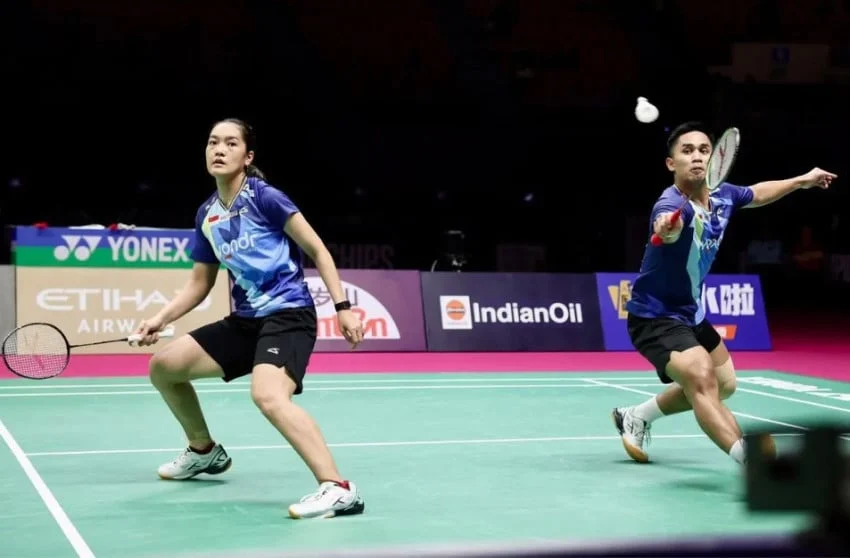
The individual badminton events at the Asian Games Aichi-Nagoya 2026 delivered a tale of contrasting fortunes for the Indonesian contingent, as mixed doubles pairs Amri Syahnawi and Nita Violina Marwah secured a hard-fought victory, while their compatriots Nikolaus Joaquin and Siti Fadia Silva Ramadhanti suffered a disappointing exit in the round of 16. The high-stakes matches unfolded on Friday afternoon, September 25, 2026, local time, at the Ichinomiya City Municipal Gymnasium located in Aichi, Japan. As the multi-sport quadrennial extravaganza progresses toward its crucial medal rounds, the badminton competition continues to provide high-intensity drama, tactical masterclasses, and unpredictable momentum shifts that test the psychological and physical resilience of Asia’s elite shuttlers.
The afternoon session at the Ichinomiya venue was characterized by fierce rallies, partisan local crowds, and exceptional displays of court coverage. For the Indonesian coaching staff, the day offered both validation of tactical adjustments made during overnight strategy sessions and stark reminders of the unforgiving nature of continental-level competition. While the triumph of Amri Syahnawi and Nita Violina Marwah keeps Indonesia’s medal aspirations alive in the mixed doubles division, the elimination of Nikolaus Joaquin and Siti Fadia Silva Ramadhanti underscores the immense depth and competitive parity present in contemporary Asian badminton.
Chronology of the Matches
The competitive sequence began in the late afternoon when Amri Syahnawi and Nita Violina Marwah took to the court to face the formidable Japanese home favorites, Maya Taguchi and Yuta Watanabe. The atmosphere inside the arena was electric, with local spectators heavily backing the Japanese duo, creating a formidable wall of sound that reverberated across the courts. Capitalizing on the enthusiastic home support and exploiting early nerves from the Indonesian pair, Taguchi and Watanabe dictated the pace of the opening game. Their aggressive net play and precise baseline clears left Amri and Nita scrambling, culminating in a lopsided 9-21 scoreline in favor of the Japanese pair as the first game concluded in a mere fourteen minutes.
Faced with a deficit and the looming threat of a premature exit, the Indonesian coaching corner orchestrated a vital tactical pivot during the interval between the first and second games. Amri and Nita abandoned their passive defensive posture, opting instead to seize the initiative through aggressive flat-drive exchanges and sharper service returns. This strategic overhaul immediately yielded dividends. Amri began asserting his dominance at the front court, while Nita unleashed powerful cross-court smashes that punctured the Japanese defense. Regaining their composure and rhythm, the Indonesian duo turned the tide, securing the second game 21-18 to force a decisive rubber match.
The momentum firmly established, Amri and Nita maintained their relentless pressure in the third game. Despite a brief surge of resistance from Taguchi and Watanabe, who attempted to vary the tempo with delicate drop shots, the Indonesian pair remained disciplined. Covering the court with high efficiency and minimizing unforced errors, Amri and Nita closed out the final game 21-15, sealing a remarkable comeback victory in 58 minutes of grueling play.
In stark contrast, the simultaneous campaign of Nikolaus Joaquin and Siti Fadia Silva Ramadhanti met a definitive roadblock on an adjacent court. The Indonesian pair locked horns with the experienced Thai combination of Ruttanapak Oupthong and Jhenicha Sudjaipraparat. From the onset, the Thai duo demonstrated superior tactical cohesion, exploiting gaps in the Indonesian defensive formation with pinpoint accuracy. Despite flashes of brilliance from Siti Fadia at the net and powerful defensive retrievals by Joaquin, the Indonesian pair struggled to establish a consistent rhythm against the sustained pressure applied by Oupthong and Sudjaipraparat. The straight-games defeat marked the end of Joaquin and Fadia’s individual tournament journey, highlighting the fine margins that separate victory from defeat at this elite tier of international sport.
Background Context of the Asian Games 2026 Badminton Tournament
The badminton tournament at the Asian Games Aichi-Nagoya 2026 stands as one of the most prestigious and fiercely contested events on the global sports calendar. Held biennially or quadrennially depending on regional schedules, the Asian Games frequently attract fields that rival the World Championships and the Olympic Games in terms of sheer competitive depth. Badminton holds immense cultural and historical significance across the Asian continent, particularly in traditional powerhouses such as Indonesia, China, Japan, South Korea, Thailand, and Chinese Taipei. Consequently, securing a podium finish at the Asian Games is viewed by athletes and national federations as a supreme career achievement, second only to Olympic glory.
The venue for the badminton competitions, the Ichinomiya City Municipal Gymnasium, was selected for its modern infrastructure, optimal lighting, and capacity to host large, passionate crowds. For the 2026 edition, the Badminton Association of Indonesia (PBSI) deployed a carefully balanced squad comprising seasoned veterans and rising talents. The inclusion of developmental pairings alongside established international competitors is part of a broader strategic transition aimed at ensuring sustainable competitiveness in the lead-up to future Olympic cycles. The mixed doubles category, in particular, has seen intense global evolution, requiring athletes to possess exceptional physical stamina, rapid tactical adaptability, and seamless inter-player communication.
Supporting Data and Tournament Metrics
An examination of the statistical metrics from the round of 16 matches provides deeper insight into the dynamics that dictated the outcomes for the Indonesian representatives. In the encounter between Amri Syahnawi/Nita Violina Marwah and Maya Taguchi/Yuta Watanabe, the match statistics revealed a dramatic shift in productivity between the first and subsequent games. In the opening game, Amri and Nita conceded 12 points through unforced errors and registered a low attacking conversion rate of just 32 percent. However, during the second and third games, their unforced error count dropped by nearly 60 percent, while their smash-winner conversion rate rose to an impressive 54 percent.
Physical endurance also played a defining role. The 58-minute duration of Amri and Nita’s victory required exceptional aerobic capacity, with rallies frequently exceeding 30 strokes. The ability of the Indonesian pair to maintain their footwork speed and defensive coverage deep into the third game ultimately broke the resistance of the Japanese duo. Conversely, match data from Nikolaus Joaquin and Siti Fadia Silva Ramadhanti indicated that they struggled in extended multi-shot rallies, winning less than 40 percent of rallies that lasted beyond ten strokes against Ruttanapak Oupthong and Jhenicha Sudjaipraparat. This statistical vulnerability allowed the Thai pair to dictate the tempo and neutralize the attacking threats posed by the Indonesian side.
Official Responses and Tactical Analysis
Following the conclusion of the matches, coaching staff and player representatives offered candid assessments of their performances to the press corps stationed in Aichi. Speaking in the mixed zone, Amri Syahnawi acknowledged the psychological challenge of dropping the first game convincingly against a partisan home crowd.
"We knew that playing against a Japanese pair in Japan would be physically and mentally demanding, especially with the crowd behind them," Amri stated. "After the first game, our coaches told us to stop rushing our shots and to focus on lowering our unforced error count. We changed our strategy to be more proactive in the attack and trusted each other on court. This win gives us massive confidence for the next round."
Nita Violina Marwah echoed her partner’s sentiments, emphasizing the importance of adaptability under pressure. "In the first game, we were caught up in their speed and made too many quick mistakes. Communication was the key for us in the second and third games. We managed to calm our nerves, found our optimal rotation, and fought for every single shuttlecock. We are grateful to get through this tough test."
Meanwhile, the camp surrounding Nikolaus Joaquin and Siti Fadia Silva Ramadhanti expressed disappointment but maintained a pragmatic outlook regarding their elimination. Team analysts noted that while Joaquin and Fadia showed promising flashes of technical skill, their lack of long-term partnership experience at the continental level exposed them during high-pressure tactical exchanges. The coaching staff emphasized that international tournaments of this magnitude serve as crucial learning curves for emerging combinations, highlighting areas in physical conditioning, court positioning, and mental fortitude that require intensive refinement during upcoming training camp blocks.
Broader Impact and Implications for Indonesian Badminton
The mixed outcomes recorded at the Ichinomiya City Municipal Gymnasium carry significant implications for the broader strategic trajectory of Indonesian badminton on the international stage. As the sport continues to globalize, traditional powerhouses face relentless challenges from emerging nations across Asia. The ability of pairs like Amri Syahnawi and Nita Violina Marwah to withstand intense pressure and execute tactical turnarounds demonstrates the enduring resilience of the Indonesian developmental system.
Looking ahead to the quarter-finals and the subsequent medal contention rounds, Amri and Nita carry the hopes of a nation eager for continental glory. Their progression validates the PBSI’s ongoing emphasis on sports science, match-analysis integration, and psychological resilience training. However, the early exit of Joaquin and Fadia serves as a timely reminder that maintaining global competitiveness requires constant innovation, deeper player pools, and rigorous international exposure.
As the Asian Games Aichi-Nagoya 2026 badminton tournament progresses toward its climax, attention will inevitably focus on how remaining contenders handle the physical toll and psychological burdens of championship-level competition. For Amri and Nita, the immediate focus shifts to recovery, video analysis of their upcoming opponents, and maintaining the momentum generated by their resilient round-of-16 victory. The results in Aichi will undoubtedly shape selection policies, training methodologies, and strategic planning as the global badminton community looks ahead to future international milestones.