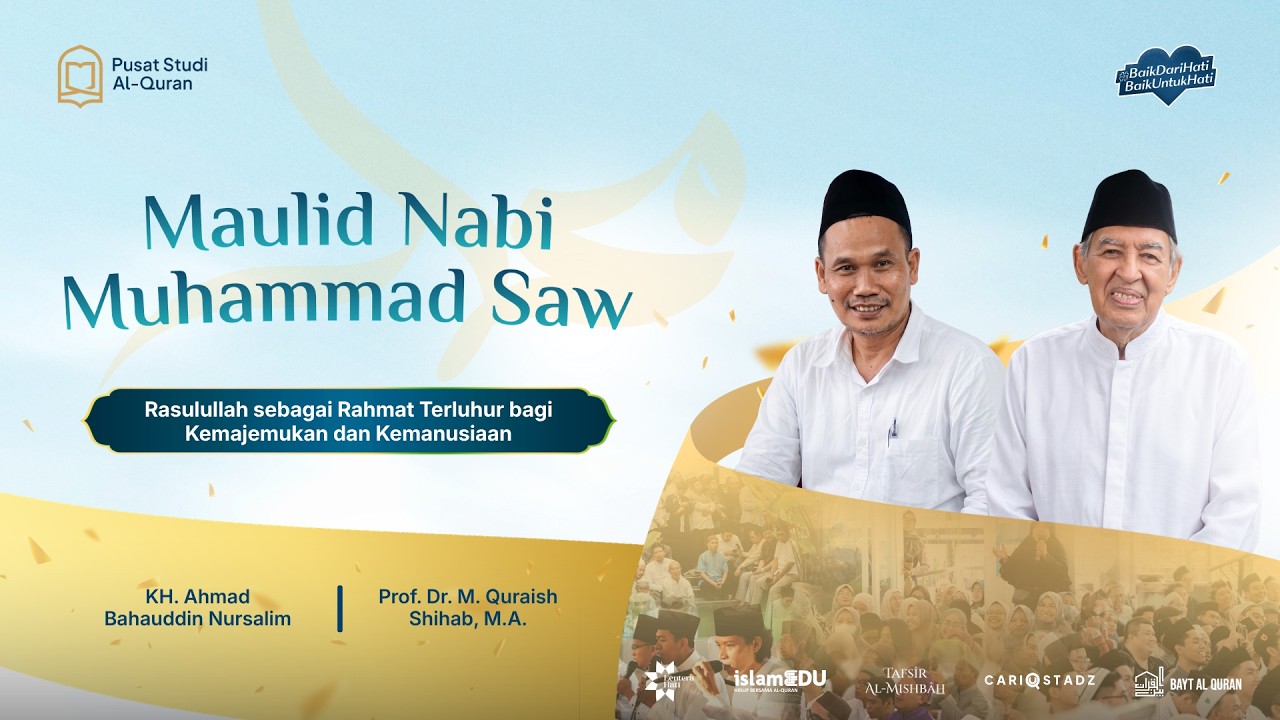
During the commemoration of the Prophet’s Birthday (Maulid Nabi) in 2026, held at the Pusat Studi Al-Qur’an, renowned scholar KH Ahmad Bahauddin Nursalim, affectionately known as Gus Baha, alongside Prof. M. Quraish Shihab, delivered a profound discourse on the nature of Prophet Muhammad SAW. The event served as a critical intellectual forum, aiming to shift the common perception of the Prophet from an abstract, untouchable figure to a tangible model of human excellence. By emphasizing the Prophet’s role as basyar (a human being), the scholars sought to reconcile the divine revelation received by the Prophet with the lived realities of daily human experience.
Context and Intellectual Framework
The event, organized by the Pusat Studi Al-Qur’an (PSQ), is part of an ongoing initiative to contextualize classical Islamic teachings within modern societal challenges. Prof. M. Quraish Shihab, a prominent Quranic exegete, has long advocated for an interpretation of the Prophet’s life that avoids hagiographic extremes, favoring instead a grounded historical and theological approach.
The core of the discussion centered on Surah Al-Kahf, verse 110, where the Quran explicitly states: "Say, ‘I am only a man like you, to whom has been revealed that your god is one God.’" This foundational text serves as the primary evidence for the Prophet’s humanity. Gus Baha noted that by acknowledging the Prophet’s human limitations, believers can find a more accessible and realistic framework for their own spiritual development.
The Prophet’s Daily Life as a Pedagogical Tool
Gus Baha highlighted that the Quran frequently mentions the mundane activities of the prophets—eating, walking in the marketplace, and interacting with the community—to underscore that divine guidance does not necessitate the abandonment of human nature. This historical reality provides a template for Muslims to navigate the complexities of contemporary life.
The lecture pointed to specific incidents, such as the Prophet experiencing moments of forgetfulness during prayer (sahw). Rather than viewing this as a flaw, Gus Baha analyzed it as a vital teaching moment. It provides legal and spiritual precedents for how believers should handle their own mistakes. When the Prophet forgot, he corrected the act, demonstrating that Islam is a religion that accounts for human fallibility and provides clear mechanisms for rectification and growth.
Chronology of Theological Discourse
Historically, the discourse on the nature of the Prophet has evolved through various schools of thought. In the early centuries of Islam, debates often focused on the duality of the Prophet’s nature—his physical humanity versus his spiritual status as the recipient of divine revelation.
- Early Period: Scholars focused on defining the limits of prophetic infallibility (ismah).
- Classical Period: The synthesis of legal, social, and spiritual aspects of the Prophet’s life led to the development of Shama’il literature, which catalogs the physical appearance and character of the Prophet.
- Modern Era: The 20th and 21st-century discourse, represented by figures like Quraish Shihab and Gus Baha, emphasizes the "humanization" of the Prophet’s model to combat extremism and elitism in religious practice.
By grounding the Prophet’s life in the mundane, the scholars are effectively countering the tendency to place religious figures on an unreachable pedestal, which often leads to passivity among followers who feel they cannot emulate such "perfect" beings.
Socio-Economic Implications of the Teachings
The implications of this perspective are significant. By validating the "human" aspects of the Prophet—such as dealing with marital disagreements, managing economic exchanges in the market, and handling public criticism—the message encourages believers to find value in their own daily struggles.
Gus Baha’s analysis suggests that the modern Muslim’s crisis of identity often stems from a distorted view of religious perfection. If a believer thinks they must be devoid of error to be "pious," they will inevitably succumb to despair or hypocrisy. By contrast, embracing one’s humanity, as the Prophet did, allows for a more sustainable and honest spiritual life.
Furthermore, the discussion touched upon the concept of tawakkul (reliance on God). The use of the phrase "Hasbunallahu wa ni’mal-wakil" (Allah is sufficient for us, and He is the best Disposer of affairs) is not a call for passivity or an excuse to ignore the realities of a situation. Rather, it is a psychological and spiritual strategy to maintain resilience in the face of adversity. The Quranic narrative cited during the event illustrates that when the Prophet and his companions were faced with threats, their faith did not lead them to retreat from the world but to confront it with greater trust in the Divine.
Comparative Analysis of Prophetic Modeling
Data from sociological studies on religious communities indicate that individuals who view their religious leaders as "relatable human beings" tend to show higher levels of psychological well-being and social engagement. In contrast, communities that treat leaders as supernatural entities often struggle with authoritarianism and lack of critical thinking.
The approach taken by Gus Baha and Prof. Quraish Shihab aligns with this sociological trend. By focusing on the Prophet as a man who walked through markets and felt human emotions, they are fostering a form of religious practice that is:
- Pragmatic: Focused on solving real-world problems.
- Humble: Acknowledging the dignity of every human being, as confirmed by the Quranic verse, "And We have certainly honored the children of Adam" (QS. Al-Isra: 70).
- Integrative: Combining deep theological reflection with the practical demands of modern existence.
Addressing the Need for Spiritual Confidence
A recurring theme in the discussion was the danger of self-deprecation. While humility (tawadhu) is a virtue, it should not be confused with a lack of self-worth. The speakers warned that a misunderstanding of humility often leads people to feel worthless or insignificant. However, the Quranic affirmation of human dignity suggests that every person carries inherent value from the Creator.

The synthesis of these ideas leads to a conclusion that is both empowering and sobering: the ultimate goal of following the Prophet is not to mimic his actions in a robotic sense, but to emulate his state of heart—a state that is fully conscious of human reality while remaining firmly anchored in a relationship with the Divine.
Broader Impact and Public Response
The response from the attendees at the Pusat Studi Al-Qur’an reflected a growing appetite for this brand of moderate, thoughtful, and accessible religious scholarship. In an era often dominated by rigid, binary interpretations of faith, the call to "remain human" while striving for holiness provides a much-needed bridge between the sacred and the secular.
Experts in religious studies observe that this type of discourse is crucial for the stability of pluralistic societies. When Muslims are taught to view their Prophet as a human who navigated the complexities of community, social conflict, and personal relationships, they are more likely to approach their own neighbors—regardless of background—with the same patience and grace the Prophet exemplified.
Conclusion: The Path Forward
The 2026 Maulid Nabi lecture serves as a milestone in contemporary Indonesian Islamic discourse. By moving away from abstract glorification and toward a practical, human-centric model of the Prophet, Gus Baha and Prof. Quraish Shihab have provided a roadmap for modern believers.
The message remains clear: the life of the Prophet is not a museum piece to be gazed at from afar; it is a living manual for the human experience. Through the lens of the Prophet’s humanity, Muslims are encouraged to accept their own limitations as part of the human condition, while simultaneously using their faith to navigate life’s challenges with integrity, patience, and a steadfast reliance on the Divine. This approach ensures that the legacy of the Prophet Muhammad remains vibrant, relevant, and deeply transformative for generations to come.