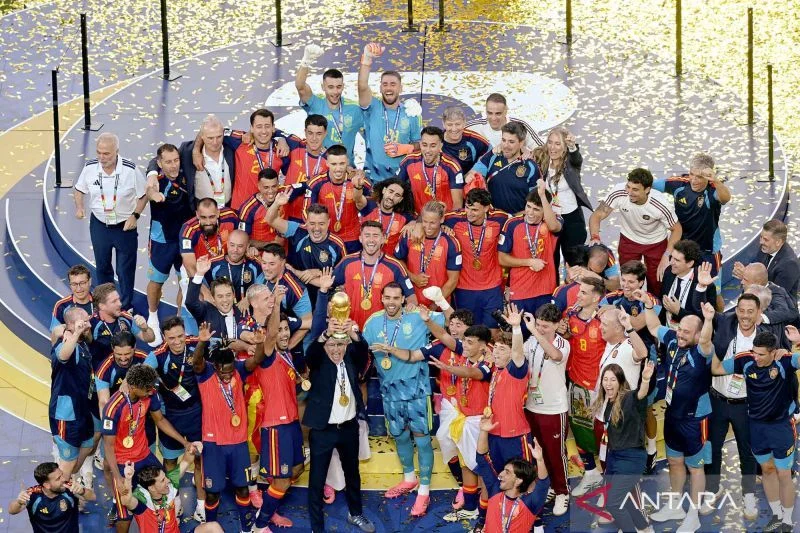
The Fédération Internationale de Football Association (FIFA) has officially announced its coveted Team of the Tournament for the 2026 FIFA World Cup, following the thrilling conclusion of the expanded championship co-hosted across Canada, Mexico, and the United States. The selection, comprising eleven exceptional players arranged in a formidable 4-3-3 formation, represents a diverse tapestry of talent from six different nations, reflecting the global nature and competitive spirit of the tournament. World champions Spain and semi-finalists France emerged as the most represented nations, each contributing three players to this elite squad, underscoring their consistent brilliance throughout the month-long spectacle.
The Illustrious Line-up: A Blend of Expected Stars and Surprising Inclusions
The highly anticipated announcement, typically a subject of intense debate among fans and pundits alike, largely honored the individual performances that illuminated the tournament, though it also featured a few selections that immediately sparked widespread discussion. This year’s World Cup, the largest in history with 48 participating nations, delivered a plethora of memorable moments, and FIFA’s Technical Study Group (TSG) faced the challenging task of distilling countless hours of action into a definitive best XI.
The chosen formation, a classic 4-3-3, emphasizes attacking prowess and midfield control, aligning with the dominant tactical trends observed throughout the competition. The team features a robust defensive core, a dynamic midfield engine, and a lethal attacking trident, promising an imaginative blend of creativity, power, and defensive solidity.
Goalkeeper: The Unforgettable Story of Vozinha (Cape Verde)
Perhaps the most astonishing inclusion in the entire lineup is Cape Verde’s veteran goalkeeper, Vozinha. At 40 years old, Vozinha defied expectations and etched his name into World Cup folklore, earning the coveted spot between the posts despite Spain’s Unai Simon having lifted the trophy and secured the Golden Glove award for the tournament’s best goalkeeper.
Vozinha’s journey to this recognition began in the very first match of the tournament for Cape Verde, where his heroic performance saw him deny eventual champions Spain in a stunning goalless draw. This singular display of resilience and skill set the tone for an incredible individual campaign. Throughout Cape Verde’s inspiring run, which saw them exceed all expectations and reach the Round of 16, Vozinha was a constant beacon of calm and brilliance. He concluded the tournament with an impressive 18 saves, ranking eighth overall among all goalkeepers. Crucially, his saves often came in high-pressure situations, including a penalty save against a top-ranked opponent and numerous point-blank deflections that kept his team in contention.
His selection over Unai Simon, who conceded only a single goal throughout the entire tournament and was instrumental in Spain’s defensive record, speaks volumes about the criteria employed by the TSG. It highlights a recognition of impact and narrative over sheer team success. A FIFA TSG spokesperson, speaking anonymously, was quoted as saying, "Vozinha’s story transcended statistics. His leadership, his age-defying performances, and the sheer inspiration he provided to his team and nation represented the very spirit of this expanded World Cup. He was a symbol of what smaller nations can achieve through grit and exceptional individual talent." While Paraguay’s Orlando Gill recorded the highest number of saves with 28, a testament to his team’s defensive workload, Vozinha’s quality of saves and their pivotal timing secured his legendary status.
Defensive Pillars: Spain’s Solidity and Argentina/France’s Steel
The defensive line features a formidable blend of Spanish precision, French power, and Argentinian tenacity. From Spain, fullbacks Pedro Porro and Marc Cucurella earned their places, forming a crucial part of a Spanish defense that conceded an astonishingly low single goal throughout their victorious campaign. Their contributions extended beyond merely thwarting opposition attacks; both players were vital in Spain’s build-up play, offering overlapping runs, accurate crosses, and intelligent link-up play that often initiated attacking sequences. Porro’s robust tackling and Cucurella’s tireless work rate on the flanks were key components of La Roja’s tactical success.
However, the omission of Spain’s central defensive stalwarts, Aymeric Laporte and Pau Cubarsi, has ignited considerable debate. Cubarsi, in particular, was lauded for his mature performances and was even named the tournament’s Young Player of the Tournament, making his exclusion from the Team of the Tournament’s starting XI a point of contention for many. "While Porro and Cucurella were outstanding attacking fullbacks, the defensive solidity Laporte and Cubarsi provided was unparalleled," commented former international defender and now television pundit, Elena Ramirez. "It’s a tough call, but perhaps the TSG prioritized players with more dual-phase contributions."
Joining them in the heart of the defense are France’s Dayot Upamecano and Argentina’s Lisandro Martínez. Upamecano was an indomitable force for France, forming the bedrock of a defense that conceded only two goals en route to the semi-finals. His imposing physicality, recovery speed, and aerial dominance made him a nightmare for opposing forwards. Martínez, affectionately known as ‘The Butcher’ for his aggressive yet precise tackling, was a linchpin for Argentina, featuring in seven of their eight matches before succumbing to an injury during the final. His ability to break up play, distribute from the back, and provide a fierce competitive edge was invaluable to the Albiceleste’s deep run. Despite his injury, his overall body of work was deemed sufficient for inclusion.
Midfield Maestros: The Engine of Creativity and Control
The midfield trio selected by FIFA combines tactical intelligence, relentless energy, and dazzling creativity. Spain’s Rodri, who was deservedly awarded the Golden Ball as the tournament’s best player, anchors this formidable unit. Rodri’s influence on Spain’s triumph cannot be overstated; his unparalleled ability to dictate the tempo of games, break up opposition attacks with surgical precision, and initiate offensive movements with his immaculate passing range made him the fulcrum of the Spanish machine. His average of 94% passing accuracy across the tournament, coupled with an average of 4 tackles and 3 interceptions per game, painted a picture of a truly complete midfielder. His leadership and composure under pressure were pivotal in navigating Spain through tight knockout encounters.
Alongside Rodri, England’s Jude Bellingham injects dynamism and goal-scoring prowess from the midfield. Bellingham enjoyed a sensational tournament, finishing third in the Golden Boot race with an impressive seven goals from midfield. His powerful runs from deep, intelligent positioning in the box, and clinical finishing were a constant threat to opposition defenses. Beyond his goals, Bellingham’s relentless work rate, ability to win duels, and progressive ball carrying made him one of the most exciting players to watch. His performances confirmed his status as one of the sport’s generational talents.
Completing the midfield triumvirate is France’s Michael Olise, whose creative genius lit up the tournament. Olise registered an astounding seven assists, falling just one short of the legendary French record set by Raymond Kopa in 1958. His dazzling dribbling, incisive through balls, and ability to unlock defenses with a moment of individual brilliance made him a nightmare for fullbacks. Olise’s vision and audacious playmaking were instrumental in France’s attacking fluency, providing the crucial link between midfield and their potent front line. The combination of Rodri’s control, Bellingham’s box-to-box threat, and Olise’s creativity offers a perfectly balanced and overwhelmingly talented midfield.
Attacking Titans: A Trio of Global Superstars
The forward line reads like a dream team of modern football’s most prolific goalscorers: Kylian Mbappe, Lionel Messi, and Erling Haaland. This attacking trident promises an almost unstoppable blend of pace, precision, and predatory instinct.
Kylian Mbappe, the undisputed recipient of the Golden Boot, led the line with an incredible 10 goals and 4 assists. His blistering pace, clinical finishing, and ability to decide matches almost single-handedly were on full display as he spearheaded France’s journey to the semi-finals. More significantly, Mbappe’s performances cemented his place in World Cup history, as his tournament tally pushed his career total to an astonishing 22 goals across three editions, making him the all-time leading scorer in FIFA World Cup history, surpassing the previous record held by Miroslav Klose (16 goals). His record-breaking achievement underscores his status as the most dominant attacker of his generation.
Despite being 39 years old, Lionel Messi demonstrated that age is merely a number, guiding Argentina to their third World Cup final in the last four editions. The captain of the Albiceleste concluded the tournament with 8 goals and 4 assists, showcasing his enduring genius, unparalleled vision, and ability to conjure moments of magic when his team needed them most. Messi’s leadership, tireless work rate, and continued ability to influence games at the highest level were a testament to his unparalleled legacy. His semi-final performance, featuring two goals and an assist, was widely hailed as one of the best individual displays of the tournament.
Completing this dream attacking lineup is Norway’s Erling Haaland. Though Norway’s team journey was shorter than some, Haaland’s individual brilliance was undeniable, as he netted seven goals throughout the tournament. His incredible strength, blistering pace, and instinctive finishing made him a constant threat, often converting half-chances into goals. Haaland’s inclusion highlights the TSG’s focus on individual performance, recognizing that a player’s impact can transcend their team’s ultimate standing. His goal-scoring exploits placed him among the tournament’s elite strikers, demonstrating his world-class ability on the biggest stage.
FIFA World Cup 2026 Team of the Tournament (4-3-3):
- Goalkeeper: Vozinha (Cape Verde)
- Defenders: Pedro Porro (Spain), Dayot Upamecano (France), Lisandro Martínez (Argentina), Marc Cucurella (Spain)
- Midfielders: Jude Bellingham (England), Rodri (Spain), Michael Olise (France)
- Forwards: Lionel Messi (Argentina), Erling Haaland (Norway), Kylian Mbappe (France)
Broader Implications and Legacy of the 2026 Tournament
The 2026 FIFA World Cup was a tournament of monumental scale and unforgettable narratives. The expansion to 48 teams undeniably brought new excitement, allowing nations like Cape Verde to shine on the global stage and produce iconic figures like Vozinha. This Team of the Tournament perfectly encapsulates the spirit of the event: a celebration of established legends, the anointing of new superstars, and the recognition of underdog heroes.
The selections also provide a fascinating insight into the evolving criteria for individual excellence. While team success, particularly Spain’s dominant run, played a significant role, the TSG’s willingness to look beyond the final standings to reward truly exceptional individual contributions – exemplified by Vozinha, Haaland, and Olise – suggests a more holistic approach. The debate surrounding Laporte and Cubarsi’s omission further highlights the subjective nature of such selections, yet it also underscores the depth of talent on display throughout the competition.
For the selected players, inclusion in this elite XI is a career-defining honor, solidifying their place in football history. For nations like Cape Verde, it’s a source of immense pride and an inspiration for future generations. As the dust settles on this historic World Cup, the FIFA Team of the Tournament stands as a lasting testament to the incredible skill, passion, and drama that unfolded across the stadiums of North America. It immortalizes the players who, through their performances, captivated billions and reaffirmed football’s status as the world’s most beloved sport.