The Ministry of Primary and Secondary Education (Kemendikdasmen) has officially released the operational guidelines for the 2026 Academic Competency Test, known locally as Tes Kemampuan Akademik (TKA), marking a significant milestone in the evolution of Indonesia’s national assessment landscape. Scheduled to take place between October and November 2026, the TKA serves as a critical instrument for validating high school academic records and providing a standardized benchmark for university admissions. This assessment is designed to address the long-standing discrepancies in school-based grading systems and ensure a level playing field for students across the archipelago.
The Strategic Shift in National Assessment
The introduction of the TKA is a response to the vacuum left by the abolition of the National Examination (Ujian Nasional) several years ago. While the National Assessment (Asesmen Nasional) focuses on school-level quality and literacy-numeracy environments, the TKA is specifically tailored to individual student achievement. Education experts have noted that since the removal of the UN, there has been a perceived decline in student motivation and a lack of standardized data to verify the integrity of school report cards.

The Kemendikdasmen’s decision to implement the TKA stems from the need for a "validator." In the current educational climate, grading standards vary significantly between institutions. Some schools may practice "grade inflation" to improve their institutional profile, while others maintain rigorous standards that may inadvertently disadvantage their students during national university selections. By providing an objective, computer-based assessment, the TKA offers a scientific data point that can be used by universities to weigh the "real" value of a student’s GPA. Furthermore, the results are intended to assist the workforce in identifying candidates with specific academic proficiencies.
Comprehensive Chronology and Schedule of Implementation
The rollout of the 2026 TKA is structured into several phases to ensure technical readiness and student familiarity with the new testing format. The ministry has outlined a timeline that begins mid-year to allow schools sufficient time for administrative preparation.
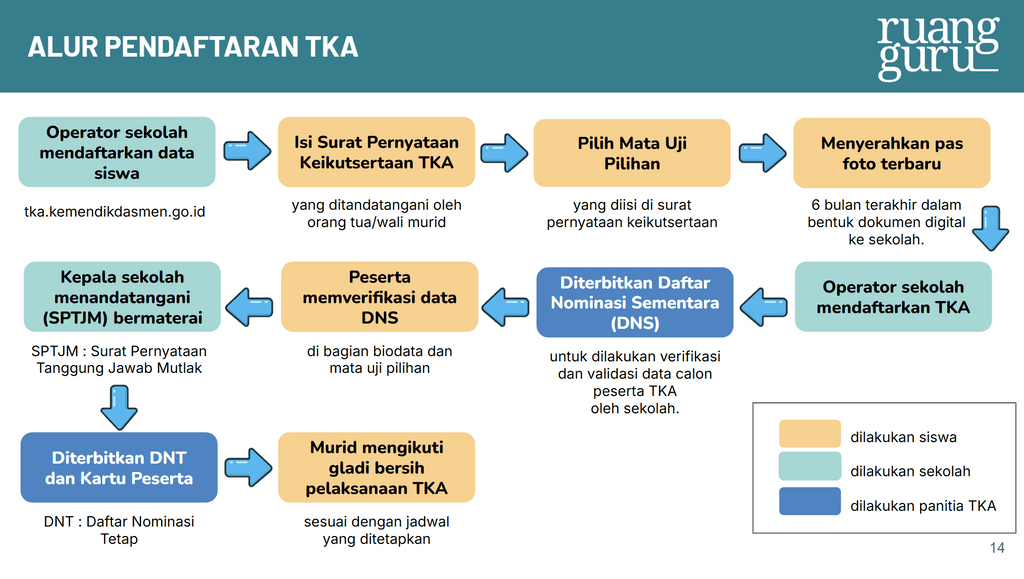
- Registration Phase (Starts July 27, 2026): Schools are required to begin the data synchronization process through the official portal. This involves verifying student eligibility and ensuring that all participants are correctly registered in the national education database (Dapodik).
- Simulation Phase (September 2024): A preliminary simulation will be conducted to introduce students to the user interface of the testing software and the types of reasoning-based questions they will encounter.
- Gladi Bersih (Technical Rehearsal) (Early October 2026): This phase is a full-scale trial of the testing infrastructure, including server stability, power backup systems, and proctoring protocols.
- Main Examination Period (Late October to November 2026): The TKA will be administered in multiple sessions to accommodate the millions of students in the SMA (Senior High School), MA (Islamic Senior High School), and SMK (Vocational High School) streams.
- Announcement of Results: The re-tabulation and scoring process will follow immediately, with certificates expected to be issued by early 2027, just in time for the university admission cycle.
Eligibility and Participant Scope
The 2026 TKA is not mandatory for all students but is highly recommended for those seeking to leverage their academic performance for higher education or professional placement. According to the latest Kemendikdasmen guidelines, the following categories of students are eligible:
- Students currently in the final year (Grade 12) of SMA, MA, SMK, or equivalent institutions during the 2025/2026 academic year.
- Students enrolled in "Paket C" (equivalency programs) who are in their final stage of study.
- Graduates from the previous two academic years (gap-year students) who wish to update their academic competency scores for university re-applications.
- Students from international schools or overseas Indonesian schools (SILN) who require a national competency equivalency.
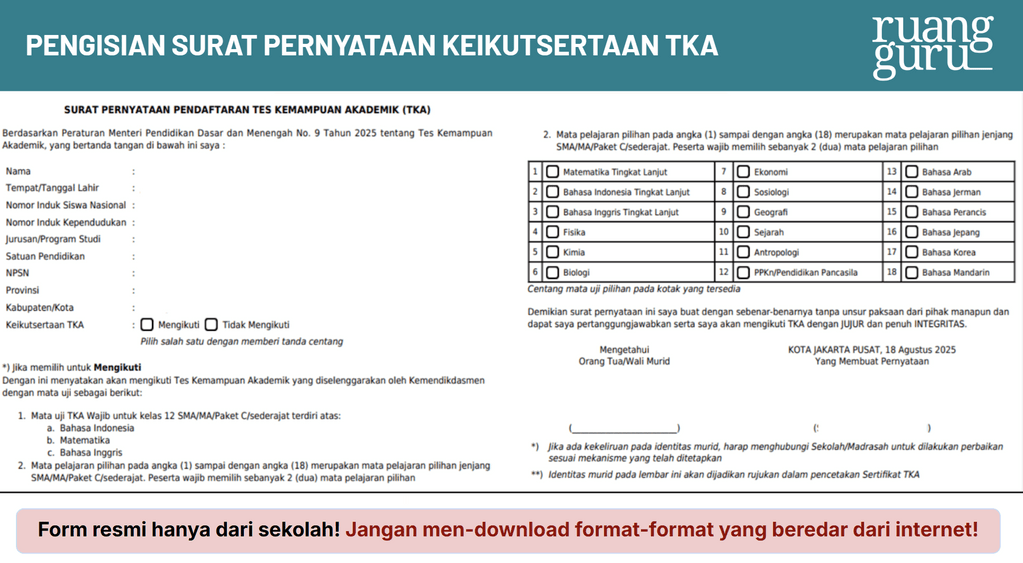
To participate, students must sign an Integrity Pact (Surat Pernyataan), committing to honesty and acknowledging the consequences of any fraudulent activity during the examination.
Examination Structure: Compulsory and Elective Subjects
The TKA is divided into two distinct categories to balance core competencies with specialized interests. The examination is conducted over two days to prevent student fatigue and ensure high-quality cognitive output.
Day 1: Compulsory Subjects
All participants, regardless of their major or stream, must sit for the Compulsory Subjects. This session lasts for 150 minutes and covers:
- Mathematics: Focused on quantitative reasoning, logic, and the application of mathematical concepts in real-world scenarios.
- Indonesian Language: Emphasizing critical reading, text analysis, and formal communication skills.
- English Language: Assessing reading comprehension and the ability to process information in a global language context.
Day 2: Elective Subjects
On the second day, students choose two subjects that align with their future career paths or university majors. This session lasts for 130 minutes. The options include:
- Science Stream (IPA): Physics, Chemistry, and Biology.
- Social Science Stream (IPS): Economics, History, Sociology, and Geography.
- Vocational Stream (SMK): Specific competency-based subjects or cross-disciplinary electives like Advanced Mathematics or Applied Sciences.
Advanced Question Design and Testing Methodology
The 2026 TKA moves away from rote memorization. The Kemendikdasmen has aligned the test items with High-Order Thinking Skills (HOTS). The questions are designed to measure how well a student can synthesize information, evaluate arguments, and solve complex problems.
The format of the questions includes:
- Objective Multiple Choice: Standard single-answer questions.
- Complex Multiple Choice: Questions where students may need to select more than one correct statement or match items from two columns.
- Short Answer/Numeric Input: Requiring students to calculate or derive a specific value or term without the aid of predetermined options.
Crucially, the ministry has stated that there is no fundamental difference in the difficulty level between students following the Kurikulum Merdeka (Freedom to Learn Curriculum) and the 2013 Curriculum (K13). The TKA focuses on "essential competencies" that are universal across both frameworks.
Technical Execution and Integrity Protocols
To maintain the sanctity of the results, the TKA utilizes a Computer-Based Test (CBT) system. Schools are designated as "Testing Centers" based on their IT infrastructure. Schools that lack sufficient hardware are required to "cluster" with nearby institutions that possess the necessary facilities.
Strict proctoring rules are in place:
- Verification: Students must present their login cards and official identification.
- Zero-Device Policy: No electronic devices, calculators, or unauthorized notes are permitted in the testing room.
- Timing: A 15-minute grace period is allowed for latecomers, after which entry is strictly prohibited.
- Surveillance: The testing software is equipped with "lockdown" features to prevent students from accessing other applications or the internet during the exam.
Scoring, Recapitulation, and Certification
The scoring for the TKA 2026 is automated through a centralized server managed by the National Center for Educational Assessment (Pusmendik). Unlike previous grading systems that used a 0-100 scale, the TKA may employ Item Response Theory (IRT), a method that weights questions based on their difficulty level. This ensures that a student who answers a difficult question correctly receives more credit than one who answers an easy question.
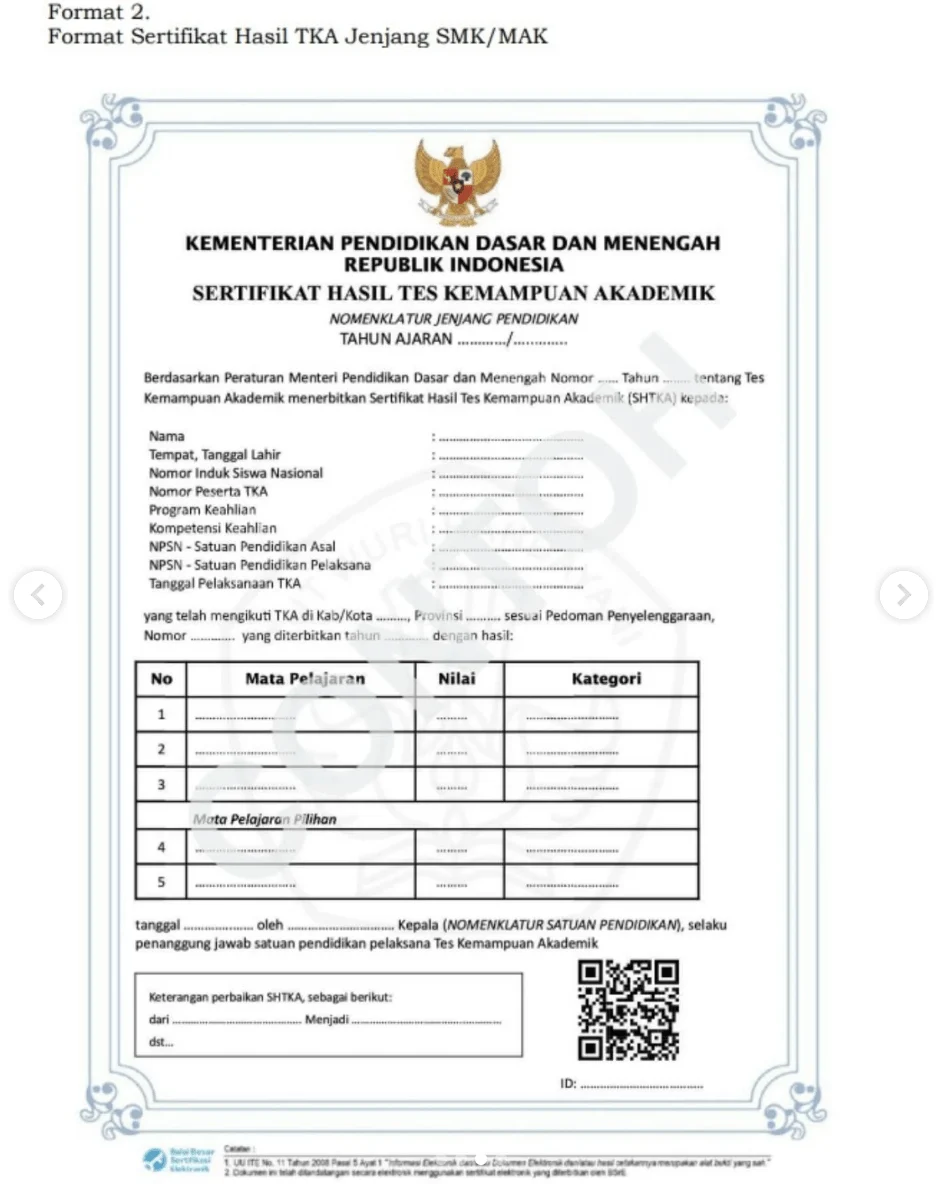
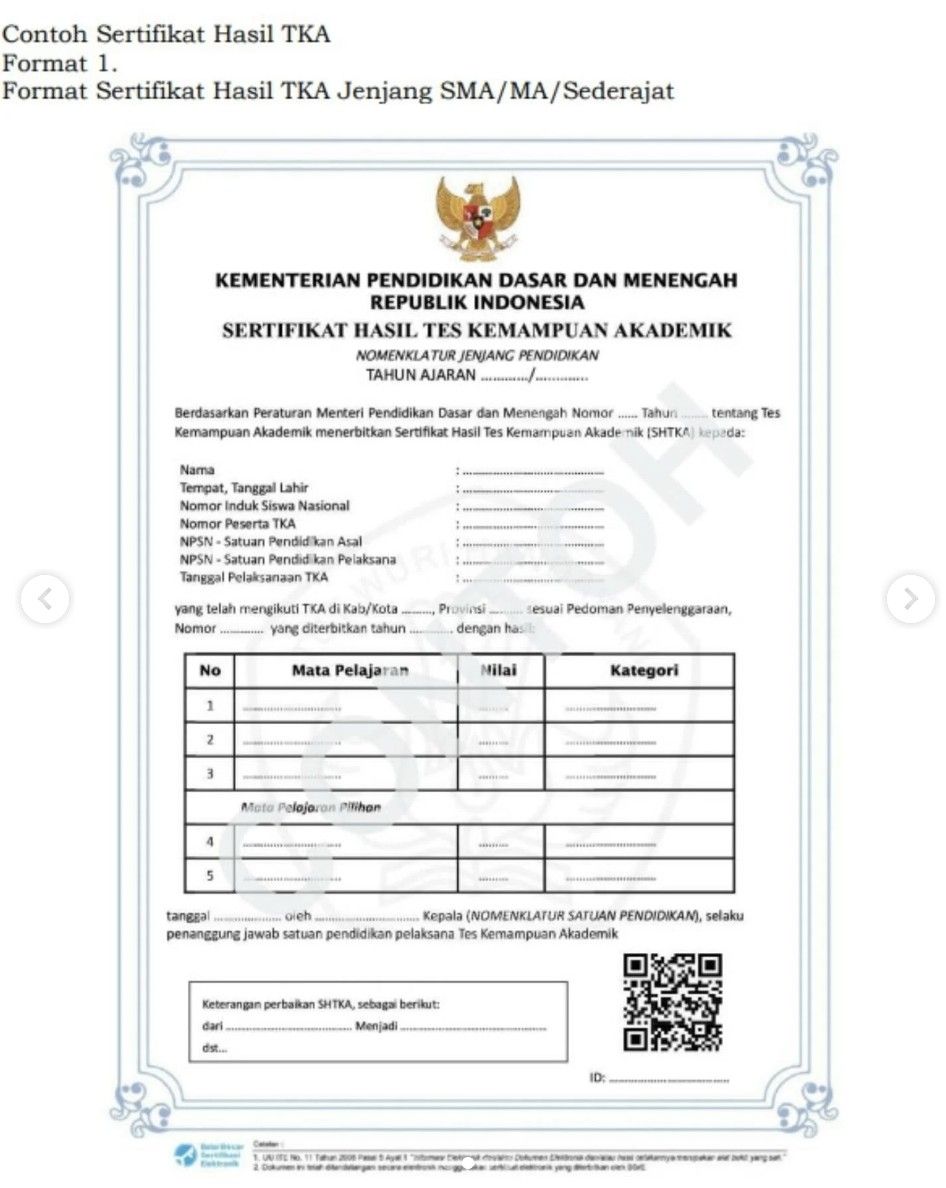
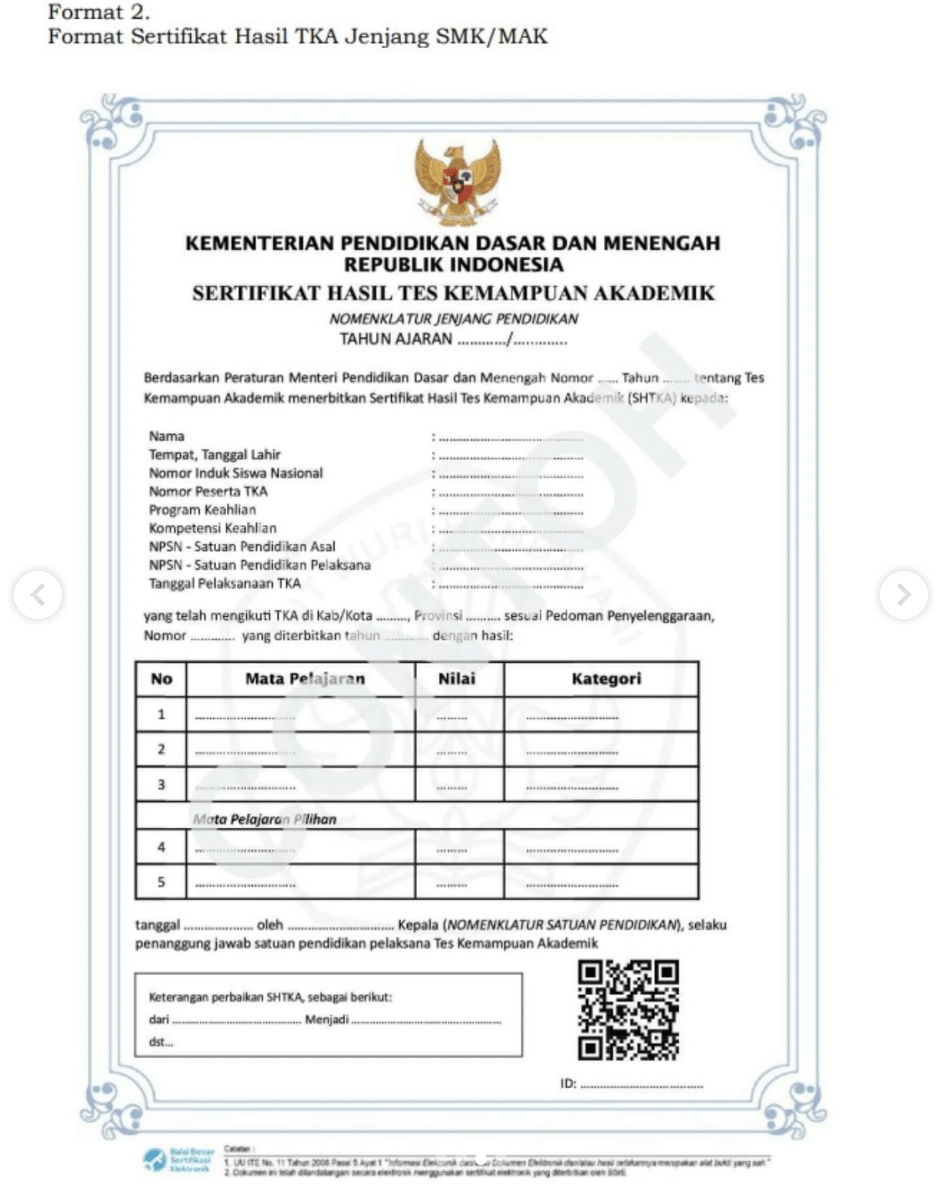
Upon completion, students receive a formal TKA Certificate. This document provides a detailed breakdown of scores for each subject, along with a percentile rank that shows how the student performed relative to the national average. This certificate is expected to become a mandatory attachment for the SNBP (National Selection Based on Achievement) and a significant "plus point" for the SNBT (National Selection Based on Test).
Broader Implications for the Indonesian Education System
The re-introduction of a standardized academic test in the form of the TKA carries profound implications for the future of Indonesian education. Analysts suggest that this move will force schools to re-evaluate their internal grading policies. If a school consistently issues high report card grades but its students perform poorly on the TKA, the school’s "integrity index" may be adjusted downward by university admission boards.
Furthermore, the TKA provides the government with high-quality data to identify regional disparities. By analyzing TKA results, the Kemendikdasmen can pinpoint provinces or districts where academic mastery in subjects like Mathematics or English is lagging, allowing for more targeted interventions and resource allocation.
For students, the TKA is a high-stakes opportunity to prove their capabilities beyond the confines of their local environment. It serves as a bridge to top-tier universities and a credential that carries weight in an increasingly competitive job market. As the October 2026 start date approaches, the emphasis for students, teachers, and parents alike remains on holistic preparation—not just for the test itself, but for the higher level of analytical thinking that the TKA demands.