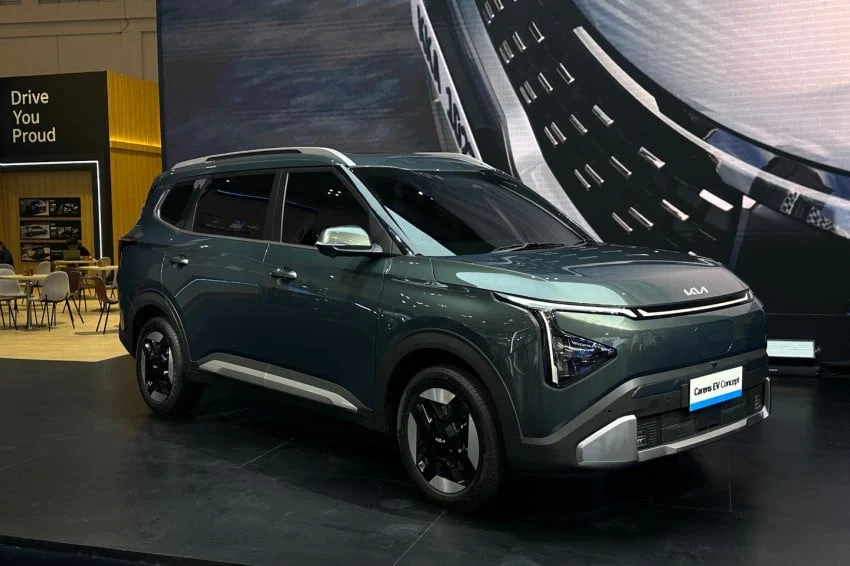
The Indonesian electric vehicle landscape is witnessing a strategic shift toward family-oriented multi-purpose vehicles, underscored by the official opening of the pre-booking period for the Kia Carens EV. Announced on Monday, October 26, 2026, by Kia Sales Indonesia, the battery-electric MPV has entered the local market with an estimated On-The-Road (OTR) Jakarta price range of Rp382 million to Rp432 million. Equipped with a battery capacity of up to 51.4 kWh, the vehicle aims to capture the growing demographic of families seeking sustainable three-row mobility solutions. However, industry analysts and market observers suggest that the primary competitive hurdle for the Carens EV may not stem from established Chinese contenders like the BYD M6, but rather from an internal corporate rival—the upcoming Hyundai Neira.
Developed on a shared corporate platform, the Kia Carens EV and the Hyundai Neira target the exact same consumer segment. This mechanical and structural overlap places the two models in a direct contest where traditional differentiation points—such as powertrain efficiency, charging capabilities, and chassis dynamics—largely neutralize one another. Consequently, prospective buyers evaluating these two electric family haulers are expected to pivot their decision-making criteria toward brand equity, resale value perception, and, crucially, the robustness of the respective after-sales and dealership networks across the archipelago.
Chronology of the Launch and Market Entry
The trajectory of the Kia Carens EV in Indonesia began earlier in the automotive calendar, gaining significant momentum during its concept presentation at the Gaikindo Indonesia International Auto Show (GIIAS) held in Jakarta. The positive reception of the concept vehicle prompted Kia Sales Indonesia to fast-track its commercialization, culminating in the official pre-booking rollout on October 26, 2026.
By initiating the pre-book phase, Kia aims to gauge early market demand and secure production allocations for the Indonesian market. The announced pricing bracket of Rp382 million to Rp432 million positions the Carens EV competitively within the sub-Rp500 million electric vehicle tier, a sweet spot for middle-class Indonesian families transitioning away from internal combustion engine (ICE) MPVs.
Simultaneously, the competitive landscape has evolved rapidly. While market analysts initially anticipated a fierce battle between South Korean offerings and Chinese dominance led by the BYD M6, the discourse shifted toward the imminent arrival of the Hyundai Neira. Manufactured locally at Hyundai’s production facility in Bekasi, West Java, the Neira shares foundational architecture with the Carens EV, amplifying the sibling rivalry within the broader Hyundai Motor Group ecosystem.
Technical Overview and Specifications
At the core of the Kia Carens EV’s value proposition is its powertrain configuration, anchored by a battery pack boasting a capacity of up to 51.4 kWh. This energy storage size is specifically calibrated to balance daily urban commuting needs with occasional out-of-town trips, offering a practical driving range tailored to Indonesia’s primary infrastructure corridors, such as the Trans-Java toll road network.
The vehicle retains the practical, spacious cabin architecture that made its ICE predecessor a popular choice among Indonesian families, accommodating up to seven passengers across three rows of seating. Integration of modern Advanced Driver Assistance Systems (ADAS), digital cockpit displays, and vehicle-to-load (V2L) capabilities positions the Carens EV as a technologically modern contender in the segment.
However, because the Hyundai Neira is engineered on the same platform, automotive engineers note that the mechanical specifications, motor outputs, and battery performance metrics of the two vehicles are projected to be nearly identical. This technological parity shifts the burden of persuasion away from raw datasheet comparisons and places it squarely on intangible brand assets and ecosystem support.

The Battle of Infrastructure and Brand Equity
The crux of the competitive challenge facing the Kia Carens EV lies in the disparity of network maturity between the two sibling brands in Indonesia. While Kia has steadily rebuilt its presence in the country under new management structures, Hyundai has invested heavily over the past several years in establishing a formidable footprint.
Hyundai’s localized manufacturing presence in Bekasi has not only streamlined supply chains but also enabled the brand to cultivate a vast, highly visible dealership and service network spanning major metropolitan areas and secondary cities across Indonesia. Furthermore, Hyundai has proactively developed a comprehensive EV charging infrastructure ecosystem, partnering with local entities to ensure convenient access to fast-charging stations for its customer base.
In contrast, while Kia offers competitive warranties and is expanding its service points, its network density remains comparatively modest. For Indonesian consumers—many of whom are purchasing their first electric vehicle—the psychological comfort of having an authorized service center and charging hub in close geographic proximity remains a decisive factor. The fear of battery degradation, specialized maintenance requirements, and residual value uncertainty elevates the importance of a mature after-sales infrastructure.
Implications for the Indonesian EV Ecosystem
The arrival of the Kia Carens EV and its confrontation with the Hyundai Neira signals a maturation of the Indonesian electric vehicle market. Moving beyond the initial wave of early-adopter hatchback and SUV segments, the market is now penetrating the high-volume family MPV sector, which forms the backbone of domestic automotive sales.
For consumers, this intra-group competition yields distinct advantages. The pressure to differentiate identical underlying technologies forces both brands to refine their pricing strategies, enhance warranty offerings, and introduce innovative financing packages through captive financial services. Collaborative leasing options, green-financing incentives, and comprehensive battery insurance schemes are expected to become standard competitive tools.
Furthermore, the domestic production angle plays a critical role. While the Kia Carens EV enters via initial importation channels depending on production scheduling, the locally manufactured status of its counterpart gives Hyundai a distinct advantage in terms of meeting government-mandated local content requirements (TKDN), potentially unlocking additional fiscal incentives and regulatory perks.
Strategic Outlook
As the pre-booking period progresses toward official deliveries, Kia Sales Indonesia faces the task of effectively communicating the unique design language, interior packaging, and ownership experience of the Carens EV to eclipse the brand recognition enjoyed by its sibling. The marketing narrative must successfully convince buyers that despite sharing a platform with the Hyundai Neira, the Carens EV delivers a distinct character and ownership proposition worth choosing.
Ultimately, the market performance of the Kia Carens EV will serve as a bellwether for platform-sharing dynamics in the electric era. It will test whether distinctive styling and localized marketing can overcome a competitor’s head start in dealership footprint and brand familiarity within one of Southeast Asia’s most dynamic automotive battlegrounds.