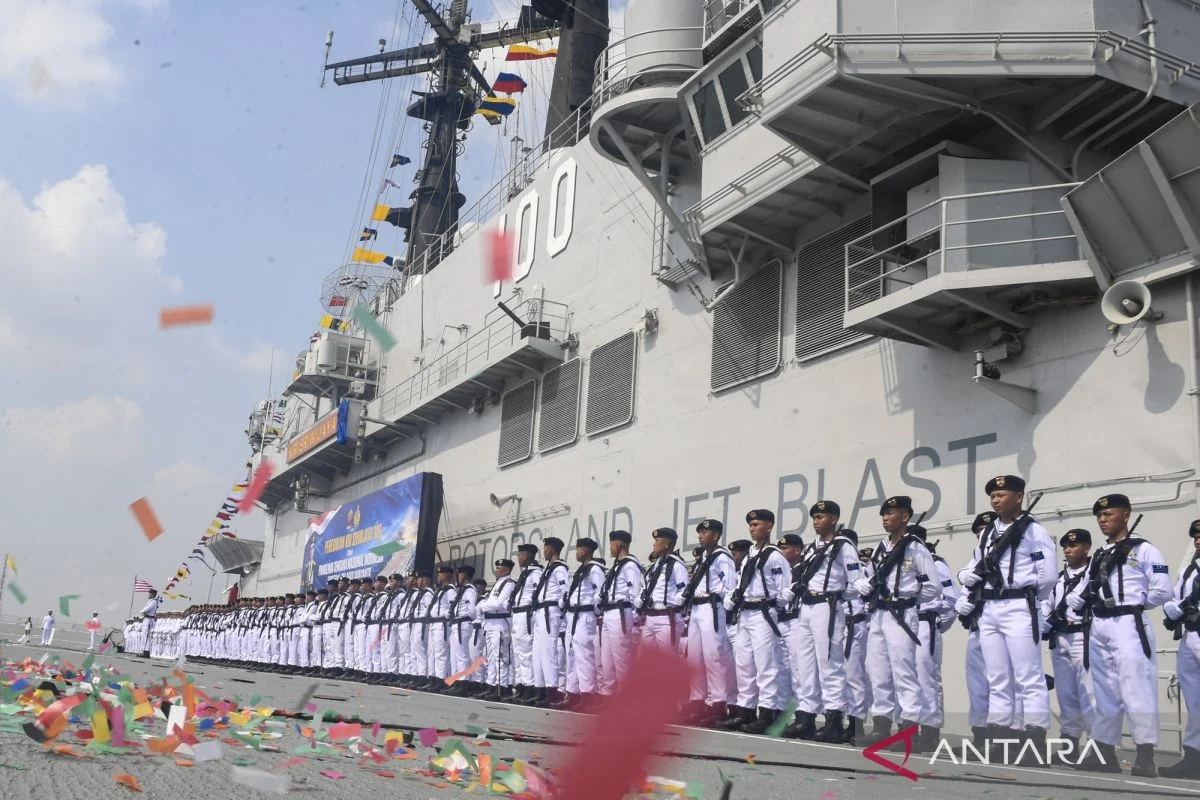
The arrival of the former Italian Navy aircraft carrier ITS Giuseppe Garibaldi at Pier 107 of Tanjung Priok Port in North Jakarta marks a monumental turning point for the Indonesian National Armed Forces-Navy (TNI AL). Docking on Friday, September 18, this formidable vessel represents the first-ever aircraft carrier to enter the Southeast Asian archipelago’s naval inventory. Acquired through a strategic government-to-government transfer and defense cooperation framework with Italy, the warship—formerly bearing the hull number C551—is set to be officially commissioned and renamed KRI Sriwijaya. This landmark acquisition not only bolsters Indonesia’s blue-water navy capabilities but also initiates a national conversation regarding the strategic utility, operational definitions, and broader geopolitical implications of operating a floating airbase within the world’s largest archipelagic state.
Chronology of the Acquisition and Official Handover
The journey of the vessel from the Mediterranean to the Java Sea is the culmination of extensive bilateral defense negotiations between Jakarta and Rome. Preliminary discussions regarding the acquisition began years prior, driven by Indonesia’s growing need to project power, secure its vast maritime boundaries, and enhance its rapid-response capabilities for both military and humanitarian missions. Following the successful conclusion of the transfer agreement, the transit voyage brought the vessel halfway across the globe, culminating in its arrival at Tanjung Priok Port on September 18.
The ceremonial transition of ownership is scheduled for September 24, at the same port in North Jakarta. During this historic ceremony, the Italian tricolor will be lowered, and the Indonesian Red and White flag will be hoisted, officially baptizing the vessel as KRI Sriwijaya. High-ranking military officials, defense ministry representatives, and diplomatic delegations from both nations are slated to attend. Furthermore, state protocols indicate that the President of the Republic of Indonesia is scheduled to receive the visiting Italian naval delegation to commemorate the deepening defense partnership.
Defining a Modern Aircraft Carrier: Beyond Mere Size
The public debate ignited by the arrival of KRI Sriwijaya underscores a common misunderstanding: that any large warship can be classified as an aircraft carrier. In naval architecture and tactical doctrine, sheer tonnage does not define a carrier. Rather, it is the ship’s fundamental design, engineering layout, and primary operational purpose that set it apart.
Unlike traditional surface combatants such as destroyers, frigates, and corvettes—which rely primarily on surface-to-surface missiles, naval artillery, and torpedoes as their principal offensive and defensive weapons—an aircraft carrier is engineered from the keel up to function as a mobile air base. It incorporates a specialized flight deck, expansive internal hangars for aircraft maintenance and storage, sophisticated aviation fuel storage and distribution systems, and dedicated command-and-control infrastructure designed to manage airborne sorties.
While conventional warships may carry one or two utility helicopters for scouting or transport, their primary design objective is surface or anti-submarine warfare. Conversely, an aircraft carrier places aviation at the core of its tactical identity, allowing naval commanders to project air power hundreds of miles away from traditional land-based runways.
Strategic Operational Focus: Military Operations Other Than War (OMOTW)
Despite the formidable offensive reputation associated with aircraft carriers globally, the Indonesian Navy has outlined a pragmatic and defensive operational doctrine for KRI Sriwijaya. Chief of Staff of the TNI AL, Admiral Muhammad Ali, has emphasized that the vessel will undergo comprehensive structural assessments, physical refurbishments, and engine overhauls to tailor its capabilities precisely to Indonesia’s defense and humanitarian requirements.
Rather than positioning the ship exclusively for high-intensity power-projection combat operations akin to superpowers, Indonesia intends to leverage KRI Sriwijaya heavily for Military Operations Other Than War (OMOTW). Given Indonesia’s unique geography as an archipelago comprising over 17,000 islands, rapid logistical deployment and disaster relief present constant challenges. The ship is projected to serve as a versatile floating base capable of deploying heavy transport helicopters, tactical drones, medical personnel, and emergency supplies directly to remote disaster zones where local infrastructure has been severely compromised.
This humanitarian-centric approach directly addresses the vulnerabilities of Indonesia’s geographical makeup. During natural disasters such as earthquakes, tsunamis, or volcanic eruptions, traditional supply lines via damaged roads and compromised regional airports are frequently cut off. A mobile maritime hub equipped with robust aviation facilities ensures that relief operations can be sustained independently offshore, bypassing crippled land infrastructure entirely.
Technological Specifications and Aviation Integration
The ITS Giuseppe Garibaldi, commissioned originally in the late 1980s by the Italian Navy, possesses a rich operational history and a design well-suited for versatile aviation operations. Historically, the ship was constructed to operate fixed-wing vertical/short take-off and landing (V/STOL) aircraft, such as the AV-8B Harrier II, alongside a diverse complement of anti-submarine and utility helicopters.
For the Indonesian Navy, naval leadership has expressed a keen interest in maximizing the ship’s utility through modern aviation assets, including advanced rotary-wing aircraft and Unmanned Aerial Vehicles (UAVs). Discussions within naval circles have highlighted the aspiration to equip and integrate platforms capable of vertical take-off and landing (VTOL), ensuring maximum operational flexibility without requiring extensive catapult or arresting gear modifications.
The inclusion of hangars and flight decks allows KRI Sriwijaya to function seamlessly as a "floating airport," capable of conducting continuous flight operations, routine maintenance, and tactical coordination in the open ocean. This capability drastically extends the operational horizon of the Indonesian fleet, enabling persistent maritime domain awareness across the exclusive economic zone (EEZ) and vital sea lanes of communication (SLOCs) such as the Sunda and Malacca Straits.
Strategic Implications and Regional Standing
The acquisition of KRI Sriwijaya represents a profound leap in defense diplomacy, naval engineering, and strategic deterrence for Indonesia. By incorporating a light aircraft carrier into its fleet, the Indonesian Navy joins an elite group of regional navies capable of operating fixed-wing or heavy rotary aviation assets from specialized sea-based platforms.
From an analytical standpoint, the implications of this acquisition are multifaceted. Regionally, it signals Indonesia’s unwavering commitment to modernizing its armed forces in response to evolving non-traditional and traditional maritime security threats. Economically and logistically, the maintenance and operational lifecycle of an aircraft carrier will test national industrial capacities, prompting closer collaboration with domestic shipyards and international defense partners for maintenance, repair, and overhaul (MRO) services.
Furthermore, the choice of the name "Sriwijaya"—paying homage to the historic Srivijaya Empire, a maritime superpower that once dominated Southeast Asian waters and trade routes—carries strong symbolic weight. It reflects a national aspiration to project maritime strength, safeguard sovereignty, and secure regional stability.
As the countdown to the official September 24 handover ceremony continues at Tanjung Priok, the eyes of the defense community remain fixed on Jakarta. The integration of KRI Sriwijaya into the TNI AL fleet is not merely a purchase of heavy hardware; it is the genesis of a new strategic chapter that will redefine Indonesia’s naval capabilities, disaster response mechanisms, and maritime posture for decades to come.