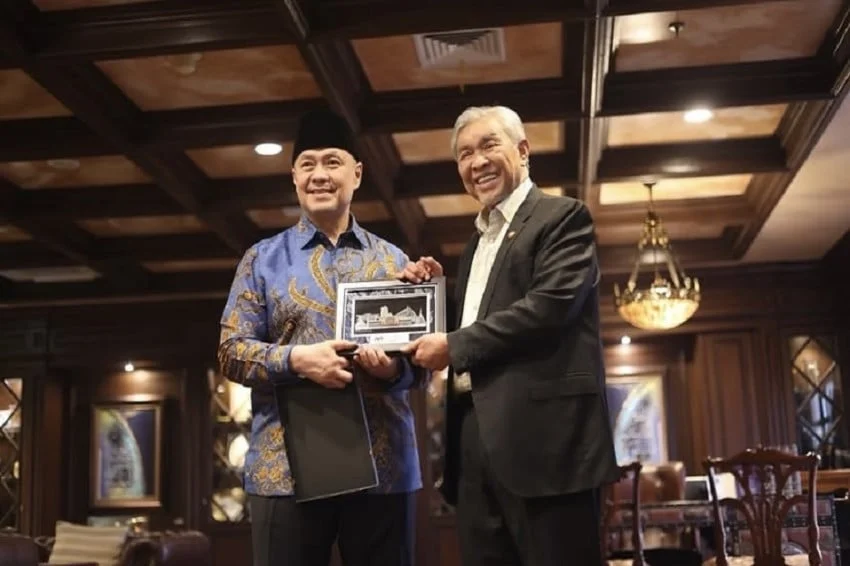
In an era where geopolitical alliances are frequently forged through rigid diplomatic channels and formal statecraft, personal diplomacy continues to play an indispensable role in smoothing over diplomatic friction and reinforcing regional stability in Southeast Asia. This dynamic was prominently displayed in the Indonesian capital on Monday, September 21, 2026, when Malaysia’s Deputy Prime Minister, Dato’ Seri Ahmad Zahid Hamidi, paid a high-profile visit to Menara 165 in Jakarta. The visit centered around a high-level meeting with Dr. Ary Ginanjar Agustian, the founder of ESQ Corp and Ary Ginanjar University, marking a significant milestone in bilateral engagements between Indonesia and Malaysia that transcends conventional political boundaries.
Beyond the standard protocol associated with a sitting deputy prime minister, the encounter served as a testament to a robust, decades-long friendship rooted in mutual respect, shared cultural values, and a commitment to spiritual and human capital development. As Southeast Asia navigates a complex economic and geopolitical landscape, the meeting between Ahmad Zahid and Ary Ginanjar underscores how interpersonal trust can act as a vital diplomatic conduit, facilitating harmonious relations between two neighboring nations whose destinies are inextricably linked.
The Chronology of a Two-Decade Partnership
To fully grasp the significance of the September 2026 meeting at Menara 165, it is essential to examine the historical trajectory of the relationship between Ahmad Zahid Hamidi and Ary Ginanjar Agustian. Their alliance dates back more than twenty years, originating in the early 2000s when Ahmad Zahid served as Malaysia’s Minister of Religious Affairs. During this formative period, Ary Ginanjar was rapidly expanding his influence as a pioneering educator and the creator of the ESQ (Emotional Spiritual Quotient) leadership model, a framework that integrates high cognitive intelligence, emotional resilience, and spiritual grounding.
Over the ensuing two decades, as Ahmad Zahid ascended through the upper echelons of the Malaysian political establishment—holding critical, high-security portfolios including Minister of Defense and Minister of Home Affairs, prior to assuming his current role as Deputy Prime Minister—the bond between the two men remained remarkably resilient. In an official statement released in Jakarta on Tuesday, September 22, 2026, Ary Ginanjar reflected on the enduring nature of their relationship, emphasizing its immunity to political fluctuations.
"Our friendship does not look at positions, but rather it is a friendship of the heart. In times of joy and sorrow, that relationship has been preserved," Ary Ginanjar stated.
This longevity is particularly noteworthy in the volatile world of international politics, where personal relationships often dissolve once official titles change. The ability of both leaders to maintain an open channel of communication over twenty years has provided a reliable informal backchannel during times when official state-to-state relations experienced turbulence.
Historical Context: Overcoming Bilateral Friction Through Personal Diplomacy
One of the most compelling revelations emerging from the high-level talks at Menara 165 was the recounting of how personal and spiritual diplomacy has historically intervened during moments of acute diplomatic tension between Jakarta and Kuala Lumpur. Ary Ginanjar recalled a particularly sensitive period when Indonesia and Malaysia were embroiled in maritime boundary disputes surrounding the Ambalat block in the Sulawesi Sea—a flashpoint that periodically strained national sentiments in both countries.
During the height of the Ambalat tensions, when nationalist rhetoric ran high and official bilateral talks faced severe headwinds, Ahmad Zahid Hamidi—who was then serving as Malaysia’s Minister of Defense—chose to undertake a visit to Menara 165. Rather than adhering strictly to insulated diplomatic channels, the visit was leveraged to create a neutral, informal space that brought together key defense and security figures from both Indonesia and Malaysia in an atmosphere of constructive dialogue.
Analysts note that such informal platforms are critical in international relations. While formal diplomatic negotiations are bound by strict protocols, public postures, and domestic political pressures, backchannel dialogues rooted in pre-existing personal trust allow leaders to de-escalate tensions away from the glare of media scrutiny. By utilizing a philosophical and spiritual hub like Menara 165 as a meeting ground, both leaders demonstrated that shared cultural affinity and human-to-human connection can effectively neutralize nationalist posturing and pave the way for formal diplomatic resolutions.
The Role of ESQ Corp and Ary Ginanjar University in Regional Human Capital
The choice of venue—Menara 165, the headquarters of ESQ Corp and the academic seat of Ary Ginanjar University—highlights another critical dimension of the visit: the shared vision of both leaders regarding human capital development, leadership, and moral integrity in governance.
In recent years, both Indonesia and Malaysia have faced the challenge of preparing their workforce and leadership pipelines for the demands of the fourth industrial revolution, rapid technological disruption, and shifting global economic power centers. The ESQ leadership model, which emphasizes character building alongside professional competence, has found a receptive audience not only in Indonesia but also across the wider Malay Archipelago, including Malaysia, Brunei, and Singapore.
During the September 2026 discussions, both leaders reportedly explored avenues for expanding educational and leadership collaborations between Malaysian institutions and Ary Ginanjar University. By fostering academic exchanges, joint research initiatives, and cross-border leadership training programs, the two figures aim to cultivate a new generation of civil servants, corporate executives, and policymakers who share a common ethical framework and a cooperative vision for the Association of Southeast Asian Nations (ASEAN).
Broader Implications for Indonesia-Malaysia Relations
The visit of Malaysia’s Deputy Prime Minister to Jakarta carries profound implications for the broader bilateral relationship between Indonesia and Malaysia as they look toward the future. Geopolitically, Indonesia and Malaysia are the twin pillars of ASEAN stability. Their alignment on regional security, economic integration, trade, and the protection of migrant workers is vital for the collective prosperity of Southeast Asia.
By maintaining robust informal ties at the leadership level, both nations are better equipped to manage recurring bilateral issues, such as labor migration policies, environmental concerns like transboundary haze, and maritime demarcations. The meeting at Menara 165 serves as a practical reminder that effective diplomacy relies not merely on treaties and institutional frameworks, but equally on the proactive cultivation of mutual understanding and personal rapport among regional leaders.
Furthermore, as ASEAN grapples with external pressures from major power competition in the Indo-Pacific, solidarity between its founding members remains paramount. The seamless interaction between Dato’ Seri Ahmad Zahid Hamidi and Dr. Ary Ginanjar Agustian exemplifies the enduring strength of "Serumpun" ties—the cultural and historical kinship shared by the peoples of Indonesia and Malaysia.
Conclusion
The visit of Malaysian Deputy Prime Minister Dato’ Seri Ahmad Zahid Hamidi to Menara 165 on September 21, 2026, transcends a routine diplomatic courtesy call. It stands as a powerful reaffirmation of a two-decade-long personal alliance that has weathered geopolitical storms and contributed quietly to regional stability. Through a combination of shared values, historical resilience, and a mutual commitment to ethical leadership, Ahmad Zahid and Ary Ginanjar have demonstrated how human connections can reinforce international bridges. As Indonesia and Malaysia continue to navigate the complexities of the 21st century, the enduring partnership forged between these two leaders remains a shining example of constructive bilateral engagement and regional solidarity.