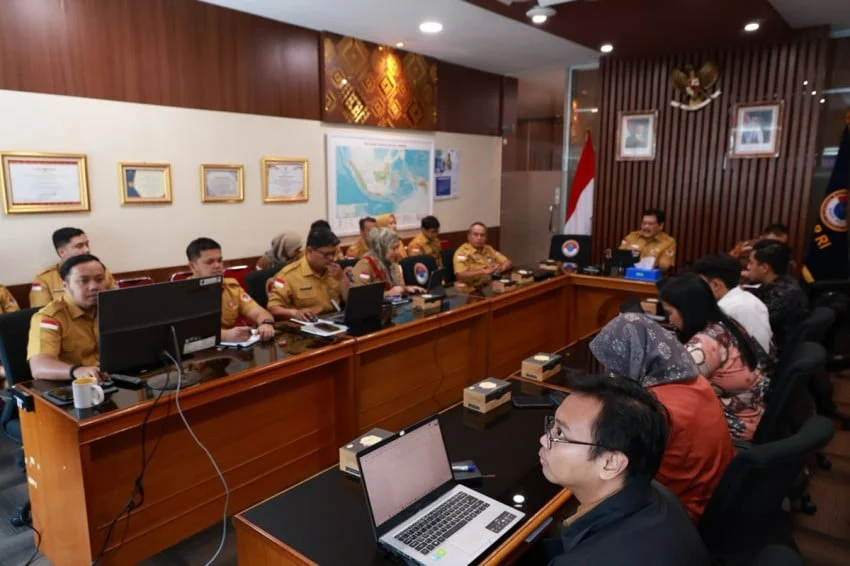
The National Border Management Agency of the Republic of Indonesia, operating under the auspices of the Ministry of Home Affairs, has engaged in high-level strategic discussions with the Coordinating Ministry for People’s Empowerment to accelerate the holistic development of the Entikong border region and the Sekayam Transmigration Area, located in Sanggau Regency, West Kalimantan Province.
The high-level coordination meeting, held on Tuesday, September 22, 2026, at the permanent secretariat office of the BNPP in Jakarta, represents a critical milestone in the central government’s ongoing efforts to transform peripheral regions into vibrant economic hubs. The discussions centered on forging a seamless synergy between infrastructure development, spatial planning, regional economic stimulation, and grassroots community empowerment. By aligning these strategic pillars, the Indonesian government aims to unlock the immense socioeconomic potential of the Entikong-Sekayam corridor, ensuring that border communities not only serve as a sovereign security buffer but also thrive as active participants in the national economy.
Strategic Context and Institutional Leadership
The strategic dialogue brought together key decision-makers from multiple governmental bodies to address the unique developmental challenges and opportunities inherent in Indonesia’s borderlands. The proceedings were co-chaired by senior officials from the BNPP, including Harris Fadhly, who serves as the Assistant Deputy for Economic Infrastructure and Community Welfare, and Ismawan Harijono, the Assistant Deputy for Border Area Spatial Planning. Representing the Coordinating Ministry for People’s Empowerment was Amin Mudzakir, the Assistant Deputy for the Empowerment of People in Specific Regions.
The involvement of the Coordinating Ministry for People’s Empowerment highlights the shift in national policy toward a human-centric approach in border management. While historical border policies heavily prioritized security and defense infrastructure—often leaving socio-economic development as a secondary concern—contemporary strategies integrate defense requirements with robust community welfare programs. This multidisciplinary approach ensures that infrastructure investments translate directly into tangible improvements in the daily lives of residents in remote and frontier regions.
Spatial Planning and Functional Integration
A cornerstone of the discussions in Jakarta was the operationalization of the Detailed Spatial Planning framework for the National Strategic Activity Center of Entikong. Harris Fadhly elaborated on the statutory guidelines governing the region, noting that the Entikong and Sekayam areas possess clearly defined functional allocations designed to guide sustainable development over the coming decades.
Under the current spatial design, Entikong is officially designated as the Main Service Center. Its strategic proximity to the international border with Malaysia positions it as a primary gateway for cross-border trade, customs clearance, and international logistics. Consequently, infrastructure projects in Entikong are heavily focused on enhancing trade efficiency, upgrading transportation networks, and modernizing public service delivery systems to project a strong and capable national presence at the frontier.
Conversely, the adjacent Sekayam Transmigration Area is designated as a Supporting Service Center. The strategic blueprint for Sekayam envisions a diversified development trajectory that encompasses national defense and security functions, regional economic integration, and long-term food self-sufficiency. By leveraging its vast agricultural potential through the historical framework of the transmigration program, Sekayam is slated to become a vital hinterland supplier capable of feeding both local markets and the growing commercial demands of the Entikong trade zone.
Optimizing the Role of Cross-Border Posts
A major focal point of the inter-agency meeting was the optimization of the Cross-Border Post, commonly known as Pos Lintas Batas Negara (PLBN). In recent years, the Indonesian government has invested heavily in constructing modern, state-of-the-art PLBN facilities across the archipelago’s land borders to replace outdated, rudimentary checkpoints. These modern posts are envisioned as more than mere immigration and customs barriers; they are designed to function as catalysts for regional economic growth.
During the discussions, officials emphasized that the physical presence of the PLBN must be supported by the synchronized development of surrounding economic zones. Without integrated planning in the hinterlands, the benefits of the modern PLBN risk remaining isolated, failing to stimulate local entrepreneurship or integrate regional producers into broader supply chains. Therefore, the strategic alignment between the BNPP and the Coordinating Ministry for People’s Empowerment focuses heavily on developing supporting infrastructure in the zones surrounding the checkpoint. This includes establishing local markets, cold storage facilities, logistics parks, and agro-industrial processing centers tailored to local commodities.
Background and Chronology of Border Development Policies
The dialogue in Jakarta is part of a broader, long-term national policy trajectory aimed at redressing historical disparities between Indonesia’s urban centers and its border regions. For decades, peripheral areas suffered from infrastructural deficits, economic isolation, and high dependency on neighboring countries for basic goods and services.
The turning point in modern Indonesian border governance occurred with the enactment of Law No. 43 of 2008 Concerning State Territory, which mandated the establishment of a dedicated agency to manage national borders. This led to the formation of the BNPP, which coordinates policies among various ministries, non-ministerial government institutions, and regional governments.
Over the past decade, the national strategy has transitioned through distinct phases:
- Phase One: Emergency Infrastructure and Security Upgrades (2014–2019). This initial phase focused on constructing trunk roads, rehabilitating security posts, and building the first wave of modern PLBNs to establish visible sovereign presence and improve basic connectivity.
- Phase Two: Economic Integration and Connectivity (2020–2024). Attention shifted toward connecting border regions to domestic supply chains, improving telecommunications access, and expanding basic utilities such as electricity and clean water.
- Phase Three: Integrated Regional Development and Self-Sufficiency (2025–Present). The current phase, exemplified by the recent talks between the BNPP and the Coordinating Ministry for People’s Empowerment, emphasizes holistic regional planning, economic diversification, agro-industrial development, and localized capacity building to ensure sustainable community livelihoods.
Socioeconomic Realities of Sanggau Regency and Sekayam
To fully understand the implications of the Entikong-Sekayam development initiative, it is necessary to examine the socio-economic landscape of Sanggau Regency within West Kalimantan. Sanggau shares an extensive land border with the state of Sarawak, Malaysia, making it a critical nexus for international relations, bilateral trade, and human mobility.
The Sekayam Transmigration Area within the regency has historically functioned as an agricultural settlement zone, populated largely by transmigrants from Java and Bali alongside indigenous communities. While the area possesses rich soil and significant potential for agricultural and plantation commodities—primarily rubber and palm oil—its economic progress has historically been hindered by logistical bottlenecks, limited access to formal credit markets, and fluctuating commodity prices.
By integrating the Sekayam Transmigration Area with the bustling economic ecosystem of the Entikong border crossing, policymakers aim to create a captive agricultural supply chain. Agricultural produce from Sekayam can be processed locally and funneled through Entikong for export, retaining greater value within the regency rather than being transported raw to distant ports in Pontianak or Kuching.
Institutional Collaboration and Cross-Sectoral Synergy
The complexity of border management necessitates continuous coordination across multiple jurisdictions and institutional portfolios. The meeting between the BNPP and the Coordinating Ministry for People’s Empowerment underscores the necessity of breaking down bureaucratic silos that have historically hampered regional development.
The BNPP brings to the table its regulatory authority over border spatial planning, inter-ministerial coordination, and infrastructural oversight. Meanwhile, the Coordinating Ministry for People’s Empowerment provides the vital social lens, ensuring that economic development translates into poverty alleviation, job creation, educational enhancement, and healthcare accessibility for marginalized populations.
Through this collaborative framework, the agencies are designing intervention programs that target cooperative farming models, vocational training for local youth tailored to border trade demands, and micro, small, and medium enterprise (MSME) financing schemes. These initiatives are intended to prevent border communities from acting merely as low-wage laborers, empowering them instead to become business owners, logistics operators, and agricultural producers of scale.
Implications and Broader Economic Impacts
The concerted focus on the Entikong-Sekayam corridor carries significant implications for the economic geography of West Kalimantan and national security architecture. Economically, the formalization and upgrading of localized supply chains are expected to reduce transaction costs for cross-border traders, curb informal or illegal trading practices, and enhance state revenue collection through proper customs administration.
From a social perspective, targeted empowerment programs are projected to curb out-migration by young workers seeking employment in urban centers or across the border. By fostering a dynamic local economy anchored in agro-industry and trade services, the region can retain human capital, thereby stabilizing demographic trends in sensitive border sectors.
Furthermore, aligning regional development with national security objectives reinforces the concept of "total people’s defense," wherein prosperous, loyal, and economically resilient border populations act as the primary guardians of national sovereignty. When citizens enjoy a high quality of life and tangible economic stakes in their homeland, the strategic integrity of the national frontier is profoundly strengthened.
Future Outlook and Implementation Timeline
Following the September 2026 coordination meeting, working-level technical teams from both the BNPP and the Coordinating Ministry for People’s Empowerment are expected to draft a comprehensive joint action plan. This roadmap will outline specific budgetary allocations, institutional responsibilities, and implementation timelines for infrastructural projects and community empowerment programs slated for rollout across the Entikong-Sekayam zone.
As these plans transition from the drawing board to physical execution, ongoing monitoring and evaluation mechanisms will be instituted to ensure that developmental milestones are met efficiently. Through sustained cooperation, strategic spatial planning, and targeted social investments, the Entikong and Sekayam regions are well-positioned to evolve into a shining model of integrated border management for the rest of the Indonesian archipelago.