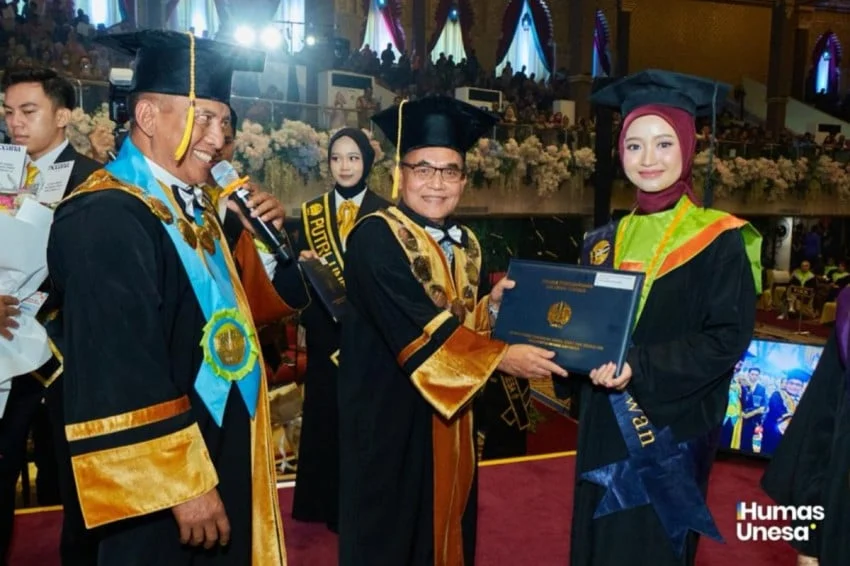
The graduation ceremony at Universitas Negeri Surabaya (Unesa) often serves as a platform to celebrate academic excellence, but the institution’s 122nd graduation ceremony held at Graha Unesa on Saturday, September 26, 2026, highlighted a unique intersection between rigorous academic achievement and practical technological intervention. Amid the sea of graduating students, Vanessa Aulia Syifa Yudiasmara stood out not only for securing the title of best graduate within her cohort with an extraordinary Grade Point Average (GPA) of 3.92, but also for her innovative contribution to disaster management: an e-Government application known as SIRPASNA.
A graduate of the D4 Informatics Management Study Program at the Faculty of Vocational Studies, Vanessa leveraged her academic knowledge to address a critical logistical bottleneck in disaster-prone regions across Indonesia. Her applied research culminated in the development of a digital platform designed to streamline and prioritize the rehabilitation and reconstruction of damaged public infrastructure, specifically roads and bridges, in the immediate aftermath of natural disasters. This breakthrough underlines a growing trend among Indonesian higher education institutions to steer final-year projects and applied research toward solving tangible, real-world socioeconomic problems.
The Urgent Challenge of Post-Disaster Infrastructure Assessment
Indonesia’s geographical position along the Pacific Ring of Fire and at the convergence of major tectonic plates makes it one of the most disaster-prone countries in the world. Earthquakes, floods, volcanic eruptions, and landslides frequently strike various regions, leaving behind trails of devastation that extend far beyond immediate humanitarian crises. While emergency response teams are typically deployed to handle search and rescue operations, the subsequent phase—rehabilitation and reconstruction—often encounters systemic hurdles.
Among the most pressing challenges in post-disaster management is the accurate, rapid pendataan (data collection) and assessment of damaged infrastructure. Roads and bridges form the literal and economic lifelines of affected communities. When these critical pathways are compromised or destroyed, the entire ecosystem of recovery is severely hampered. Delays in infrastructure assessment directly translate to delayed logistics delivery, restricted mobility for emergency medical personnel, and prolonged isolation for vulnerable populations. Furthermore, stalled infrastructural repairs have a cascading negative impact on regional economies, preventing local markets from reopening, disrupting agricultural supply chains, and delaying the resumption of daily commercial activities.
Traditionally, post-disaster infrastructure damage assessment has relied heavily on manual reporting, physical inspections by local authorities, and fragmented bureaucratic communication. These conventional methods are not only time-consuming but also prone to data discrepancies, subjective prioritization, and administrative bottlenecks. Recognizing these inefficiencies, Vanessa identified a critical gap where digital governance could transform emergency recovery workflows.
Genesis of the SIRPASNA Application
Driven by the desire to merge informatics management with public service utility, Vanessa conceptualized and developed SIRPASNA. Designed as an advanced e-Government application, the platform aims to bridge the gap between field data collection and bureaucratic decision-making during the critical recovery window following a disaster.
The core functionality of SIRPASNA centers on optimizing the process of determining priorities for infrastructure rehabilitation. When a disaster strikes, local authorities and field officers often face an overwhelming volume of damage reports simultaneously. Without a systematic method for triage, resource allocation can become disorganized, leading to prolonged suffering in areas that require urgent intervention. SIRPASNA introduces a data-driven approach to this challenge. By utilizing structured data inputs, the application helps disaster response agencies evaluate the severity of structural damage, calculate the economic and social impact of restricted access, and systematically rank which roads and bridges require immediate reconstruction.
The development of SIRPASNA required an intricate understanding of both software engineering and the administrative realities of local government agencies. As part of her D4 Informatics Management curriculum at the Faculty of Vocational Studies, Vanessa applied principles of database management, user interface design, and systems analysis to ensure the application is both robust and user-friendly for field operators who may be working under high-stress conditions.
Academic Excellence and the 122nd Unesa Graduation Ceremony
Vanessa’s technical accomplishment did not occur in a vacuum; it was mirrored by her exceptional dedication to her studies. Maintaining a GPA of 3.92 throughout an intensive vocational program requires rigorous discipline, time management, and a high level of comprehension. Her curriculum, which heavily emphasizes practical skills alongside theoretical foundations, prepared her to conceptualize an application that moves beyond a theoretical thesis and holds genuine commercial and public sector deployment potential.
The culmination of her undergraduate journey was formally recognized on Saturday, September 26, 2026, during the 122nd graduation ceremony held at Graha Unesa. Amidst cheers from faculty members, family, and peers, Vanessa was officially named the adiwisudawan (best graduate) of her faculty. The recognition served as a testament to the dual-track success achievable in modern vocational education—where academic mastery and societal impact go hand in hand.
University officials and faculty members at the Faculty of Vocational Studies have expressed immense pride in Vanessa’s achievements. Academic leaders noted that her project exemplifies the core mission of Unesa: producing graduates who are not only academically proficient but also possess the civic consciousness and innovative capacity to address national challenges.
Broader Implications and the Future of e-Government in Indonesia
The introduction of applications like SIRPASNA points toward a broader, much-needed digital transformation within Indonesian public administration, particularly in disaster mitigation and regional development. As Indonesia continues to expand its digital infrastructure under national e-Government initiatives, localized innovations created by university students provide scalable models for public sector efficiency.
Experts in disaster management and public policy have long advocated for the integration of technology into every phase of the disaster management cycle—mitigation, preparedness, response, and recovery. While significant investments have been made in early warning systems (such as tsunami buoys and seismic sensors) and emergency response frameworks, the post-disaster recovery phase has historically received less technological attention. Innovations focusing on reconstruction logistics, like Vanessa’s SIRPASNA, fill this critical vacuum.
By offering a transparent, data-driven framework for prioritizing infrastructure repairs, applications of this nature can significantly reduce bureaucratic friction, minimize the potential for misallocated relief funds, and accelerate the return to normalcy for affected communities. Furthermore, such tools empower local governments to make objective decisions based on real-time field data rather than political pressure or delayed manual reports.
Looking ahead, the success of applications like SIRPASNA depends heavily on institutional adoption and integration. For student-led innovations to move from academic prototypes to fully operational public utilities, active collaboration between universities, local governments, and disaster management agencies such as BNPB (National Board for Disaster Management) is essential. Observers suggest that projects originating from institutions like Unesa should be showcased and tested in pilot programs across disaster-prone regions in East Java and beyond.
Conclusion
Vanessa Aulia Syifa Yudiasmara’s journey from an informatics management student to an award-winning innovator and Unesa’s best graduate highlights the transformative potential of applied higher education in Indonesia. Through the creation of SIRPASNA, she has demonstrated that academic excellence can be effectively channeled into practical solutions for complex societal challenges. As Indonesia continues to grapple with the realities of natural disasters and the ongoing need for resilient infrastructure, the contributions of young innovators like Vanessa offer a promising glimpse into a more technologically equipped and digitally responsive future.