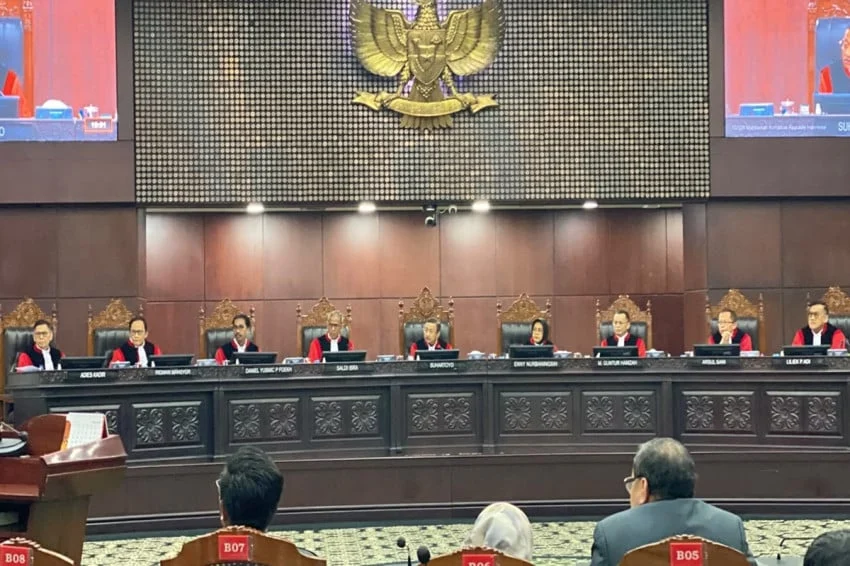
The Constitutional Court of Indonesia, widely known as Mahkamah Konstitusi or MK, officially concluded the preliminary examination hearing regarding a high-profile petition filed by prominent legal expert and constitutional scholar Denny Indrayana alongside several co-petitioners. The session, held on Monday, September 21, 2026, centered on a contentious legal challenge targeting the educational credentials and diploma requirements of Vice President Gibran Rakabuming Raka, which were utilized during his candidacy in the 2024 Presidential Election. The legal challenge has ignited widespread public discussion, raising fundamental questions about the intersection of electoral administration, candidate eligibility verification, and the jurisdiction of constitutional adjudication in post-election disputes.
As the preliminary session drew to a close in the main courtroom in Jakarta, Chief Justice Suhartoyo formally announced that the bench had received and deliberated upon applications submitted by external entities wishing to join the proceedings as related parties. Among the key applicants granted official status were representatives from the central board of the grassroots organization Perkumpulan Militan Gerakan Bersama Rakyat Nusantara, widely recognized as Militan Gibran 08 Nusantara, as well as individual citizens Andi Azwan and Abdul Aziz Salim. Despite the petitions being filed merely hours before the commencement of the inaugural hearing, the panel of constitutional judges reached a unanimous agreement to admit them into the legal framework of the case, ensuring that all perspectives surrounding the legitimacy of the vice president’s electoral documentation are thoroughly represented before the judiciary.
Chronology of the Legal Challenge and Initial Proceedings
The unfolding legal battle represents the latest chapter in a protracted series of challenges directed at the outcomes of the 2024 general elections. The legal action spearheaded by Denny Indrayana and his co-petitioners formally contends that procedural and substantive flaws marred the verification of Vice President Gibran Rakabuming Raka’s academic credentials at the time of his registration with the General Elections Commission, known as the Komisi Pemilihan Umum or KPU. The petitioners are urging the Constitutional Court to intervene decisively, seeking the annulment of official determinations regarding Gibran’s candidacy, election, and subsequent inauguration as vice president.
The preliminary examination hearing on Monday served as the crucial first step in determining whether the legal standing of the petitioners and the substance of their claims meet the rigorous threshold required for constitutional review. During the session, the bench reviewed the foundational arguments presented by the petitioners, who argued that the integrity of the electoral process rests upon absolute transparency and strict compliance with statutory educational qualifications for executive office holders.
However, the rapid entry of supporting factions complicated the preliminary dynamics. Attorneys and representatives for Militan Gibran 08 Nusantara mobilized swiftly, submitting their formal requests to intervene as related parties just hours before the gavel fell for the opening session. Acknowledging the tight window of submission, Chief Justice Suhartoyo addressed the courtroom regarding the administrative dispatch of the bench.
"Then, lastly, before we provide the schedule for the subsequent hearing, there is also a request to become a related party submitted by Andi Azwan and Abdul Aziz Salim," stated Chief Justice Suhartoyo during the proceedings. He further elaborated on the court’s pragmatic approach to the late filings, noting, "We from the panel of judges, because we only just received this request close to the hearing, have agreed to accept it."
With this procedural hurdle cleared, the newly minted related parties have secured formal standing to present arguments, submit legal briefs, and counter the narrative advanced by Denny Indrayana and his associates. This inclusion guarantees that the defense of the vice president’s credentials will feature coordinated inputs from both state election organizers and dedicated civil society support networks.
Upcoming Timeline and Procedural Roadmap
With the preliminary examination successfully adjourned, the Constitutional Court has outlined a fast-paced yet structured calendar to manage the complexities of the dossier. The judicial spotlight now shifts to the upcoming session scheduled for Wednesday, September 23, 2026.
The primary agenda for the mid-week hearing involves hearing the formal responses, defenses, and comprehensive answers from the designated respondents and official observers. The Komisi Pemilihan Umum (KPU), acting as the primary respondent responsible for executing the technical verification of candidate requirements during the 2024 election cycle, will take the floor to defend the validity of its administrative processes. Additionally, the Elections Supervisory Board, known as Badan Pengawas Pemilu or Bawaslu, is slated to deliver its official factual findings, oversight reports, and institutional assessments concerning the handling of candidate documentation during the registration phases.
Crucially, Wednesday’s session will also mark the formal debut of the newly accepted related parties, including Militan Gibran 08 Nusantara and individual intervenors Andi Azwan and Abdul Aziz Salim. These entities will be granted dedicated segments to articulate their positions, challenge the legal theories put forth by the petitioners, and advocate for the preservation of the electoral outcome that installed Gibran Rakabuming Raka alongside President Prabowo Subianto in the executive branch.
Legal Arguments and Institutional Implications
The core grievance brought forward by Denny Indrayana and his co-petitioners touches upon sensitive doctrines of administrative law and constitutional compliance. The petitioners argue that any ambiguity or alleged discrepancy concerning a candidate’s educational documentation undermines the constitutional prerequisites mandated for holders of the nation’s highest offices. They contend that the judicial branch possesses the inherent authority to review and rectify electoral outcomes if systemic verification failures are demonstrably proven to have occurred prior to polling day.
Conversely, the inclusion of robust defensive coalitions underscores the high stakes of the litigation. Organizations such as Militan Gibran 08 Nusantara view the petition not merely as a technical challenge to a diploma, but as a broader political effort to destabilize a democratically elected administration. By intervening as a related party, the volunteer network aims to provide counter-evidence and legal arguments emphasizing that the KPU operated strictly within the boundaries of prevailing electoral laws and regulations when it validated the candidate’s credentials in 2024.
Legal analysts observing the proceedings note that the case places the Constitutional Court under intense public scrutiny once again. The court must carefully balance the constitutional rights of citizens to question state administrative acts against the legal principles of finality and legal certainty in election results. While election dispute mechanisms typically possess strict temporal limitations, petitions touching upon foundational qualification criteria often invoke complex interpretations of constitutional jurisdiction.
Broader Context of Post-Election Judicial Review in Indonesia
The petition led by Denny Indrayana adds to a complex tapestry of legal challenges that have tested Indonesia’s democratic institutions following the monumental 2024 general elections. The transition of power, which saw Prabowo Subianto and Gibran Rakabuming Raka assume leadership of the world’s third-largest democracy, was accompanied by extensive scrutiny from political opponents, civil society watchdogs, and legal scholars.
While the Constitutional Court previously adjudicated major presidential election disputes immediately following the conclusion of the 2024 voting cycle—ultimately upholding the election results—subsequent specialized filings targeting specific administrative facets of individual candidates continue to find their way onto the court’s docket. These ongoing legal maneuvers reflect a persistent reliance on judicial avenues to resolve political and administrative grievances, highlighting both the vitality and the litigious nature of Indonesia’s contemporary political landscape.
As the MK prepares for the critical evidentiary and response phase on Wednesday, September 23, 2026, legal experts across the archipelago will be watching closely. The outcome of this procedural trajectory will not only determine the immediate legal fate of the current petition regarding Vice President Gibran Rakabuming Raka’s documentation but will also set important precedents regarding the extent to which post-election administrative challenges can be legally sustained within Indonesia’s constitutional framework.