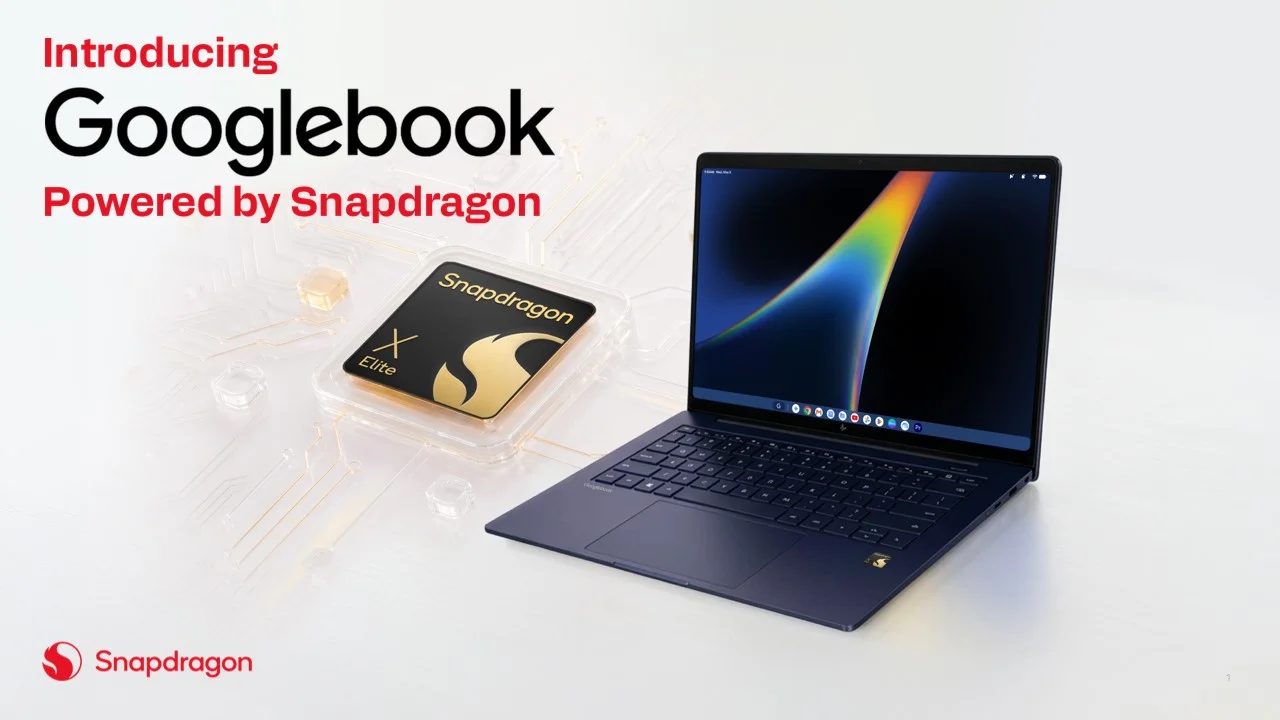
Google has officially introduced a groundbreaking new product category known as the Googlebook, powered by the high-performance Qualcomm Snapdragon X Elite processor. Announced on September 21, 2026, this strategic collaboration between Google and Qualcomm bridges the gap between desktop-class computing and the mobile-first Android ecosystem. By integrating Qualcomm’s advanced silicon architecture, the Googlebook aims to redefine modern laptop computing through deeply embedded artificial intelligence, native Android application support, and seamless cross-device interoperability.
The launch marks a significant milestone in the evolution of personal computing, establishing a direct challenge to established operating systems by combining the expansive utility of Android with the heavy-duty processing capabilities required for modern professional and creative workflows. Major hardware partners Dell and HP have already committed to launching the first wave of devices, signaling strong industry confidence in this new computing paradigm.
Chronology and Launch Details of the Googlebook Initiative
The roadmap leading to the September 21, 2026 unveiling of the Googlebook has been years in the making, reflecting the convergence of mobile and desktop architectures. As the demand for lightweight, highly efficient, and AI-driven devices grew, both Google and Qualcomm recognized the limitations of traditional x86 architectures in delivering sustained battery life alongside advanced on-device artificial intelligence.
Initial development phases focused heavily on optimizing Qualcomm’s ARM-based Snapdragon X Elite platform to handle complex operating system environments beyond traditional Windows deployments. Rumors and industry leaks surrounding a deep partnership between Google and Qualcomm intensified throughout early 2026, culminating in the official embargo lift and product launch on September 21.
During the global announcement, executives from both companies emphasized that the Googlebook is not merely a rebranded Chromebook or a standard Android tablet with a keyboard. Instead, it represents an entirely new platform built from the ground up to leverage the neural processing capabilities of the Snapdragon X Elite, tailored specifically to run Google’s advanced Gemini Intelligence suite natively. Following the announcement, hardware partners Dell and HP immediately opened pre-order channels for their inaugural flagship models: the Dell XPS Googlebook and the HP Googlebook 14.
Core Technological Architecture: Snapdragon X Elite Integration
At the heart of every Googlebook lies the Qualcomm Snapdragon X Elite processor, a system-on-a-chip (SoC) engineered to deliver exceptional performance-per-watt metrics. Built on an advanced process node, the Snapdragon X Elite integrates high-performance CPU cores, an upgraded graphics processing unit (GPU), and a powerful Neural Processing Unit (NPU) capable of handling heavy artificial intelligence workloads directly on the device.
The inclusion of this processor enables the Googlebook to execute complex machine learning tasks locally without relying entirely on cloud-based servers. This local processing ensures faster response times, enhanced data privacy, and offline functionality for AI-driven features. Furthermore, the processor’s architecture provides the necessary horsepower to run thousands of native Android applications and mobile games smoothly on a traditional laptop form factor.
Gaming performance is further enhanced by Qualcomm’s Snapdragon Elite Gaming technologies, which bring advanced features such as higher frame rate support, optimized graphic rendering, and low-latency response times to the Googlebook platform. Despite these high-performance benchmarks, the Snapdragon X Elite maintains industry-leading power efficiency, allowing the Googlebook to achieve all-day battery life under normal professional and educational use cases. However, actual battery performance continues to vary based on specific workloads, screen brightness settings, and individual user habits.
Advanced Software Features and Gemini Intelligence Integration
The software experience on the Googlebook is anchored by deep integrations with Gemini Intelligence, Google’s flagship artificial intelligence ecosystem. Unlike traditional virtual assistants that operate reactively, Gemini Intelligence on the Googlebook functions proactively and contextually, offering personalized assistance tailored to the user’s workflow.

Key software features introduced with the platform include Cast my Apps, Magic Pointer, and Rambler. Cast my Apps facilitates a fluid transition between the user’s smartphone, tablet, and the Googlebook, allowing applications to be mirrored, controlled, or seamlessly handed off across screens. Magic Pointer introduces advanced navigation capabilities, utilizing AI to predict user intent and streamline precision tasks. Meanwhile, Rambler acts as a contextual productivity hub, intelligently aggregating and surfacing relevant information pulled directly from the user’s emails, calendar events, and active on-screen content.
This ecosystem synergy is reinforced by native Android app compatibility. Users are no longer restricted to browser-based applications or limited mobile ports; instead, they can download and execute native Android apps and resource-intensive mobile games directly from the application store. This capability transforms the Googlebook into a versatile multimedia and productivity powerhouse, bridging mobile convenience with desktop productivity.
First-Wave Hardware Partners: Dell and HP Lead the Charge
To ensure a robust market entry, Google and Qualcomm partnered with two of the world’s leading PC manufacturers—Dell and HP—to bring the first Googlebook hardware to consumers.
Dell has introduced the Dell XPS Googlebook, a premium device that merges the acclaimed aesthetic, build quality, and display technology of the XPS lineup with the new Googlebook operating platform. Aimed at professionals, creators, and power users, the Dell XPS Googlebook emphasizes high-end materials, exceptional keyboard ergonomics, and vibrant visual fidelity.
Simultaneously, HP has announced the HP Googlebook 14, targeting a broader audience of students, mobile professionals, and everyday consumers. The HP Googlebook 14 focuses on portability, durability, and all-day usability, offering a balanced feature set designed to maximize the power-efficient capabilities of the Snapdragon X Elite processor.
Both manufacturers opened pre-orders immediately following the September 21 announcement. However, regional availability remains staggered, and as of the initial launch window, Qualcomm and its partners have not yet disclosed official pricing structures, release schedules, or distribution plans for international markets such as Indonesia.
Industry Implications and Market Analysis
The introduction of the Googlebook platform powered by the Snapdragon X Elite represents a significant pivot in the personal computer landscape. For years, the laptop market has been dominated by a duopoly of traditional operating systems running on x86 architectures. By introducing a dedicated platform that merges Google’s software dominance with Qualcomm’s mobile silicon expertise, the tech industry is witnessing a structural shift toward ARM-based, AI-native computing.
From an economic and competitive standpoint, the Googlebook addresses a long-standing consumer desire for devices that offer the seamless integration and app ecosystem of smartphones combined with the productivity benefits of a physical keyboard and larger display. The ability to run native Android apps on a laptop removes friction for millions of users who are already deeply entrenched in the mobile application ecosystem.
Furthermore, the emphasis on local AI processing via the Snapdragon X Elite’s NPU highlights the industry-wide transition toward ambient computing. As artificial intelligence becomes a core component of daily digital workflows, devices capable of running large language models and context-aware agents locally will likely gain a competitive advantage in terms of security, latency, and operational cost.
As Dell and HP roll out the first generation of devices and early consumer reviews begin to surface, the long-term success of the Googlebook will depend heavily on developer adoption, software optimization, and competitive pricing strategies. If the platform succeeds in convincing mainstream users to transition away from legacy operating systems, it could fundamentally reshape the future trajectory of personal computing hardware and software development for the next decade.