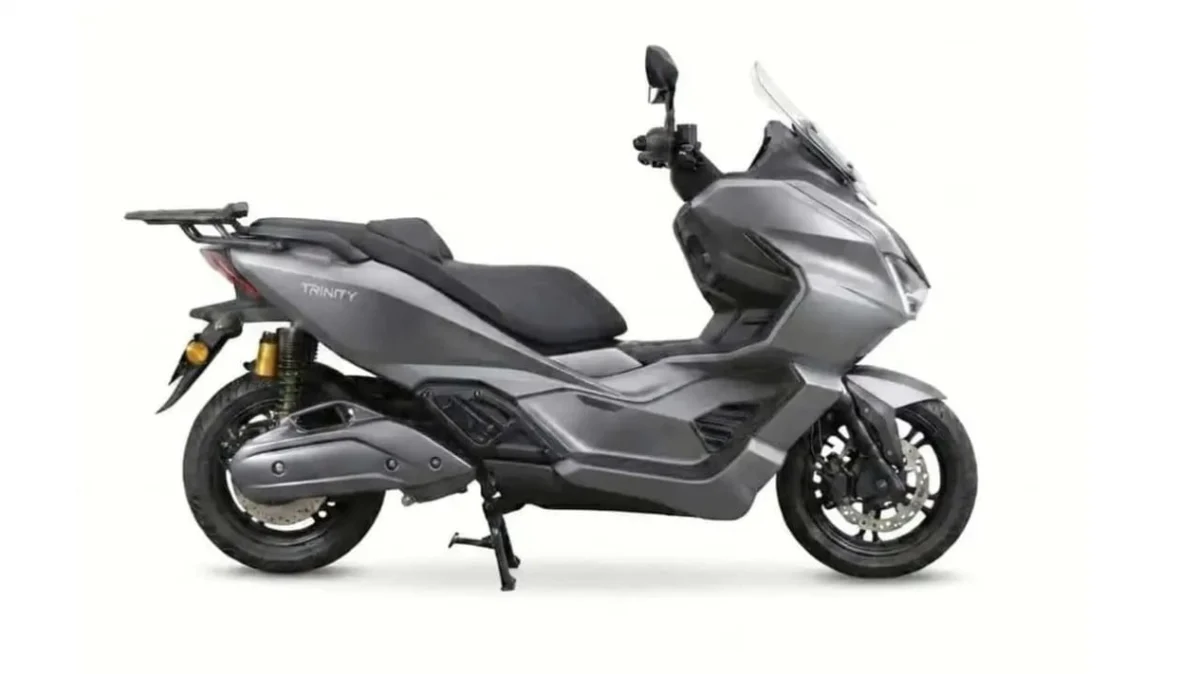
The global landscape of urban and commuter mobility is undergoing a profound structural transformation, driven by tightening environmental regulations, advancements in battery chemistry, and an escalating consumer demand for high-performance zero-emission alternatives. Within this shifting paradigm, the European market—particularly Germany—has emerged as a vital testing ground for innovative electric two-wheelers designed to bridge the gap between lightweight city runabouts and heavyweight touring motorcycles. A prime example of this engineering evolution is showcased in the latest offering from German manufacturer Trinity, which has formally introduced a heavy-duty electric scooter capable of rivaling traditional internal combustion engine (ICE) motorcycles while operating strictly within a regulated licensing category.
On Saturday, September 12, 2026, automotive industry observers turned their attention to Trinity’s latest flagship release, the Saturn GT 300. While officially classified under regulatory frameworks as a "125-class" vehicle, this machine shatters preconceived notions of what an entry-level commuter scooter can achieve. Delivering performance figures that far exceed standard urban mobility expectations, the Saturn GT 300 boasts a peak power output of 30 horsepower and a blistering top speed of 140 kilometers per hour (87 miles per hour). By marrying the accessibility of light-motorcycle licensing with the raw propulsion dynamics of a much larger displacement machine, Trinity has engineered a product that challenges conventional market segmentations.
Understanding the Regulatory Framework and Classification Mechanics
To comprehend the significance of the Trinity Saturn GT 300, one must first analyze the unique regulatory environment governing motorized two-wheelers in Germany and the broader European Union. The designation "125-class" (often referred to as 125er in German) traditionally denotes motorcycles and scooters powered by internal combustion engines with a displacement not exceeding 125 cubic centimeters. Because electric propulsion systems do not rely on internal cylinder displacement, regulatory bodies categorize these vehicles based on continuous power ratings and maximum speed capabilities.
In Germany, the 125cc category is uniquely accessible through the standard A1 motorcycle license, as well as via the simplified B196 regulatory framework. The B196 endorsement allows experienced motorists holding a standard Class B passenger car driver’s license to operate 125cc motorcycles and equivalent electric two-wheelers after completing a mandatory course of theoretical and practical training, without needing to pass a full motorcycle test. This legal pathway has made the 125 segment one of the most commercially vital and fiercely contested sectors in the European automotive market.
Trinity strategically engineered the Saturn GT 300 to exploit the absolute upper limits of this regulatory sweet spot. The vehicle features an electric motor capable of delivering a nominal, continuous output of 11 kilowatts (approximately 15 horsepower), which complies cleanly with the legal threshold for the A1 and B196 license classes. However, under heavy throttle applications and demanding riding conditions, the motor’s power management system allows it to dynamically surge to a peak output of 22 kilowatts (approximately 30 horsepower). This clever duality enables riders with standard light-motorcycle credentials to legally command a vehicle with acceleration and highway-passing capabilities normally reserved for mid-to-large displacement maxi-scooters.
Powertrain Performance, Range, and Battery Architecture
Beneath its aggressive bodywork, the Trinity Saturn GT 300 houses an advanced electrical architecture designed to sustain high-output performance over extended distances. Powering the system is a high-capacity lithium-ion battery pack boasting an energy storage rating of 13.3 kWh. In the context of two-wheeled electric mobility, a 13.3 kWh battery is exceptionally substantial, placing the Saturn GT 300 in a weight and energy class shared by light electric passenger cars rather than traditional kick-scooters or low-speed delivery bikes.
The inclusion of such a massive energy reservoir addresses one of the primary anxieties plaguing electric vehicle adoption: range anxiety. Trinity’s internal testing and official homologation claims indicate that the Saturn GT 300 can achieve a maximum driving range of up to 310 kilometers (approximately 192 miles) on a single charge under optimal urban riding conditions. Naturally, real-world range will vary depending on factors such as ambient temperature, rider weight, topography, and sustained high-speed operations on the German Autobahn.
When it comes to replenishment, the vehicle accommodates modern charging infrastructure. Equipped with a standard Type 2 charging connector—the same interface commonly found on electric passenger cars across Europe—the Saturn GT 300 can interface seamlessly with public AC charging stations as well as domestic wallboxes. Depending on the power delivery of the connected charging source, a complete battery replenishment cycle from empty to 100 percent takes approximately four to six hours. This charging profile makes the scooter viable not just for daily home-to-office commuting, but also for weekend touring and intercity travel.
Chassis Engineering, Ergonomics, and Safety Systems
Constructing an electric scooter capable of sustained velocities up to 140 km/h requires a complete rethinking of chassis dynamics, structural rigidity, and weight distribution. Electric powertrains, particularly those incorporating heavy lithium-ion battery banks, inherently carry a significant mass penalty compared to their gasoline-powered counterparts. The Trinity Saturn GT 300 reflects this reality on the scales, registering a curb weight of 221 kilograms (487 pounds) with the battery pack fully installed.
This weight figure places the Saturn GT 300 firmly in the territory of full-sized touring motorcycles and heavy maxi-scooters like the Yamaha TMax or Suzuki Burgman 400. To manage this substantial mass safely and effectively, Trinity has outfitted the machine with robust mechanical hardware. The scooter rolls on a staggered wheel configuration, utilizing a larger 15-inch wheel at the front to ensure high-speed directional stability and steering precision, paired with a 14-inch wheel at the rear to optimize power delivery and traction.
Stopping power is equally formidable. The braking system comprises dual hydraulic discs up front and a single hydraulic disc at the rear, ensuring balanced and fade-resistant deceleration from highway speeds. To prevent wheel lock-up during emergency braking maneuvers on slick or variable surfaces, an advanced Anti-lock Braking System (ABS) comes fitted as standard equipment. Furthermore, recognizing the torque-delivery characteristics of high-output electric motors—which can instantly overwhelm rear-tire grip upon throttle application—Trinity has integrated a sophisticated traction control system. This electronic safety net continuously monitors wheel speed differentials and modulates power delivery to maintain optimal rear-wheel traction during acceleration out of corners or in adverse weather conditions.
State-of-the-Art Connectivity and Convenience Features
Modern consumers purchasing high-end electric two-wheelers expect a digital user experience that mirrors contemporary automobiles. Trinity has answered this demand by outfitting the Saturn GT 300 with an expansive suite of technological amenities designed to enhance both rider convenience and active safety.
Dominating the cockpit is a high-resolution 7-inch touch-sensitive display instrument cluster. Far more than a simple speedometer, this central interface serves as the command hub for the vehicle’s onboard computer, integrating turn-by-turn GPS navigation directly into the rider’s field of view. To ensure seamless digital integration with the user’s smartphone, the system features native compatibility with both Apple CarPlay and Android Auto. This allows riders to manage calls, stream music, and access messaging applications safely via voice commands or touchscreen inputs while on the move.
Additional touring and safety features abound. The Saturn GT 300 comes equipped with electronic cruise control, a vital function for reducing rider fatigue during long stretches of highway cruising. Safety is further bolstered by an integrated tire pressure monitoring system (TPMS), which provides real-time alerts regarding pneumatic fluctuations that could compromise high-speed stability. Documenting journeys and providing evidentiary footage in the event of an incident is handled by a factory-integrated dashboard camera (dashcam) system. Finally, the inclusion of the aforementioned Type 2 charging inlet underscores the scooter’s design focus on versatile, modern infrastructure compatibility.
Market Positioning, Pricing Strategy, and Promotional Incentives
As of its market launch announcement in September 2026, Trinity has positioned the Saturn GT 300 as a premium offering within its growing electric vehicle portfolio. The standard retail price for the scooter in Germany is established at 9,900 euro. However, to stimulate early adopter momentum and capture market share within a competitive segment, Trinity introduced an aggressive promotional pricing strategy coinciding with the vehicle’s release.
For purchase commitments finalized up until September 30, 2026, the manufacturer implemented a direct 500-euro price reduction, bringing the net acquisition cost down to 9,400 euro. When evaluated against the prevailing exchange rates of mid-September 2026—where one euro traded at approximately 20,405 Indonesian Rupiah—the standard retail value translates to roughly 202 million Rupiah, while the promotional price equates to approximately 191.8 million Rupiah.
Industry analysts emphasize that these figures represent the official retail prices within the German domestic market, inclusive of all local value-added taxes (VAT) and regulatory compliance fees. Consequently, these direct currency conversions serve purely as a macroeconomic baseline and do not reflect potential importation tariffs, shipping logistics, local homologation expenses, or regional tax structures should the model be exported to developing markets such as Southeast Asia.
Broader Industry Implications and Future Outlook
The introduction of the Trinity Saturn GT 300 marks a significant milestone in the maturation of the electric two-wheeler market. For years, skeptics of electric mobility argued that battery-powered scooters were inherently limited to low-speed, short-range urban commuting, making them impractical for users requiring highway transit or intercity travel capabilities. By pushing the performance envelope to a certified 140 km/h top speed, integrating a 13.3 kWh energy buffer, and maximizing the regulatory frameworks of the European A1 and B196 license classes, Trinity has demonstrated that electric propulsion can successfully replicate—and in some cases exceed—the utility of traditional internal combustion competitors.
Furthermore, the Saturn GT 300 highlights a broader trend within the automotive engineering sector: the convergence of motorcycle and passenger car technologies. Features such as Apple CarPlay integration, integrated dashcams, Type 2 EV charging compatibility, and advanced traction control systems illustrate that two-wheeled transport is rapidly catching up to the digital and safety ecosystems established by modern electric automobiles.
As municipal authorities across Europe continue to implement stricter low-emission zones, internal combustion bans, and favorable parking policies for zero-emission vehicles, high-performance electric scooters like the Saturn GT 300 are poised to capture an increasingly large share of commuter mindshare. Whether this specific model serves as a catalyst for a broader industry shift toward high-speed electric maxi-scooters remains to be seen, but its arrival firmly establishes that the boundaries of the 125cc-equivalent class have been permanently redrawn.