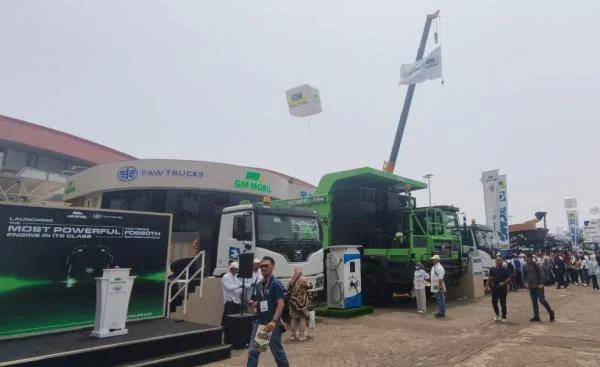
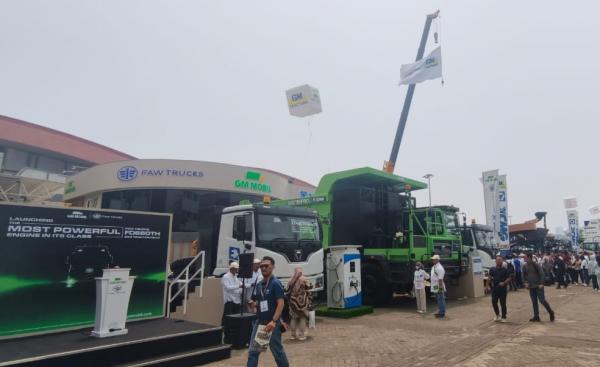
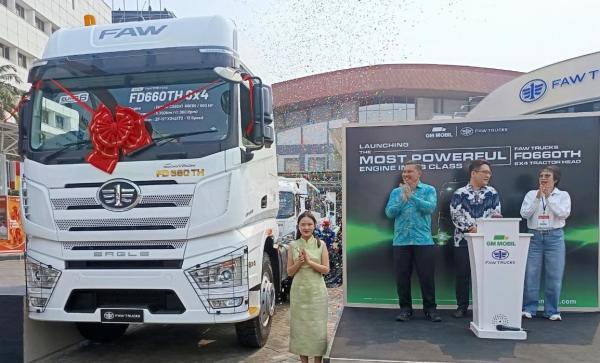
The Indonesian industrial landscape, particularly the mining and heavy logistics sectors, witnessed a significant technological advancement this week as GM Mobil officially unveiled the FAW FD660TH tractor head at the Mining Indonesia 2026 exhibition held at the JIExpo Kemayoran in Jakarta. This new entrant into the heavy-duty vehicle market is engineered to handle extreme operational demands, boasting a massive 660 horsepower (HP) engine and a Gross Combination Weight (GCW) capacity of up to 270 tons. The launch represents a strategic move by GM Mobil to capture a larger share of the infrastructure and resource extraction logistics market, providing a robust solution for companies tasked with transporting massive loads across challenging terrains.
Technical Specifications and Engineering Prowess
At the heart of the FAW FD660TH lies a powertrain designed for unrelenting performance. The tractor head is equipped with an engine capable of delivering 660 HP, complemented by a staggering 3,300 Nm of peak torque. This high-torque output is essential for the "hauling" segment, where vehicles must navigate steep inclines and uneven terrain often found in remote mining concessions.
To manage this immense power, GM Mobil has integrated a sophisticated ZF 12-speed transmission system. A critical component of this drivetrain is the hydraulic retarder. In the context of heavy-duty mining trucks, a hydraulic retarder is not merely an optional luxury but a vital safety feature. It allows the driver to maintain controlled speeds during long descents without relying solely on the friction brakes, which are prone to overheating and fading under heavy loads. This integration ensures that the vehicle remains safe and operational even under the most punishing working conditions.
A Strategic Response to Infrastructure and Mining Needs
The introduction of the FAW FD660TH comes at a time when the Indonesian government is intensifying its focus on mineral downstreaming and infrastructure development. The mining sector, which remains a primary driver of the national economy, requires machinery that can operate with high uptime and reliability.
Mining Indonesia 2026 serves as the premier platform for such technological reveals. By choosing this venue, GM Mobil has signaled its commitment to the Indonesian market, recognizing that the demand for high-capacity logistics is outpacing current fleet capabilities. The FD660TH is specifically designed to bridge the gap between standard logistics vehicles and specialized heavy-mining equipment, offering a versatile solution for companies that operate in both construction and large-scale mining logistics.
Safety Standards and Operator Protection
Beyond raw power and mechanical efficiency, modern heavy-duty trucking places a premium on safety and ergonomic design. The FAW FD660TH addresses these concerns by strictly adhering to the UNECE R29 standard. This international regulation governs the structural integrity of the truck cabin, ensuring it can withstand significant impact forces and protect the occupant during potential accidents.
In the mining and heavy construction industries, the risk of rollovers or falling debris is a constant concern. By incorporating a cabin that meets the UNECE R29 criteria, GM Mobil is addressing the growing demand from corporate clients for fleet vehicles that meet global safety benchmarks. This move not only enhances the protection of the driver but also helps companies reduce their liability and insurance premiums, contributing to a lower total cost of ownership (TCO) over the lifecycle of the vehicle.

Market Context and Industry Implications
The arrival of the FAW FD660TH must be viewed through the lens of Indonesia’s broader economic trajectory. As the country moves toward higher value-added industries, the efficiency of the supply chain becomes paramount. Logistics costs in Indonesia have historically been high compared to regional peers, often due to geographic fragmentation and the reliance on heavy transport for raw material movement.
By introducing a vehicle with a 270-ton GCW capacity, GM Mobil is enabling mining companies to transport larger volumes in a single trip. This "economy of scale" approach is a direct answer to the industry’s need for efficiency. If a single truck can move more material, the number of trips required decreases, leading to reduced fuel consumption per ton of cargo and a smaller carbon footprint per unit of output—a growing concern for companies aiming to meet Environmental, Social, and Governance (ESG) targets.
The Evolution of the Partnership between GM Mobil and FAW
The relationship between GM Mobil and FAW Trucks has evolved significantly over the past decade. Initially focused on entry-level and mid-range commercial vehicles, the partnership has shifted toward high-performance heavy-duty machinery to match the sophistication of Indonesian industrial operations.
Market analysts observe that the presence of such specialized equipment in the Indonesian market indicates a maturing logistics sector. As mining sites move to deeper or more remote locations, the requirements for engine durability and chassis strength become increasingly stringent. The FD660TH is not just a new model; it is a testament to the long-term investment strategy GM Mobil has undertaken to maintain its market presence in Indonesia.

Comparative Performance and Competitiveness
While the market for heavy-duty tractor heads in Indonesia includes various global manufacturers, the FAW FD660TH competes on the strength of its power-to-weight ratio and its integrated ZF transmission suite. Competitors in this space often face challenges regarding the cost of maintenance and the availability of spare parts. GM Mobil has historically addressed this by establishing a localized support network.
The decision to feature this model at Mining Indonesia 2026 allows potential buyers to examine the build quality firsthand. The heavy-duty steel construction, the reinforced suspension, and the advanced cooling systems are features that appeal to fleet managers who prioritize reliability. In the mining industry, "downtime is death" to productivity; therefore, the ability of GM Mobil to provide rapid after-sales support and parts availability will be as critical to the success of the FD660TH as the horsepower rating itself.
Future Outlook for Industrial Transport
Looking ahead, the integration of digital fleet management systems will likely be the next frontier for heavy-duty vehicles like the FAW FD660TH. As the industry shifts toward Industry 4.0, the ability to track vehicle performance, fuel usage, and driver behavior in real-time is becoming standard. While the current model focuses on mechanical superiority, the platform is well-positioned for future retrofits of telematics that could further optimize logistics operations.
The launch of the FAW FD660TH is a clear indicator that the heavy-duty vehicle market in Indonesia remains robust despite fluctuating global commodity prices. Companies are continuing to invest in their physical assets, anticipating sustained demand for mineral resources and ongoing government infrastructure projects.
Conclusion
The unveiling of the FAW FD660TH at Mining Indonesia 2026 marks a pivotal moment for GM Mobil. By introducing a vehicle that combines 660 HP of engine output with a 270-ton GCW capacity, the company has directly addressed the most pressing needs of the Indonesian mining and logistics industries. The emphasis on safety standards, such as the UNECE R29-compliant cabin, further highlights the industry’s shift toward more professionalized and safety-conscious operations.
As the exhibition continues, the industry will be watching closely to see how the FAW FD660TH performs in pilot programs and initial fleet deployments. If the vehicle lives up to its technical specifications, it could become a staple in the fleets of Indonesia’s major mining contractors, helping to drive efficiency and productivity across one of the nation’s most vital economic sectors. For now, the FD660TH stands as a symbol of the continued modernization of Indonesian industry, proving that as the scale of operations grows, the machinery required to support them is evolving to meet the challenge head-on.