The landscape of global and domestic commercial transportation is undergoing a profound paradigm shift, moving rapidly away from internal combustion engines toward sustainable, electrified alternatives. While passenger electric vehicles (EVs) and light electric commercial vans have largely established their presence within urban environments, conquering the rugged, unforgiving terrain of heavy industry has long remained a formidable engineering hurdle. For years, heavy-duty sectors such as mining, forestry, and plantation management relied exclusively on robust diesel-powered 4×4 vehicles capable of withstanding extreme off-road conditions, unpredictable weather, and continuous high-torque demands.
However, the relentless advancement of battery technology, electric motor efficiency, and chassis engineering is steadily dismantling these operational boundaries. Demonstrating this transformative leap, JAC Motors stepped onto the prominent stage of the Mining Indonesia 2026 exhibition, held at the Jakarta International Expo (JIExpo) Kemayoran from September 9 to 12, 2026. Rather than showcasing standard urban electric cars, the brand commanded industry-wide attention by presenting a purpose-built electrified solution tailored explicitly for heavy-duty operational environments.
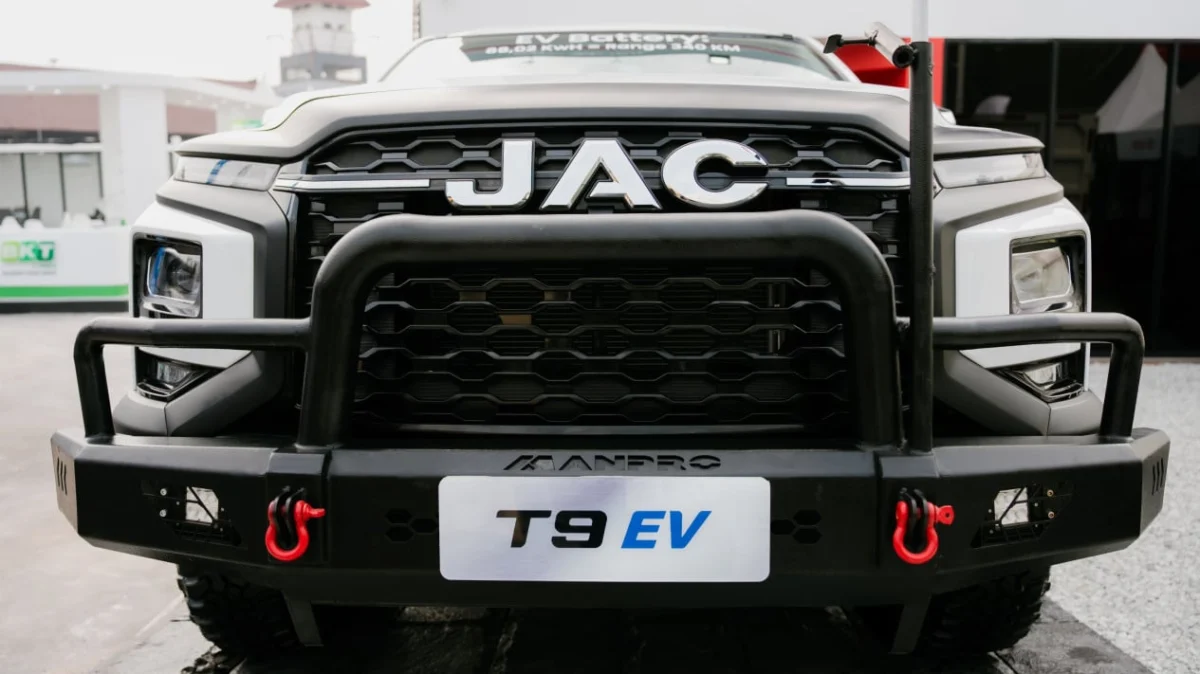
At the core of this strategic showcase was the Trekker T9 EV, a premier double-cabin electric pickup truck equipped with an advanced 4×4 drivetrain. Designed to prove that zero-emission mobility can seamlessly integrate with the demanding realities of heavy industry, the vehicle introduced critical mechanical enhancements engineered to conquer unpredictable mining terrains. By highlighting the integration of heavy-duty capabilities with eco-friendly performance, JAC Motors signaled a broader industrial transition: commercial fleet electrification in Indonesia is no longer confined to paved city streets, but is aggressively expanding into the country’s core economic extraction sectors.
Background Context of Mining Indonesia 2026 and Industry Evolution
Mining Indonesia stands as one of Southeast Asia’s largest and most influential international mining equipment exhibitions, serving as a critical nexus for global manufacturers, technology providers, and resource extraction conglomerates. The event acts as a bellwether for industry trends, safety standards, and technological adoptions across the region. As environmental, social, and governance (ESG) frameworks become increasingly stringent for mining corporations operating globally and within Indonesia, the pressure to decarbonize supply chains and operational fleets has escalated exponentially.
Traditionally, mining operations accounted for a massive share of industrial diesel consumption and subsequent greenhouse gas emissions. Heavy haulage, personnel transport, supervisory mobility, and utility logistics within remote mining concessions relied heavily on fossil fuels. Transitioning these fleets to electric power presents a dual challenge: vehicles must not only match the durability and pulling power of their diesel counterparts but must also operate reliably under extreme geographical, thermal, and mechanical stress without the luxury of established charging infrastructure.
Against this backdrop, the Mining Indonesia 2026 exhibition provided an ideal proving ground for automotive manufacturers to demonstrate heavy-duty electrification. The event convened thousands of industry stakeholders, policymakers, and engineering experts, creating a high-stakes environment where cutting-edge innovations faced intense scrutiny from prospective corporate buyers. JAC Motors leveraged this spotlight to position its Trekker T9 EV not merely as an alternative fuel vehicle, but as a robust, mission-critical operational asset engineered to solve specific logistical challenges faced by mining site managers across the archipelago.
Engineering the Trekker T9 EV for Severe Off-Road Terrains
Operating within a mining concession exposes vehicles to some of the harshest physical environments on earth. Uneven haul roads, deep mud pits, sharp shale, steep inclines, and water crossings demand exceptional mechanical resilience. Recognizing these severe conditions, JAC Motors engineered the Trekker T9 EV with specialized structural and mechanical upgrades that differentiate it sharply from standard consumer-grade electric pickup trucks.
The standout engineering feature unveiled at the exhibition is the integration of a sophisticated Differential Lock system into the T9 EV’s 4×4 architecture. In conventional open-differential setups, engine or motor torque is automatically delivered to the wheel with the least amount of resistance. While efficient on dry, level pavement, this mechanic creates a severe vulnerability in off-road environments: if a single wheel loses traction—such as sinking into deep mud or hanging over a rocky outcrop—that wheel spins uncontrollably while the wheel with solid traction remains stationary, leaving the vehicle stranded.
The newly integrated Differential Lock on the Trekker T9 EV mechanically locks the left and right wheels of an axle together, forcing them to rotate at the exact same speed regardless of individual traction disparities. When engaged by the driver, this system ensures that torque is distributed evenly and decisively across the axle, granting the vehicle the superior gripping power and forward momentum required to claw through treacherous terrain. Combined with the instantaneous torque delivery characteristic of electric motors—which provides maximum pulling power from a complete standstill—the 4×4 T9 EV delivers a responsive, highly controllable off-road driving dynamic that minimizes wheel slip and preserves vehicle momentum.
Furthermore, the vehicle’s high-voltage battery architecture and electric powertrain are housed within reinforced, sealed protective shielding to prevent damage from flying debris, water submersion, and extreme thermal fluctuations common in tropical mining zones. This meticulous attention to mechanical durability ensures that the transition to electric mobility does not compromise the utility, safety, or reliability demanded by heavy industrial operators.
Strategic Delivery and Real-World Implementation Chronology
The debut of the Trekker T9 EV at Mining Indonesia 2026 was far more than a speculative concept display or a marketing exercise. In a landmark milestone for commercial EV adoption in Indonesia, JAC Motors transitioned immediately from exhibition to execution, completing a major commercial delivery of 150 units of the Trekker T9 EV directly to three prominent mining and industrial conglomerates.
This multi-company handover represents a meticulously planned logistical chronology that began months prior with rigorous field testing and site-specific evaluations. The participating corporate buyers span diverse and geographically challenging regions across the Indonesian archipelago, reflecting the broad applicability and adaptability of the T9 EV platform:
- Aceh: Representing the northern extraction sector, corporate operators in this region face unique tropical terrain challenges, high humidity, and complex soil compositions.
- Berau, East Kalimantan: Operating within one of Indonesia’s primary coal and mineral extraction hubs, these fleets face heavy-duty operational cycles, extensive daily mileage, and demanding haul-road conditions.
- Banyuwangi, East Java: Serving regional mineral and agricultural logistics, operations here test the vehicle’s versatility in transitioning between rugged concession tracks and regional transport corridors.
The simultaneous deployment of 150 electric double-cabin pickup trucks across these disparate geographical zones serves as an empirical validation of the vehicle’s operational readiness. By moving past pilot phases into large-scale commercial fleet integration, these mining companies are actively pioneering the large-scale decarbonization of auxiliary mining support fleets in Indonesia.
Executive Insights and Official Corporate Responses
The strategic significance of this milestone was underscored by key leadership figures within the Indonesian automotive and commercial distribution sectors. Reggie Kurnia, Chief Operating Officer (COO) of Indomobil JAC, addressed industry stakeholders and media representatives during the official handover ceremony at JIExpo Kemayoran on Wednesday, September 9, 2026, emphasizing the brand’s long-term vision and market alignment.
"Hingga saat ini, kendaraan JAC Motors telah digunakan oleh pelanggan di berbagai wilayah Indonesia. Hal ini menjadi bukti bahwa produk dan solusi yang kami hadirkan memiliki relevansi dengan kebutuhan mobilitas industri di Indonesia," stated Reggie Kurnia, highlighting that the widespread acceptance of JAC vehicles is rooted in their practical alignment with national industrial demands.
Elaborating on the strategic philosophy driving the brand’s commercial rollout, executive representatives noted that the introduction of heavy-duty electric vehicles is dictated strictly by functional utility rather than environmental idealism alone. In the mining sector, operational downtime translates directly to significant financial losses. Therefore, fleet managers evaluate vehicles based on total cost of ownership (TCO), uptime reliability, maintenance simplicity, and mechanical resilience under duress.
By engineering the Trekker T9 EV to withstand severe off-road parameters while eliminating the complexities and high operating expenditures associated with internal combustion engines—such as frequent oil changes, complex transmission maintenance, and exposure to volatile fossil fuel pricing—JAC Motors has positioned its electric pickup as a financially prudent, high-performance asset for forward-thinking mining executives.
Fact-Based Analysis of Implications for the Indonesian Mining Sector
The successful deployment of 150 electric pickup trucks into active mining concessions carries profound implications for the future trajectory of Indonesian industry, environmental regulation, and automotive engineering.
First, from an environmental perspective, the transition from diesel-powered light commercial vehicles to electric alternatives directly contributes to corporate and national emission-reduction targets. Indonesia has committed to ambitious carbon neutrality timelines under international climate agreements. While heavy extraction machinery and massive haul trucks present complex engineering challenges for immediate complete electrification, auxiliary fleets—such as supervisor vehicles, exploration trucks, and light utility transport—represent an immediate, highly actionable target for fleet decarbonization. Electrifying these support vehicles significantly slashes localized particulate matter emissions and greenhouse gas outputs within confined or sensitive mining perimeters.
Second, the economic implications are substantial. Mining operations in remote regions like Berau or Aceh frequently incur exorbitant expenses related to transporting diesel fuel over long distances to power site generators and operational fleets. Electric vehicles integrated with localized renewable energy microgrids—such as on-site solar installations increasingly adopted by modern mining companies—drastically reduce reliance on imported fossil fuels, stabilizing operating expenditures against global oil price volatility. Furthermore, electric motors feature significantly fewer moving parts than internal combustion engines, resulting in reduced maintenance overhead, fewer spare parts inventories, and enhanced vehicle lifecycle availability.
Third, the psychological and operational barrier to EV adoption within heavy industry is systematically eroding. For decades, traditionalists in the mining sector maintained that electric vehicles lacked the torque delivery, structural durability, and battery endurance required for industrial labor. The proven performance of the Trekker T9 EV equipped with a Differential Lock directly challenges this skepticism, providing concrete empirical data that modern commercial EVs can perform equal to or better than traditional diesel counterparts in adverse off-road conditions.
Broad Industrial Outlook and Future Trajectory
As Mining Indonesia 2026 concludes its multi-day exhibition, the ripples of this event are expected to reverberate across the broader commercial automotive and natural resource extraction sectors. The commercial success of the JAC Trekker T9 EV demonstrates that the boundary between sustainable urban mobility and heavy-duty industrial utility is rapidly dissolving through targeted technological innovation.
Industry analysts project an accelerated adoption curve for electrified commercial fleets across Indonesia’s resource-rich provinces in the coming years. As supporting charging infrastructure expands within remote industrial zones and battery energy density continues its upward trajectory, manufacturers are anticipated to introduce even more specialized heavy-duty electric platforms.
For JAC Motors and its strategic partner Indomobil, the successful handover of 150 units to mining enterprises in Aceh, Berau, and Banyuwangi marks not a culmination, but a foundational proof-of-concept. By successfully bridging the gap between zero-emission technology and extreme off-road endurance, the company has set a new benchmark for commercial fleet electrification, proving that sustainable innovation can thrive even in the most rugged and demanding corners of modern industry.