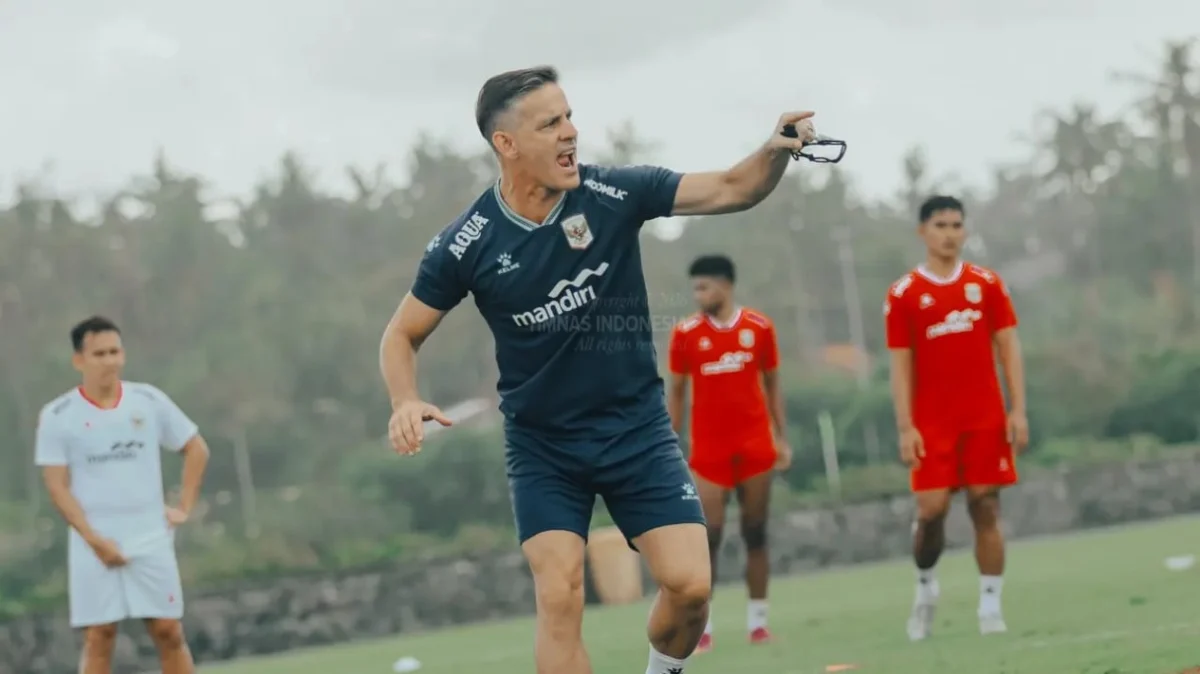
As the eagerly anticipated AFF Cup 2026 draws closer, the Indonesian National Football Team, under the astute guidance of head coach John Herdman, has entered a crucial phase of selection, marked by intense competition and unforeseen player setbacks. The initial provisional squad of 50 players, meticulously assembled for a rigorous training camp at the state-of-the-art Bali United Training Center, is now being whittled down to a definitive 23-man roster, intensifying the battle for coveted spots and forcing difficult decisions upon the coaching staff. This period of final evaluation has unfortunately coincided with significant challenges, including a untimely injury to a promising naturalized striker and the withdrawal of another key prospect due to club commitments, underscoring the complexities inherent in international football preparations, particularly for tournaments outside the FIFA international match calendar.
The Hamstring Hurdle: Mauro Zijlstra’s Race Against Time
Among the aspiring talents vying for a place in the Garuda squad, 21-year-old naturalized striker Mauro Zijlstra has emerged as a focal point of concern, his dreams of representing Indonesia in the prestigious regional tournament now hanging precariously in the balance. During a high-intensity training session in Bali, Zijlstra sustained a hamstring injury, an unfortunate development that has cast a shadow over his participation. Hamstring strains are among the most common injuries in football, often occurring during sprinting, rapid acceleration, or sudden changes in direction, and typically require careful management and recovery periods ranging from a few weeks for minor strains to several months for more severe tears. For a player like Zijlstra, who was making a strong impression, the timing could not have been worse, as the coaching staff initiated their final assessments.
Coach John Herdman openly expressed his disappointment regarding Zijlstra’s predicament. "It is very unfortunate. In one of the training sessions, Mauro felt a problem in his hamstring," Herdman stated, his words reflecting a blend of concern and regret. The Canadian tactician further elaborated that medical examinations had confirmed the severity of the injury, necessitating a recovery period that would likely preclude Zijlstra from featuring in at least a significant portion of the tournament. "After examinations, the injury means he will likely have to miss at least part of the tournament," Herdman confirmed. While an official list of omitted players has yet to be released, Herdman’s remarks serve as a strong indication that Zijlstra is highly unlikely to secure a spot in the final 23-man squad. The inherent demands of the AFF Cup, characterized by a compressed schedule and physically demanding matches, dictate that only fully fit players can be considered, as carrying an injured player would jeopardize the team’s overall performance and tactical flexibility. The potential absence of Zijlstra, a forward who had shown promising development during the training camp and possessed a unique blend of physicality and clinical finishing from his time with clubs like FC Volendam, represents a significant blow to Indonesia’s attacking depth and tactical options. His naturalization, part of the Indonesian Football Association (PSSI)’s broader strategy to enhance the national team’s quality with diaspora players, was seen as a key step in bolstering the squad’s competitive edge.
The Club-Country Conundrum: Luke Vickery’s Unavailability
Mauro Zijlstra’s potential exclusion follows closely on the heels of another significant setback for the Indonesian team: the unavailability of Luke Vickery. The midfielder, who recently completed his naturalization process, was definitively ruled out of the AFF Cup 2026 after his club, Macarthur Bulls FC of Australia’s A-League, declined to release him for national team duty. This decision highlights a recurring and often contentious issue in international football, particularly for tournaments that fall outside the official FIFA international match calendar. Under FIFA regulations, clubs are only obligated to release players for international ‘A’ matches and tournaments designated within the FIFA window. The AFF Cup, despite its regional prestige and fervent support, does not hold this status, granting clubs the autonomy to retain their players.
Herdman revealed that the PSSI had engaged in extensive negotiations with Macarthur Bulls, striving to secure Vickery’s release. However, the Australian club ultimately prioritized its own preparations for the upcoming A-League season, deeming Vickery an integral part of their squad. This scenario is a common frustration for national teams participating in non-FIFA tournaments, as clubs are often reluctant to disrupt their pre-season or in-season schedules, risk player injuries, or lose key personnel for an extended period without mandatory obligation. For Indonesia, Vickery’s absence is particularly impactful. As a newly naturalized player, his integration was anticipated to add fresh dynamics and quality to the midfield, potentially offering both defensive solidity and creative impetus. His profile, honed in a competitive league like the A-League, would have brought a different dimension to the Garuda’s tactical setup. The PSSI’s proactive naturalization program, aimed at integrating players with Indonesian heritage from competitive European and Australian leagues, seeks to elevate the overall standard of the national team. However, the case of Luke Vickery underscores one of the inherent risks and challenges associated with this strategy, particularly when dealing with regional tournaments lacking FIFA’s full endorsement.
John Herdman’s Strategic Vision and Formidable Task
The challenges presented by Zijlstra’s injury and Vickery’s club-imposed absence fall squarely on the shoulders of John Herdman, the highly respected coach known for his transformative work with both the Canadian Women’s and Men’s National Teams. Herdman, who famously guided Canada to the FIFA World Cup after a 36-year absence, brings a wealth of experience in high-pressure environments and a reputation for meticulous planning and player development. His arrival at the helm of the Indonesian National Team was met with considerable optimism, with expectations that he would instill a new level of professionalism, tactical sophistication, and winning mentality.
Herdman’s coaching philosophy emphasizes tactical flexibility, strong defensive organization, and a disciplined approach, coupled with an ability to maximize the potential of individual players. Faced with the task of narrowing down a 50-player pool to 23, his current predicament demands not only astute tactical decisions but also profound man-management skills. The initial large squad reflected Herdman’s desire to assess a wide array of talent, including both established national team players, rising stars from the Liga 1, and newly naturalized individuals. The training camp in Bali, specifically chosen for its excellent facilities at the Bali United Training Center, was designed to test players physically, mentally, and tactically. Intensive sessions focused on fitness, team cohesion, and the implementation of Herdman’s tactical schemes. The competition for places has been fierce, pushing every player to their absolute limits. The final selection process involves evaluating players not just on their raw talent but also on their adaptability, understanding of the tactical system, physical resilience, and ability to perform under pressure. Herdman’s task now is to ensure the final squad possesses the right balance across all positions, adequate depth to navigate a demanding tournament schedule, and a collective spirit capable of overcoming adversity.
The Significance of the AFF Cup for Indonesian Football
The AFF Cup, formerly known as the Tiger Cup, holds immense significance for Indonesian football. While not a global tournament, it is the premier regional competition in Southeast Asia, carrying substantial national pride and prestige. For Indonesia, a football-mad nation with a passionate fanbase, success in the AFF Cup is a perennial aspiration. Despite reaching the final on multiple occasions (most recently in 2020), Indonesia has famously never lifted the trophy, a fact that fuels an enduring desire for regional supremacy. The tournament provides a crucial platform for the national team to test its mettle against regional rivals such as Thailand, Vietnam, Malaysia, and Singapore, and serves as a barometer for the progress of Indonesian football development.
The PSSI has long articulated a vision for elevating Indonesia’s standing in Asian and global football, and success in the AFF Cup is seen as a vital stepping stone. The naturalization program, which has seen a steady influx of players with Indonesian heritage from European and other leagues, is a cornerstone of this strategy. The aim is to blend the technical prowess and tactical discipline acquired in more developed footballing nations with the inherent talent and fighting spirit of local players, thereby raising the overall quality and competitiveness of the national team. The current squad under Herdman embodies this blend, showcasing a diverse pool of talent. The Bali training camp is not merely about physical preparation but also about fostering a cohesive unit, integrating players from varied backgrounds into a unified team identity, and instilling Herdman’s tactical philosophy.
A Chronology of Preparation and Setbacks
The journey towards the AFF Cup 2026 has been a dynamic one, marked by a series of planned phases and unexpected turns:
- Early 2026: PSSI announces John Herdman as the new head coach, tasked with leading Indonesia through a new era of football.
- March-May 2026: Initial scouting and talent identification phase, including extensive monitoring of both domestic and diaspora players. Naturalization processes for several key players, including Mauro Zijlstra and Luke Vickery, are finalized.
- Late May 2026: Announcement of a preliminary 50-player squad for the AFF Cup 2026 training camp, signaling the start of intensive preparations.
- June 2026: Commencement of the centralized training camp at the Bali United Training Center. The initial weeks focus on physical conditioning, tactical introductions, and team-building exercises.
- Early July 2026: Intense tactical sessions and internal scrimmage matches begin, as the coaching staff starts evaluating players for final selection.
- Mid-July 2026: Luke Vickery’s club, Macarthur Bulls FC, formally declines his release for the AFF Cup, citing the tournament’s non-FIFA calendar status and their own A-League preparations. Efforts by PSSI to negotiate his release prove unsuccessful.
- Mid-July 2026 (Approx.): Mauro Zijlstra sustains a hamstring injury during a training session in Bali. Medical assessments confirm a recovery timeline that puts his participation in the AFF Cup in serious doubt.
- Present (July 23, 2026): Coach John Herdman publicly acknowledges Zijlstra’s injury and Vickery’s unavailability, indicating both players are unlikely to make the final cut. The coaching staff enters the final stages of squad selection.
- Late July/Early August 2026 (Anticipated): Official announcement of the final 23-man squad for the AFF Cup 2026.
- August 2026 (Anticipated): Final pre-tournament friendlies and tactical refinements before the commencement of the AFF Cup 2026.
Broader Implications and the Path Forward
The setbacks experienced during this critical preparatory phase, while undoubtedly challenging, also offer a test of the squad’s resilience and depth. The absence of a naturalized striker like Zijlstra will necessitate other forwards stepping up, potentially opening doors for local talents or other naturalized players to demonstrate their capabilities. Similarly, Vickery’s absence in midfield will demand tactical adjustments and increased responsibility from the remaining midfielders. This situation underscores the importance of a robust player pool and flexible tactical schemes, attributes that John Herdman is known for cultivating.
Furthermore, the recurring issue of clubs refusing to release players for non-FIFA tournaments like the AFF Cup highlights a systemic challenge for regional competitions. It prompts ongoing discussions within ASEAN football federations about strategies to mitigate this problem, perhaps through lobbying FIFA for special designations or establishing regional agreements with clubs. For the PSSI, it reinforces the need for meticulous planning, early communication with clubs, and potentially exploring alternative pathways for player development that are less reliant on club release mechanisms for such tournaments.
Despite these hurdles, the aspirations for the AFF Cup 2026 remain high. The Indonesian team, under Herdman’s leadership, is committed to delivering a strong performance. The rigorous training camp in Bali, despite its challenges, is designed to forge a cohesive and formidable unit. The final 23 players selected will represent the culmination of months of scouting, evaluation, and intensive preparation, carrying the hopes of a nation eager to finally claim the coveted regional title. The journey ahead for the Garuda squad is fraught with challenges, but the determination to succeed remains unwavering as they brace for the ultimate test of regional football supremacy.