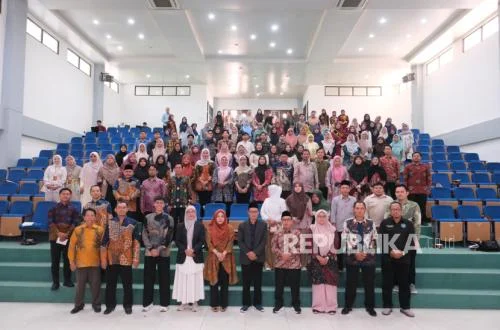
The rapid proliferation of generative Artificial Intelligence (AI) has fundamentally altered the landscape of higher education, prompting academic institutions to re-evaluate the traditional roles of information professionals. On Thursday, July 16, 2026, the Technical Implementation Unit (UPT) of the Library at Universitas Islam Negeri Fatmawati Sukarno (UIN FAS) Bengkulu hosted a landmark event titled "Workshop on Librarian Competency Enhancement 2026." This initiative, conducted in collaboration with the Faculty of Humanities (FIB) at the University of Indonesia (UI) as part of its Community Service Program, sought to address the existential and functional questions facing librarians in an era where AI can generate summaries, bibliographies, and full-length essays in a matter of seconds.
The workshop, themed “Scientific Writing Training, Information Literacy, and the Ethical Utilization of Artificial Intelligence,” served as a critical forum for librarians and library managers across the Bengkulu Province. As the academic world grapples with the dual nature of AI—as both a productivity catalyst and a potential threat to academic integrity—the event provided a strategic roadmap for integrating these technologies into the library’s service model. The central consensus among participants was that while technology is evolving at an unprecedented pace, the human element in vetting, organizing, and ethically managing information remains an indispensable pillar of the educational ecosystem.
The Context of AI Disruption in Academic Research
By 2026, the integration of Large Language Models (LLMs) into student workflows has become a standard practice rather than an outlier. Research indicates that a significant majority of undergraduate and postgraduate students now utilize AI-driven platforms not only for basic searches but for complex cognitive tasks such as thematic synthesis and structural drafting of research papers. This shift has led to a noticeable decline in traditional "stacks-based" research, where students once spent hours cross-referencing physical volumes and digital journals manually.
During the workshop’s opening session, Dr. Syahril, Head of the Library UPT at UIN FAS Bengkulu, provided a candid assessment of this transformation. He observed that the contemporary student’s first instinct is no longer to consult a librarian or a library database, but to input a query into a chatbot. This change in behavior, however, does not render the library obsolete. Instead, Dr. Syahril argued that it necessitates a shift in the librarian’s persona: from a custodian of books to an expert consultant in digital information ethics and AI literacy.
"We are not facing a technology that will replace the library; we are facing a technology that demands the library adapt," Dr. Syahril stated. He emphasized that while AI can provide rapid answers, it often lacks the nuance of academic rigor, is prone to "hallucinations" (generating false facts), and cannot independently verify the credibility of its training data. This is where the modern librarian steps in—as the arbiter of quality and the teacher of critical evaluation.
Chronology and Structure of the Workshop
The event was meticulously structured to bridge the gap between theoretical knowledge and practical application. The day began with a plenary session led by representatives from the Faculty of Humanities at the University of Indonesia. As part of their Community Service Program, the UI team brought a wealth of expertise in the intersection of humanities and technology, emphasizing that information literacy is a fundamental human right in the digital age.
The morning sessions focused on the "Ethics of AI." Participants engaged in deep-dive discussions regarding the boundaries of AI usage in scientific writing. Key topics included the distinction between "AI-assisted" research (which is generally encouraged for efficiency) and "AI-generated" content (yang raises concerns regarding plagiarism and intellectual property). The facilitators presented case studies on how AI tools can be used to identify gaps in existing literature while warning against the dangers of over-reliance on automated citations.
The afternoon transition moved toward "Scientific Writing and Information Literacy." Librarians were trained in advanced search techniques that go beyond basic Google or AI queries. This included utilizing Boolean operators in complex digital repositories, managing Open Access resources, and using AI tools to enhance—rather than replace—the literature review process. The workshop concluded with a hands-on technical session where participants explored the modernization of library management systems, including the implementation of electronic catalogs and digital lending protocols that are now standard in high-performing academic institutions.
Supporting Data: The Digital Shift in Indonesian Libraries
The push for competency enhancement at UIN FAS Bengkulu is supported by broader national data regarding library modernization. According to recent reports from the National Library of Indonesia (Perpusnas), there has been a 40% increase in the consumption of digital resources across university libraries since 2023. However, this increase in digital consumption has been accompanied by a "literacy gap," where users have access to more information but possess less ability to discern the validity of that information.
Furthermore, the Indonesian Ministry of Education, Culture, Research, and Technology has recently emphasized the importance of "Digital Humanities." The collaboration between UI and UIN FAS Bengkulu aligns with national strategic goals to decentralize high-level digital expertise, ensuring that regional universities in Sumatra have the same access to technological training as those in Java. By empowering librarians in Bengkulu, the program aims to create a ripple effect, where these professionals can then educate thousands of students in their respective institutions.
Official Responses and Professional Implications
The workshop received positive feedback from various stakeholders within the Bengkulu academic community. Library managers from neighboring institutions noted that the training provided a much-needed morale boost and a clearer sense of direction. For many, the "AI threat" had previously been a source of anxiety; the workshop reframed it as a tool for professional elevation.
Representatives from the UI Community Service team noted that librarians are uniquely positioned to become "AI Literacy Officers." In their view, the librarian of 2026 is a researcher’s most valuable ally, helping to navigate the "infodemic" of AI-generated content. By mastering these tools, librarians can provide personalized "concierge" services, helping students refine their AI prompts to yield more academically sound results and teaching them how to fact-check AI outputs against peer-reviewed databases.
Dr. Syahril reinforced this by highlighting the ongoing modernization efforts at UIN FAS Bengkulu. The library has already begun strengthening its electronic cataloging systems and expanding its subscription to international e-journals. The goal is to create a hybrid environment where physical and digital spaces complement one another. "The library must be a place where technology meets truth," he remarked.
Broader Impact and the Future of Information Management
The implications of the Workshop on Librarian Competency Enhancement 2026 extend far beyond the borders of Bengkulu. As universities worldwide struggle with the integration of AI, the model established by UIN FAS and UI provides a blueprint for regional institutional cooperation. It highlights the necessity of "lifelong learning" for academic staff, who must remain agile to stay relevant.
From a policy perspective, the workshop suggests that future librarian certifications may soon require mandatory modules in AI ethics and digital data management. The traditional Master of Library Science (MLS) degree is evolving into a more interdisciplinary field, incorporating elements of data science, ethics, and communications.
In conclusion, the event at UIN FAS Bengkulu serves as a powerful reminder that technology does not automate the need for wisdom. While AI can process data, it cannot provide the mentorship, ethical oversight, and contextual understanding that a professional librarian offers. As the academic year progresses, the librarians of Bengkulu are now better equipped to guide the next generation of scholars through the complexities of the digital frontier, ensuring that the pursuit of knowledge remains grounded in integrity, accuracy, and human insight. The successful execution of this workshop marks a significant step forward in ensuring that Indonesia’s regional academic libraries are not just survivors of the AI revolution, but its leaders.