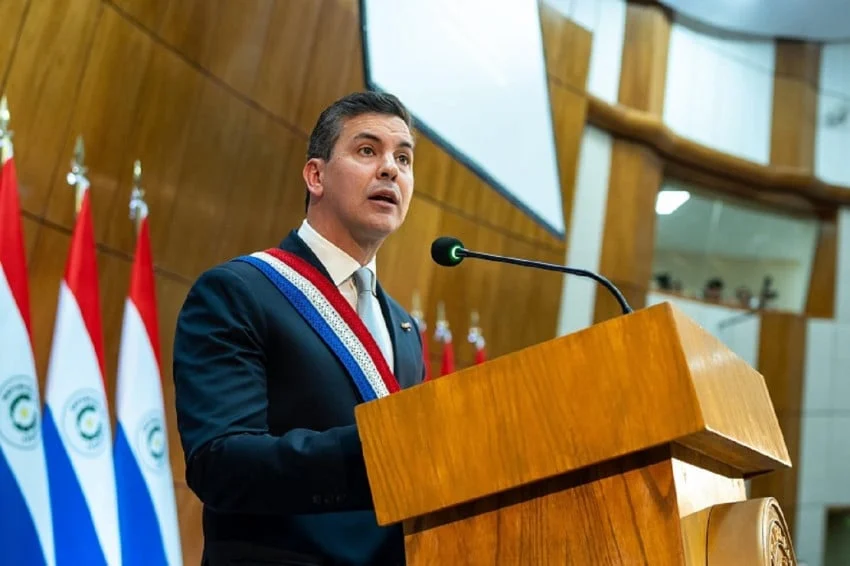
ASUNCION — In a stunning political development that has sent shockwaves across South America, Paraguay’s President Santiago Pena officially announced his resignation on Thursday. The decision comes on the heels of a devastating national banking crisis triggered by the sudden collapse of Ueno Bank, a dominant financial technology institution backed heavily by Pena’s administration. The failure of the bank locked out approximately three million account holders—representing roughly two-thirds of the country’s adult population—from accessing their personal and business funds. This unprecedented liquidity freeze instantly ignited fierce, widespread street demonstrations in the capital city of Asuncion, culminating in violent clashes with law enforcement, the loss of political backing within his own party, and mounting threats of impeachment from a united political opposition.
Pena formally delivered his resignation via a televised video address broadcast nationwide late Thursday. Speaking with visible solemnity, the embattled former leader cited the preservation of national stability, public peace, and the integrity of Paraguay’s democratic institutions as the primary drivers behind his abrupt exit. "With profound consideration for the stability of our great nation, the preservation of social peace, and the critical imperative to safeguard our democratic institutions, I have made the decision to step down from the office of the presidency," Pena stated in his brief address. The announcement effectively brings an abrupt halt to an administration that had promised economic modernization, digital transformation, and fiscal robustness, but ultimately faltered under the immense weight of systemic financial vulnerability.
The Chronology of a Crisis: From Fintech Expansion to National Paralysis
To understand the rapid unraveling of Santiago Pena’s presidency, one must examine the meteoric rise and catastrophic fall of Ueno Bank, an entity that intertwined modern digital finance with the highest echelons of Paraguayan political power. Operating initially as a dynamic financial technology company, Ueno officially transitioned into a fully licensed banking institution in 2023. Backed openly by the Pena administration as a flagship model for national financial inclusion, the bank expanded at a dizzying pace. By leveraging aggressive digital onboarding and strategic partnerships, Ueno quickly captured a massive market share, boasting on its corporate platforms that it actively serviced two out of every three adult citizens in Paraguay.
However, this rapid expansion masked severe underlying vulnerabilities. The crisis reached a boiling point on Wednesday when the Central Bank of Paraguay (Banco Central del Paraguay) took emergency action, formally placing Ueno Bank under direct government intervention and administrative supervision. The central regulatory authority revealed a chilling diagnostic: Ueno Bank possessed less than half of the statutory minimum capital required by Paraguayan law to adequately protect depositors and maintain systemic financial stability.
The immediate consequence of the central bank’s intervention was a total liquidity freeze. Approximately three million citizens suddenly found themselves unable to withdraw cash, pay bills, or execute basic digital transactions. For a population heavily reliant on daily digital banking services, the paralysis was absolute. Small business owners, wage earners, public sector employees, and retirees were locked out of their life savings overnight.
As news of the freeze spread across the country, spontaneous crowds gathered outside Ueno Bank branches and government administrative buildings in Asuncion. What began as peaceful gatherings quickly degenerated into volatile protests. Demonstrators hurled stones, blocked major thoroughfares, and clashed aggressively with riot police deployed around key government zones. Tear gas filled the air as the capital descended into civil unrest, laying bare the profound public anger directed squarely at the administration that had championed the troubled bank.
Political Isolation and the Collapse of Ruling Party Support
President Pena’s political standing deteriorated with the same alarming velocity as the nation’s banking sector. Throughout Wednesday and Thursday, as the streets of Asuncion burned, Pena frantically attempted to contain the fallout. In a desperate bid to restore public confidence and mitigate the financial devastation, Pena’s administration fast-tracked emergency legislation designed to establish a state-backed guarantee fund to reimburse affected depositors. According to executive statements, the hastily drafted emergency framework aimed to cover up to 98 percent of the everyday citizens impacted by the Ueno freeze.
However, the legislative maneuvers proved too little, too late. The sheer magnitude of the crisis alienated Pena from his vital political base. On Thursday afternoon, the powerful ruling Colorado Party (Asociación Nacional Republicana), which has dominated Paraguayan politics for decades and had previously provided Pena with a reliable legislative shield, officially withdrew its institutional support. Fearing complete electoral annihilation and profound civil instability, senior figures within the Colorado Party communicated that they could no longer defend the president’s handling of the financial sector.
Simultaneously, opposition parties in the national legislature moved with swift determination, initiating formal discussions to draft articles of impeachment against Pena. Facing certain removal from office through a parliamentary trial, abandoned by his political allies, and confronted by unrelenting civil unrest that threatened to plunge the nation into deeper anarchy, Pena opted for immediate resignation rather than a protracted and humiliating political downfall.
Economic and Systemic Implications for Paraguay
The sudden resignation of President Santiago Pena and the spectacular failure of Ueno Bank expose deep structural fragilities within Paraguay’s rapidly evolving economic landscape. In recent years, Asuncion has aggressively positioned itself as a regional hub for fintech innovation, digitalization, and foreign investment. The rapid transition of unregulated or lightly regulated financial platforms into systemically important banking institutions, however, appears to have outpaced the regulatory capacity and oversight mechanisms of the Central Bank of Paraguay.
Economists and financial analysts have raised serious questions regarding how an institution serving nearly 66 percent of the adult population was allowed to operate with capital reserves standing at less than 50 percent of legal requirements. This regulatory oversight failure has severely eroded public trust in the country’s entire financial architecture. While the emergency legislation proposed by the outgoing administration promises to reimburse the vast majority of retail depositors, the long-term cost to the national treasury remains unclear, and the psychological scarring on a populace that lost immediate access to its wealth will likely take years to heal.
Furthermore, the political vacuum created by Pena’s departure introduces a period of acute institutional uncertainty. Under the Paraguayan Constitution, the line of succession dictates how executive power must be transferred during an unpredicted presidential vacancy, requiring swift intervention by the legislative branch to swear in an interim leader capable of restoring public order, organizing emergency stabilization measures, and calming foreign investors who monitor the nation’s macroeconomic stability closely.
Reactions from Civil Society, Financial Sectors, and International Observers
In the wake of Pena’s resignation, reactions from various domestic and international sectors reflect deep anxiety paired with demands for sweeping structural accountability. Representatives of commercial unions, consumer protection agencies, and labor organizations have issued joint statements holding both executive leadership and regulatory bodies accountable for what they term an entirely preventable economic disaster. Civil society leaders have emphasized that ordinary citizens should never be forced to bear the catastrophic costs of financial mismanagement by corporate entities operating under state patronage.
Financial analysts monitoring South American markets note that the Paraguay crisis serves as a cautionary tale regarding the unchecked integration of high-risk fintech models into traditional banking frameworks without rigorous, real-time stress testing and conservative capital reserve enforcement. International rating agencies have already begun reviewing Paraguay’s sovereign debt outlook, warning that prolonged political instability combined with systemic banking failures could result in credit downgrades, increased borrowing costs, and a temporary contraction of foreign direct investment.
As Asuncion slowly begins to clean up the debris from the street clashes and lawmakers convene in emergency legislative sessions to navigate the constitutional transition of power, the nation stands at a critical historical crossroads. The events of this week have demonstrated the fragile intersection of digital financial inclusion, political patronage, and public trust, leaving Paraguay searching for steady leadership to guide it out of its deepest political and economic crisis in decades.