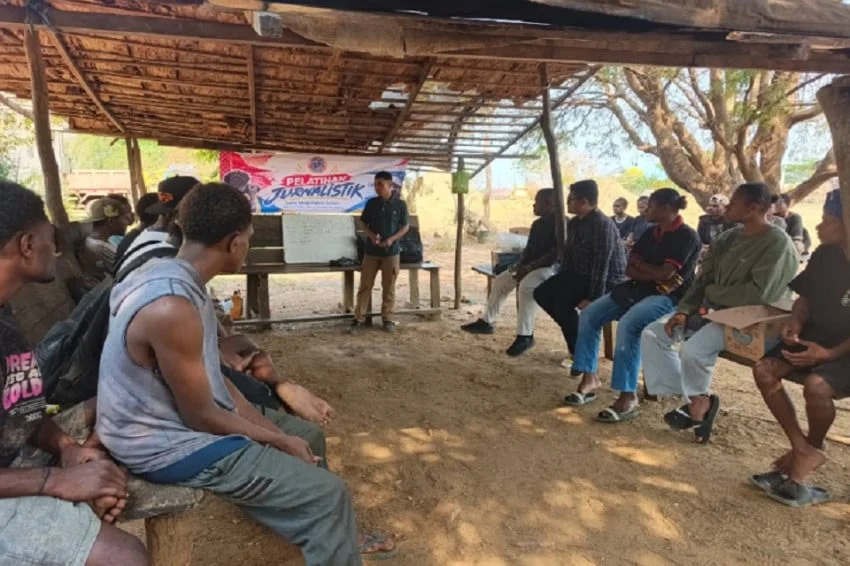
The young generation of the Kalai Anim indigenous community in Merauke Regency, South Papua, has taken a decisive step toward self-representation by acquiring essential media and reporting skills through a newly launched journalism training program. Held at the Honai Patung Hati Kudus Yesus in Merauke, the initiative aims to equip local students and youth with the technical expertise needed to articulate community concerns, highlight regional issues, and bring local grassroots perspectives directly to the broader public eye.
The training session, organized collaboratively by the Ikatan Mahasiswa dan Pelajar Kalai Anim (IMPKA) and Merah Pusaka Stratejik Indonesia (MPSI), addresses a long-standing structural challenge: the underrepresentation of remote indigenous communities in mainstream digital and print media. By fostering local media literacy, the organizers hope to bridge the information divide, enhance the accuracy of narratives concerning South Papua, and minimize the risk of miscommunication or distorted reporting regarding indigenous livelihoods and regional developments.
The Imperative of Indigenous Journalism in South Papua
In recent years, the acceleration of regional autonomy, infrastructure expansion, and socio-economic shifts in the newly established provinces of Papua have intensified the need for localized storytelling. Indigenous communities across Merauke Regency often face systemic hurdles in voicing their aspirations, grievances, and cultural preservation efforts to policymakers and the wider Indonesian public.
When external actors exclusively document indigenous life, nuances are frequently lost, leading to generalized or inaccurate portrayals. The incorporation of journalistic training for youth acts as a corrective measure. By teaching participants how to gather facts objectively, conduct interviews, write structured reports, and navigate digital publishing tools, the program transforms passive subjects of news into active chroniclers of their own history and current events.
Furthermore, mastering journalistic principles allows young community leaders to document oral traditions, customary land management practices, and local wisdom before they fade. This educational push is not merely about media consumption; it is an exercise in cultural preservation, organizational capacity building, and civic empowerment.
Chronology and Collaborative Genesis of the Training Program
The joint initiative between IMPKA and MPSI materialized after months of strategic discussions regarding the visibility of indigenous student organizations in southern Papua. The organizing bodies recognized that while many regional youth groups actively engage in community service and cultural advocacy, their activities frequently remain confined to localized networks due to a lack of media engagement strategies.
On the morning of Sunday, November 1, 2026, participants gathered at the Honai Patung Hati Kudus Yesus in Merauke for the intensive workshop. The venue itself held symbolic value, serving as a communal space that reflects unity and shared values among the indigenous population of the region.
The program commenced with opening remarks from the leadership of IMPKA, followed by technical workshops led by researchers and media practitioners from MPSI. The curriculum was specifically tailored to address grassroots reporting challenges, focusing on narrative structuring, ethical information gathering, and the strategic utilization of online platforms to amplify community campaigns.
Leadership Perspectives and Organizational Goals
Addressing the participants during the opening session, IMPKA Chairman Emanuel Talpia Yolmen underscored the transformative potential of media literacy for the younger generation. He emphasized that the acquisition of writing and reporting skills is no longer optional for modern student organizations, but rather a core competency required to safeguard community interests.
"I hope that the material delivered during this session will serve as a foundational guide, a practical reference, and a valuable experiential learning tool for all of my friends here," Emanuel stated. He noted that the ability to access, process, and disseminate information accurately will empower students to articulate their demands clearly to government bodies and civil society organizations.
Emanuel further articulated his vision for the application of these skills beyond formal organizational reports. He encouraged participants to deploy journalistic techniques in their daily community interactions, specifically focusing on documenting and popularizing Kalai Anim cultural heritage. In an era dominated by digital media, he argued, preserving indigenous identity requires active digital curation by the indigenous people themselves.
Concluding his address, the IMPKA chairman reiterated that technical training must go hand in hand with core values of solidarity, brotherhood, and collective cooperation. Strengthening organizational capacity, he noted, is fundamentally rooted in mutual trust and unified action among the youth.
Expert Analysis on Media Access and Digital Inclusion
Providing an external research perspective, Fathan Putra Mardela, a researcher with MPSI, shed light on the structural impediments that hinder indigenous and student organizations from gaining adequate media exposure. According to MPSI field evaluations, numerous regional groups across eastern Indonesia encounter significant barriers when attempting to pitch stories or publish activities in mainstream digital news portals.
"We still observe many community organizations struggling to access online media platforms and effectively pitch their stories," Fathan explained. He noted that this digital exclusion often results in a vicious cycle: limited media coverage leads to low public awareness, which in turn diminishes institutional support for local development and cultural preservation initiatives.
Fathan emphasized that bridging this gap requires systematic capacity-building programs rather than sporadic workshops. By training youth to write press releases, produce factual news reports, and utilize social media channels professionally, organizations like IMPKA can bypass traditional media bottlenecks. This enables them to establish direct communication channels with the public, government agencies, and non-governmental organizations.
Broader Implications for Regional Development and Public Discourse
The successful execution of the journalism training program in Merauke carries profound implications for the socio-political landscape of South Papua. As the region continues to undergo rapid administrative and infrastructural transformation, the inclusion of indigenous voices in public policy debates is critical for sustainable development.
-
Enhanced Data Accuracy and Fact-Checking: With locally trained youth acting as primary information gatherers, the accuracy of reports concerning local conflicts, land rights discussions, and social welfare programs is expected to improve. Reliable grassroots data prevents misinformation and fosters constructive dialogue between indigenous communities and regional authorities.
-
Empowerment of Marginalized Demographics: Equipping students and young adults with media tools democratizes information access. It ensures that remote villages and indigenous settlements within Merauke Regency are no longer acoustically isolated from urban centers where policy decisions are formulated.
-
Cultural Sovereignty in the Digital Age: The conscious documentation of Kalai Anim traditions through modern media formats ensures that indigenous heritage is preserved on terms dictated by the community. This counters external anthropological commercialization and promotes authentic cultural education.
-
Institutional Resilience: For organizations like IMPKA, professionalizing their communication strategies enhances their operational credibility. Transparent reporting of organizational activities builds trust among members, donors, and external partners, thereby securing long-term institutional sustainability.
Conclusion and Future Outlook
The journalism training initiative spearheaded by IMPKA and MPSI in Merauke represents a vital milestone in the ongoing empowerment of indigenous youth in South Papua. By transforming participants into skilled communicators, the program addresses the twin challenges of media exclusion and cultural erosion.
As these young writers and advocates return to their respective villages and campuses, the tools acquired on that November Sunday are expected to yield a steady stream of authentic, localized reporting. Ultimately, the initiative demonstrates that sustainable regional development must begin from within, anchored by an informed, articulate, and media-literate youth capable of narrating their own destiny.