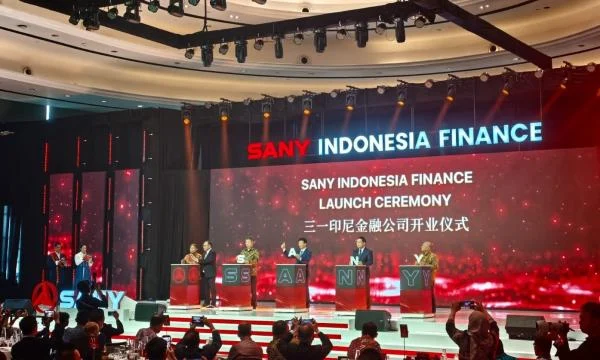
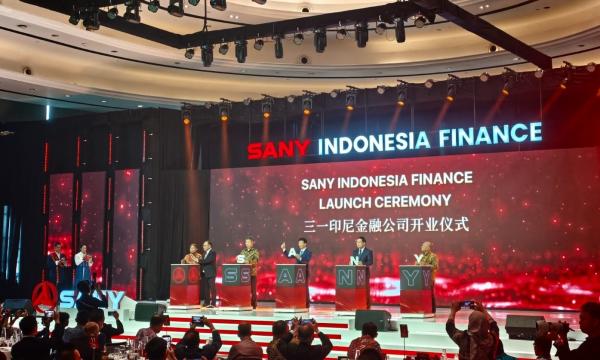
The landscape of heavy equipment financing in Indonesia is undergoing a significant transformation as Sany Group, the global industrial machinery giant from China, officially marks its foray into the domestic financial services sector. Through its newly established entity, PT Sany Indonesia Finance, the conglomerate has set an ambitious target to reach a net booking value of Rp1.5 trillion by the end of 2027. This move represents a strategic vertical integration, aiming to provide a seamless "one-stop-shop" experience for customers purchasing heavy machinery and construction equipment across the archipelago.
The announcement was made official during a press conference held at the Royal Glasshouse, Park Hyatt Jakarta, on Thursday, October 29, 2026. This milestone follows the successful acquisition of a formal operating license from the Financial Services Authority of Indonesia (OJK), a regulatory prerequisite that validates the company’s compliance with national financial standards and positions it as a significant player in the non-bank financial industry.
The Strategic Rationale for Financial Expansion
For Sany Group, the decision to enter the financing sector is rooted in a data-driven assessment of the Indonesian market. Over the past decade, Indonesia has been a high-priority market for Sany due to the country’s aggressive infrastructure development agenda and the robust demand for heavy equipment in the mining, forestry, and construction sectors.
By launching its own financing arm, Sany is effectively removing the friction points between product procurement and capital acquisition. Traditionally, contractors and mining firms had to navigate third-party leasing or banking channels, which often involve stringent credit assessments and varying interest rate structures. Sany Indonesia Finance intends to streamline this process by leveraging the proprietary data it holds on its own equipment performance and customer payment behaviors.
CEO of PT Sany Indonesia Finance, Bryan Kasenda, emphasized that the license from the OJK is the foundational pillar of the company’s broader growth strategy. "The acquisition of the OJK license is not merely a regulatory achievement; it is a vital step in fortifying our presence and creating a self-sustaining ecosystem. We are now empowered to provide bespoke financing solutions that are tailored to the specific lifecycles of Sany’s heavy machinery," Kasenda noted during the event.
Market Context and Growth Trajectory
The timing of this expansion is far from coincidental. Sany Group has reported a sharp upward trajectory in its sales performance in Indonesia throughout 2026. As the demand for excavators, cranes, and specialized mining equipment continues to rise, the need for flexible, specialized financing options has become more pronounced.
Industry analysts observe that the heavy equipment sector in Indonesia is highly sensitive to fluctuations in global commodity prices. When mining companies experience high output periods, demand for heavy machinery spikes, yet these companies often require sophisticated financing structures to manage their capital expenditures. Sany Indonesia Finance aims to capture this market by offering competitive rates that reflect the company’s deep understanding of the equipment’s residual value and operational reliability.
"We have witnessed a significant surge in our sales volume over the past few years, with 2026 proving to be a watershed year. Our internal data suggests that there is a substantial segment of the market that remains underserved by traditional financial institutions, particularly regarding the specific nuances of construction equipment financing. We are stepping in to bridge that gap," Kasenda added.
A Chronology of Sany’s Indonesian Presence
Sany’s journey in Indonesia has been characterized by consistent, methodical scaling:

- Early Market Entry: Initially focusing on direct equipment distribution through local partnerships and authorized dealerships.
- Expansion of After-Sales Services: Establishing regional service hubs to ensure high machine availability, which built significant trust among local contractors.
- Local Assembly and Manufacturing Initiatives: Moving from pure importation to exploring local assembly to comply with the Indonesian government’s Local Content Requirements (TKDN).
- Strategic Financial Diversification: The 2026 launch of Sany Indonesia Finance, marking the transition from a hardware-focused company to a holistic provider of machinery and financial solutions.
This trajectory reflects a common pattern among major Chinese multinational corporations operating in Southeast Asia—transitioning from pure-play exporters to deeply integrated local players who offer comprehensive services.
Financial Implications and Future Targets
The target of Rp1.5 trillion in net booking by 2027 is a clear indicator of the company’s confidence in the Indonesian economic outlook. To achieve this, Sany Indonesia Finance is expected to implement a multi-tiered credit strategy, catering to both large-scale infrastructure conglomerates and medium-sized enterprise contractors.
From a macroeconomic perspective, this expansion contributes to the strengthening of the construction sector. By facilitating easier access to modern machinery, Sany is indirectly supporting the acceleration of national infrastructure projects, including toll roads, power plants, and industrial estates. Furthermore, the presence of a captive finance company often leads to more stable market pricing and a healthier second-hand machinery market, as the financier can manage the recovery and remarketing of equipment more efficiently than a generic bank.
Challenges and Risk Management
Despite the optimistic outlook, the company faces a complex regulatory and economic environment. Indonesia’s financial sector is strictly governed by the OJK, which mandates rigorous risk management, capital adequacy ratios, and transparent reporting. Furthermore, the heavy equipment industry is inherently cyclical.
Sany Indonesia Finance must navigate the potential volatility of commodity prices, which directly impacts the purchasing power of their core client base in the mining sector. However, the company’s integration with the parent group provides a unique advantage: access to massive amounts of operational data. By monitoring the "health" of the machinery in real-time, the finance arm can mitigate credit risks more effectively than traditional lenders, who lack the technical expertise to evaluate the collateral—the machinery itself—as accurately.

Industry Reactions and Competitive Landscape
The entry of an Original Equipment Manufacturer (OEM)-backed finance firm usually creates a ripple effect in the banking and multi-finance sectors. While traditional banks may face increased competition in the asset-backed lending space, the overall impact is likely to be positive for the industry. Increased availability of financing encourages more companies to modernize their fleets, leading to higher efficiency in construction and mining projects across the country.
Analysts suggest that other global OEMs operating in Indonesia may feel pressure to follow suit if they do not already have robust captive finance arms. The move signals that the competition is no longer just about the horsepower of the machines or the fuel efficiency of the engines; it is now about the flexibility and accessibility of the financial packages that come attached to those machines.
Conclusion: Strengthening the Ecosystem
The launch of Sany Indonesia Finance is a testament to the maturation of the Chinese industrial sector’s global strategy. It is no longer enough to sell a product; the modern industrial market demands an end-to-end service model. By controlling the financing, Sany ensures that it remains the primary partner for its clients throughout the entire lifecycle of their equipment, from the initial sale to the final trade-in.
As the company works toward its 2027 goal, the focus will likely remain on integrating digital financial tools, enhancing risk assessment models, and ensuring that its credit products remain aligned with the government’s broader goals for sustainable infrastructure development. For the Indonesian market, this development represents a significant increase in available capital for industrial growth, marking a new chapter in the partnership between China’s industrial sector and Indonesia’s evolving economy. With the infrastructure sector poised for continued growth through 2030, Sany’s latest venture appears well-timed to capture substantial market share in the years to come.