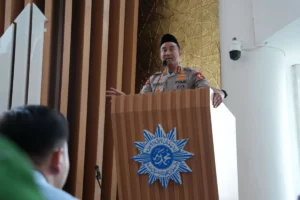
The measurement of religious devotion within Islam has long been a subject of theological study and practical application, yet contemporary religious discourse frequently struggles to balance individual spirituality with communal responsibility. Addressing this critical juncture, the Central Board of the Muhammadiyah Tabligh Council has formally articulated a progressive framework that elevates social piety—known in Islamic jurisprudence as kesalihan sosial—to the absolute pinnacle of a believer’s religious hierarchy. This profound perspective was delivered by Gita Danu Pranata, Vice Chairman of the Muhammadiyah Central Board’s Tabligh Council, during a comprehensive regional study session organized by the Northern Tamantirto Youth and Community Branch in Bantul, Special Region of Yogyakarta.
The assertion challenges conventional, insular perceptions of piety that prioritize personal devotional rituals above active civic engagement and humanitarian contribution. While emphasizing that foundational Islamic monotheism (tauhid) and strict adherence to mandatory and voluntary worship remain non-negotiable pillars of faith, the Muhammadiyah leadership argues that these acts of vertical devotion are incomplete without a robust horizontal manifestation of compassion and societal benefit. As one of Indonesia’s largest and most influential Islamic reformist organizations, Muhammadiyah continues to champion a theology of action, positioning the prophetic mission of Prophet Muhammad as a universal catalyst for societal betterment rather than a mechanism for purely personal spiritual salvation.
Context and Chronology of the Bantul Assembly
The scholarly gathering took place on October 28, drawing scores of local community members, academics, and organizational leaders to the Northern Tamantirto district in Bantul. The event formed part of a routine intellectual and spiritual outreach program initiated by the local branch of Muhammadiyah, designed to bridge grassroots religious practice with contemporary socio-ethical challenges facing modern Indonesian society.
Over recent years, Bantul—a district known for its vibrant civil society and dense network of educational and religious institutions—has increasingly become a focal point for discussions concerning religious moderation, social cohesion, and post-pandemic community recovery. Against this backdrop, the lecture by Gita Danu Pranata was strategically timed to address emerging tendencies toward hyper-individualistic religiosity, where digital piety and isolated ritual observance sometimes overshadow the immediate physical and emotional needs of marginalized neighbors.
The chronology of the event unfolded through a structured afternoon program, commencing with Quranic recitation, followed by organizational reports from the Northern Tamantirto branch, and culminating in the keynote lecture delivered by the PP Muhammadiyah official. The discourse subsequently transitioned into an interactive question-and-answer session, reflecting deep local engagement with the theological boundaries separating private worship from public welfare.
Deconstructing the Hierarchy of Faith: Individual vs. Social Piety
Elaborating on the structural tiers of Islamic observance, Gita Danu Pranata introduced a clear taxonomy that redefines how believers should evaluate their spiritual standing before God. According to this formulation, isolated spiritual achievements—no matter how rigorous—occupy a secondary tier if they fail to translate into tangible benefits for the surrounding community.
"It turns out that individual spirituality, individual religiosity, or excellence in worship executed solely for oneself—that is actually only at level two," Gita explained to the attentive audience in Bantul.
This conceptualization does not diminish the significance of the first tier, which encompasses core doctrinal purity and foundational rituals such as the five daily prayers, fasting, and pilgrimage. Instead, it contextualizes these rituals as preparatory training grounds designed to cultivate the empathy, discipline, and moral fortitude required to execute the higher tier: social piety.
For Muhammadiyah, whose historical ethos since its founding by Ahmad Dahlan in 1912 has been deeply rooted in the theological imperatives of Surah Al-Ma’un—which condemns those who perform prayers while neglecting orphans and the needy—faith is inherently operational. The organization maintains that the teachings brought by Prophet Muhammad were explicitly designed as a mercy to all creation (rahmatan lil-alamin). Consequently, a believer who seeks divine reward exclusively through private devotions while remaining indifferent to societal suffering falls short of the comprehensive model of prophetic discipleship.
The Microcosm of Community: Neighborly Relations as the Baseline of Ethics
To operationalize social piety, the Muhammadiyah leadership directed the audience’s attention to the most immediate sphere of human interaction: the neighborhood. In a society undergoing rapid urbanization and social fragmentation, the traditional bonds of mutual aid are frequently strained by anonymity and economic pressures.
Drawing upon prophetic traditions, Gita underscored the universal Islamic dictum Khairunnas anfa’uhum linnas—stating that the best of people are those who bring the greatest benefit to others. This mandate applies indiscriminately to immediate neighbors, regardless of whether biological, ethnic, or even religious ties bind them. The obligation to maintain harmonious relations extends to the households situated directly in front, behind, to the left, and to the right, stretching across both immediate proximities and distant community members.
To successfully navigate these relationships and establish a cohesive social fabric, Islamic teachings provide a structured four-pillar framework for interpersonal conduct among neighbors.
1. Mutual Acquaintance (Ta’aruf)
The foundation of neighborly harmony begins with proactive recognition and familiarization. In modern urban settings, residents often live in close physical proximity for years without knowing the names, professions, or basic circumstances of adjacent households. Islam mandates breaking down these invisible barriers through polite greetings, introductory gestures, and active participation in local community spaces. Without mutual acquaintance, empathy cannot take root.
2. Mutual Understanding (Tafahum)
Beyond mere acquaintance, community members must cultivate a deep comprehension of each other’s rights, boundaries, and vulnerabilities. Understanding a neighbor involves recognizing domestic dynamics, respecting privacy, and ensuring that one’s own domestic activities—ranging from noise levels to waste disposal—do not infringe upon the peace and security of adjacent homes. This mutual comprehension serves as a preventative mechanism against neighborhood disputes.
3. Mutual Reminder in Goodness and Patience (Ta’awun ‘al-Birr wat-Taqwa)
The third pillar elevates the relationship from passive coexistence to active moral and social stewardship. Neighbors are tasked with looking out for one another’s welfare, gently correcting harmful behaviors, and encouraging righteous actions. This entails both practical warnings against impending dangers and collaborative efforts to uplift the moral and social environment of the local neighborhood.
4. Mutual Guarantee (Takaful)
The fourth pillar represents the highest echelon of interpersonal responsibility, though its application varies depending on the nature of the relationship. Takaful involves shared economic, emotional, and physical responsibility for the welfare of others. Gita clarified that while full-scale takaful is legally and morally mandated primarily within immediate familial structures—such as the reciprocal duties between parents and children—aspects of this mutual guarantee heavily influence the Islamic ethos of neighborhood solidarity through mechanisms like disaster relief, mutual health funds, and food security initiatives.
Broader Implications and Sociological Analysis
The articulation of social piety as the premier tier of religious practice carries significant implications for contemporary Indonesian civil society. In an era characterized by polarizing identity politics and the rise of conservative theological interpretations that occasionally emphasize exclusionary ritualism over civic inclusion, mainstream organizations like Muhammadiyah are actively steering the national religious discourse back toward inclusive humanitarianism.
Sociological analysts observing religious trends in Southeast Asia note that institutionalizing social piety serves as an effective antidote to religious radicalism and sectarianism. By anchoring religious validation in community service, poverty alleviation, and environmental stewardship, organizations encourage believers to direct their religious zeal into constructive developmental channels.
Furthermore, this theological stance reinforces Muhammadiyah’s extensive institutional portfolio, which spans thousands of schools, hospitals, orphanages, and disaster response units across the Indonesian archipelago. When leaders like Gita Danu Pranata emphasize that individual worship is merely a secondary tier compared to societal uplift, they are offering a theoretical justification for the organization’s century-old philanthropic strategy.
Conclusion
The Bantul regional lecture by the Muhammadiyah Tabligh Council serves as a timely reminder of the core ethical imperatives embedded within Islamic teachings. By establishing social piety as the ultimate benchmark of religious authenticity, Muhammadiyah challenges believers to look beyond personal spiritual salvation and engage deeply with the pressing socioeconomic realities of their communities. Through structured neighborly relations—grounded in acquaintance, understanding, mutual reminders, and collective responsibility—the organization continues to foster a model of Islam that is simultaneously faithful in its vertical devotions and transformative in its horizontal impacts.