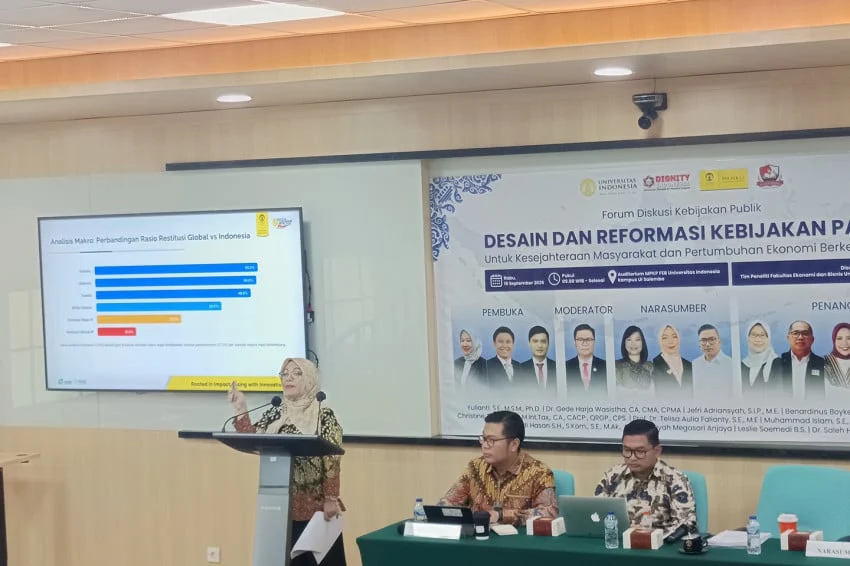
The Indonesian government is facing an increasingly complex fiscal dilemma as it attempts to balance the imperatives of national revenue targets with the urgent need to maintain the liquidity and operational continuity of the domestic business sector. Recent data indicates a significant surge in applications for tax overpayment refunds, or tax restitution, which has strained the administrative capacity of the Directorate General of Taxes (DJP) and created a bottleneck that threatens the working capital of companies across various sectors. In response to this mounting pressure, the Public Policy Analysis (PPA) unit at the Faculty of Economics and Business, Universitas Indonesia (FEB UI), has formulated seven strategic policy recommendations aimed at overhauling the tax restitution management system.
The tension between fiscal space and corporate liquidity has reached a critical juncture. As the state seeks to secure every rupiah of projected tax revenue to fund development projects and social programs, businesses—particularly exporters and capital-intensive industries—find their cash flows tethered to pending refund requests. This conflict has prompted calls for a comprehensive structural reform that shifts from a rigid, manual-heavy oversight model to a sophisticated, risk-based administrative framework.
The Anatomy of the Restitution Crisis
The current backlog in tax restitution is not merely a bureaucratic inefficiency; it is a symptom of a multifaceted economic environment. Economists note that fluctuations in restitution applications are driven by a complex interplay of variables, including macroeconomic shifts, the pace of foreign and domestic investment, export performance, and the inherent design of the Value Added Tax (VAT) system.
Under the current VAT regime, businesses often pay more in input taxes than they collect in output taxes, especially during periods of high investment or export growth. While the law mandates the return of these excess payments, the administration of these refunds has historically been marked by lengthy audit processes. These audits are designed to prevent tax fraud, yet they frequently ensnare compliant businesses in a web of uncertainty. When the state treasury experiences fiscal tightness, the duration of these audits tends to extend, effectively turning the government into an unintended borrower of corporate capital.
Seven Pillars of Reform
During a public discussion held at the UI Salemba campus on September 16, 2026, Prof. Telisa Aulia Falianty, a prominent economist and Professor at FEB UI, outlined the seven-point framework designed to harmonize tax enforcement with economic vitality. The core of this proposal lies in a tiered, risk-based management system.
- Risk-Based Categorization: The government must move away from a "one-size-fits-all" audit approach. By categorizing taxpayers based on historical compliance, the DJP can expedite refunds for low-risk, highly compliant entities while focusing intensive audits on high-risk profiles.
- Standardized Service Level Agreements (SLAs): Each risk category must be assigned a clear, legally binding timeline for the completion of the refund process. For low-risk taxpayers, this could mean an automated, near-instantaneous refund, while for high-risk cases, the period should be capped at a reasonable timeframe—such as six months to one year—to ensure business certainty.
- Transparent Digital Tracking: Implementing a user-friendly, real-time dashboard for taxpayers to track the status of their restitution applications. This transparency would reduce the information asymmetry that currently plagues the relationship between the tax authority and the private sector.
- Expansion of Audit Capacity: To handle the increasing volume of requests, the DJP is urged to bolster its workforce of tax examiners. Human resource expansion must be paired with continuous professional training to ensure that examiners are equipped to handle complex international transactions.
- Full Integration of the Coretax System: The ongoing implementation of the Coretax administration system must be fast-tracked. Digital integration allows for the cross-referencing of invoices and transaction data, reducing the reliance on manual paper-based audits which are prone to delays and errors.
- Public Accountability of Backlogs: The government should periodically publish data regarding the total volume and age of pending restitution claims. This data-driven approach fosters public accountability and allows policymakers to identify specific sectors where liquidity crunches are most acute.
- Enhanced Fraud Mitigation Protocols: By utilizing advanced data analytics, the tax authority can proactively identify and mitigate risks associated with "ghost" tax invoices, under-invoicing, and transactions not based on actual facts (TBTS), thereby protecting state revenue without punishing legitimate businesses.
The Economic Ripple Effect
The implications of delayed tax restitution extend far beyond the balance sheets of individual companies. When companies face liquidity constraints, they are forced to delay capital expenditures, postpone hiring, or resort to expensive commercial financing to maintain day-to-day operations. In the broader context of the Indonesian economy, this creates a drag on growth.
The Indonesian Chamber of Commerce and Industry (KADIN) has consistently highlighted that the uncertainty surrounding tax refunds acts as a "hidden tax" on productivity. For many SMEs and export-oriented firms, a significant portion of their operational budget is essentially held hostage by the state. If the average time to process a refund is extended from three months to twelve, a firm’s cash conversion cycle is severely disrupted, potentially leading to insolvency in high-volume, low-margin sectors.
Technological Shifts: The Coretax Horizon
The proposed reforms coincide with the government’s transition toward the Coretax system, a modernization project aimed at digitalizing the entire taxation chain. Experts argue that technology is the only viable path to closing the gap between stringent oversight and efficient service.
Under the current manual or semi-automated systems, the DJP is often forced to perform extensive manual verification to prevent the systemic abuse of VAT refunds—a common target for organized tax fraud. However, with the integration of real-time e-invoicing and machine learning algorithms, the system can flag suspicious patterns instantaneously. This shift would allow the tax office to focus its human capital on investigating genuine cases of fraud, rather than performing repetitive administrative checks on honest taxpayers.
Institutional Responses and Future Outlook
While the government has acknowledged the need for reform, the transition is fraught with challenges. The Ministry of Finance faces the constant pressure of meeting the annual APBN (State Budget) targets. When the budget is under strain, there is an institutional tendency to delay disbursements, including tax refunds, to keep the fiscal deficit within the statutory limits.
However, the FEB UI study argues that this is a short-term gain that leads to long-term pain. By stifling business liquidity, the government inadvertently slows down the economic activity that generates future tax revenue. A healthier approach, the study suggests, is to view tax restitution not as an expense, but as a critical component of the national business infrastructure.
The discourse surrounding these seven recommendations is expected to continue as the government prepares for the next fiscal cycle. Policymakers are under mounting pressure from business associations to provide a concrete timeline for the implementation of these reforms. As Indonesia aims to maintain its position as a competitive investment destination in Southeast Asia, the efficiency of its tax administration will remain a primary metric for investors.
Ultimately, the goal of the PPA FEB UI recommendations is to transform the tax authority from an adversarial entity into a partner in national economic development. By balancing the "fiscal space" with "business liquidity," the government can ensure that its revenue collection efforts do not come at the cost of the very engine that powers the nation’s growth. Whether the government will fully adopt this risk-based, transparent framework remains a focal point for economic observers in the coming months. The successful integration of these reforms could serve as a model for emerging economies globally, demonstrating that rigorous tax compliance and a healthy business climate are not mutually exclusive, but rather complementary pillars of a sustainable national economy.