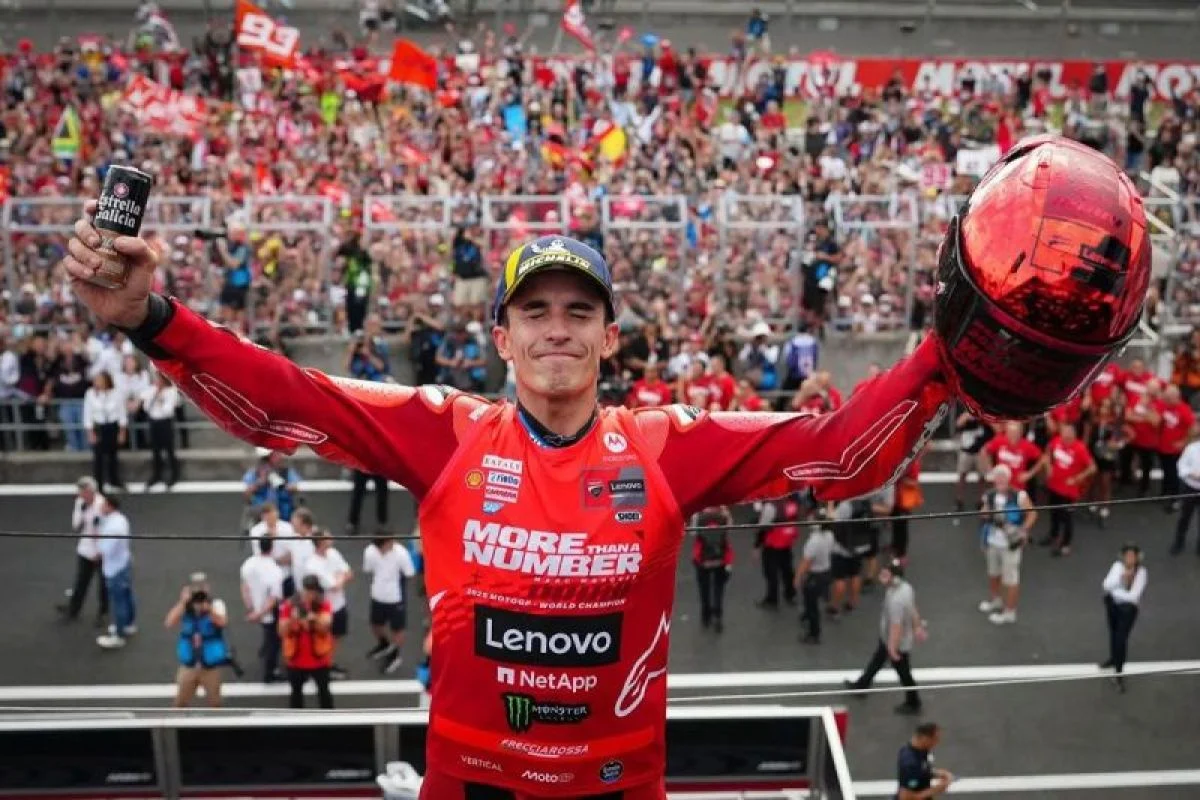
The premier class of motorcycle Grand Prix racing has witnessed one of the most remarkable redemption arcs in modern sporting history. Spanish professional motorcycle racer Marc Marquez has officially reclaimed the pinnacle of global motorsport by securing the 2025 MotoGP World Championship. This triumphant milestone comes exactly six years after his last global crown in 2019, cementing a legacy defined by extraordinary resilience, physical rehabilitation, and strategic career evolution.
Marquez’s journey to his seventh premier-class title—and the ninth world championship of his overall career—underscores a rare tenacity. From his explosive debut with the Repsol Honda Team in 2013 to his brief transitional stint with Gresini Racing in 2024, and ultimately his triumphant campaign with the factory Ducati Lenovo Team in 2025, Marquez has continually redefined the boundaries of elite athletic performance. With this latest victory, the rider from Cervera has not only ended a half-decade championship drought but has also tied the legendary Valentino Rossi with seven premier-class titles, breathing vibrant new life into the historical hierarchy of Grand Prix racing.
The Evolution of a Champion: Team Transitions and Strategic Shifts
The 2025 championship campaign represents the culmination of a multi-year masterclass in adaptability. Having spent more than a decade as the undisputed cornerstone of the Repsol Honda Team—where he secured six of his premier-class titles—Marquez faced an unprecedented turning point in his career. Persistent machine struggles and severe injuries prompted the Spanish star to make a high-stakes, unconventional move to the independent Gresini Racing Team for the 2024 season.
That calculated gamble served as a crucial proving ground, demonstrating that Marquez’s racecraft remained peerless even on machinery that was not a factory-spec prototype. Recognizing his enduring competitive hunger and unmatched data feedback, the Ducati Lenovo Team secured his services for the subsequent regulatory era. Integrating seamlessly into the Bologna-based factory squad, Marquez combined his trademark aggressive cornering style with the metronomic efficiency of the Desmosedici GP machine, outperforming a grid of elite younger competitors and managing tire conservation better than ever before in his career.
Chronology of Glory: The Seven Premier-Class Crowns
To fully comprehend the magnitude of Marquez’s 2025 triumph, one must examine the chronological architecture of his record-breaking career. Each championship chapter highlights a distinct phase of tactical maturation, physical dominance, and historical benchmark-setting.
1. The Rookie Phenomenon: MotoGP 2013
Marking his arrival with immediate authority, Marquez claimed pole position and his maiden premier-class victory at Laguna Seca in 2013. At just 20 years and 63 days old, he shattered the longstanding record held by Freddie Spencer—who was 20 years and 196 days old when he won the 1982 Belgian 500cc Grand Prix at Spa-Francorchamps—to become the youngest premier-class Grand Prix winner and world champion in history.
2. Back-to-Back Brilliance: MotoGP 2014
Demonstrating that his rookie success was no fluke, Marquez dominated the 2014 season. He clinched his second consecutive world title by finishing second at the Twin Ring Motegi circuit, securing 20 crucial championship points. In doing so, he became the first Honda rider to seal a world championship on home manufacturer soil in Japan, while simultaneously breaking Mike Hailwood’s 1963 record to become the youngest rider to capture back-to-back premier-class crowns at 21 years and 237 days old.
3. The Resilient Comeback: MotoGP 2016
Following a turbulent and physically punishing 2015 campaign marred by frequent crashes and mechanical inconsistencies, Marquez engineered a tactical masterclass in 2016. Opting for consistency over absolute raw pace when necessary, he navigated the season with calculated precision to secure his third premier-class title. At 23 years old, he surpassed Hailwood’s vintage benchmark from 1964 as the youngest competitor to amass three elite championships.
4. Unyielding Dominance: MotoGP 2017
The 2017 season tested Marquez’s psychological fortitude through a fierce, season-long championship duel with Ducati’s Andrea Dovizioso. Down to the final round in Valencia, Marquez managed pressure with veteran poise, securing the crown and etching his name deeper into history as the youngest rider to collect four premier-class titles.
5. Conquering Adversity: MotoGP 2018
Despite facing early-season adversity—including multiple penalties at the contentious Argentine Grand Prix—Marquez maintained supreme consistency throughout 2018. He racked up nine grand prix victories and sealed the championship mathematics at Motegi, Honda’s home turf. This victory marked a historic milestone: the first time a rider under the age of 26 had accumulated seven total world titles across all categories.
6. The Peak of Invincibility: MotoGP 2019
The 2019 season stands as one of the most statistically dominant campaigns in Grand Prix history. Marquez engaged in breathtaking last-lap battles against elite rivals like Andrea Dovizioso and Fabio Quartararo. He secured his sixth premier-class title with a staggering margin, bringing his cumulative world championship tally to eight across all classes, including his 2010 125cc and 2012 Moto2 triumphs.
7. The Redemption Arc: MotoGP 2025
Following the harrowing 2020 arm fracture at Jerez that triggered years of surgical interventions, double vision struggles, and competitive wilderness, Marquez mounted an emotional comeback in 2025. By securing second place at the Motegi circuit on Sunday, September 28, 2025, he mathematically secured his seventh premier-class title. Notably, he shared the podium battle with his younger brother and rival, Alex Marquez, capping a deeply personal family and professional redemption story.
Rival Reactions and Industry Perspectives
The racing paddock reacted to Marquez’s seventh premier-class crown with a blend of awe, professional respect, and acknowledgment of an era-defining achievement. Fellow competitors noted that overcoming nearly five years of debilitating physical pain to re-establish technical supremacy required a psychological fortitude rarely seen in professional sports. Industry analysts highlighted that Marquez’s successful transition across three distinct manufacturer philosophies—Honda, Gresini-Ducati, and factory Ducati—permanently silences critics who argued his success was solely a byproduct of superior machinery during his early career.
Broader Economic and Tourism Impacts in Indonesia
The timing of Marquez’s historic championship convergence coincides with his arrival in Southeast Asia for the pivotal rounds of the autumn calendar, generating massive commercial ripples. Tourism and infrastructure stakeholders in Indonesia reported immediate economic benefits following the confirmation of his seventh title. Official ticketing partners confirmed that premium hospitality packages, including the exclusive Deluxe and Royal Box categories for the upcoming Indonesian Grand Prix, sold out within hours of the announcement.
State-owned tourism holding company InJourney announced plans for extensive celebratory activations and fan-engagement surprises to honor the newly crowned world champion upon his arrival in Lombok. Local race organizers anticipate record-breaking spectator attendance, driven by the immense popularity of Marquez and the narrative weight of his historic title chase.
Fact-Based Analysis and Future Implications
The implications of Marc Marquez’s 2025 championship extend far beyond individual statistics. By matching Valentino Rossi’s benchmark of seven premier-class titles, Marquez has intensified the ongoing debate regarding the greatest Grand Prix rider of all time. Furthermore, his resurgence proves that modern sports medicine and advanced biomechanical rehabilitation can extend the peak performance window of elite riders, even after catastrophic orthopedic trauma.
As the championship caravan progresses toward the final rounds of the season, the focus shifts to whether Marquez can continue his factory Ducati tenure with equal dominance into regulatory changes on the horizon. For now, the rider from Cervera stands once again at the absolute summit of motorsport—a testament to relentless reinvention, physical endurance, and unyielding competitive spirit.