
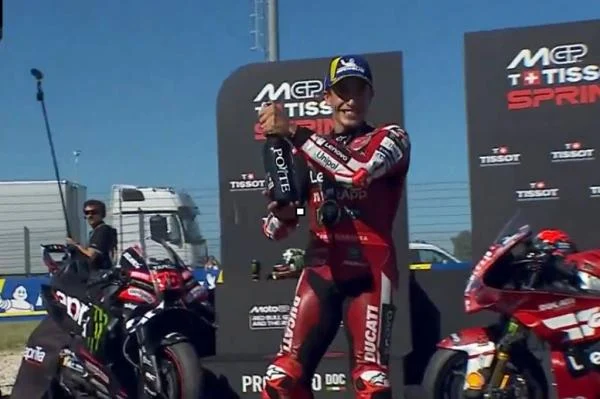
The Misano World Circuit Marco Simoncelli witnessed a defining moment in the 2026 MotoGP World Championship season this Saturday, September 12, as Ducati Lenovo’s Marc Marquez claimed a commanding victory in the Sprint Race. In a display of tactical brilliance and aggressive riding, the Spanish veteran dismantled the hopes of the pole-sitter, Aprilia Racing’s Marco Bezzecchi, to secure a crucial win that further tightens the battle for the premier class title.
The Sprint Race, which spanned the challenging 4.2-kilometer coastal layout, saw Marquez demonstrate why he remains one of the most formidable competitors in the history of the sport. Despite starting from the front row behind a record-breaking Bezzecchi, Marquez’s start was clinical, effectively neutralizing the advantage the Italian had built during the morning’s qualifying session.
A Tactical Masterclass at the Start
The tension at the Misano grid was palpable as the lights went out. Marco Bezzecchi, having shattered the circuit record with a blistering lap of 1:29.982 earlier in the day, sought to capitalize on his pole position. However, his advantage evaporated within seconds of the start. Marquez, utilizing the explosive launch capabilities of the Ducati Desmosedici, surged forward, positioning his machine perfectly to challenge for the lead heading into the tight Turn 1.
Marquez’s move was decisive. By out-braking Bezzecchi into the opening corner, he successfully dictated the pace for the remainder of the short-format race. While Bezzecchi attempted to maintain pressure, the veteran Spaniard’s defensive lines and precise throttle control ensured that any attempt at a counter-attack was thwarted. The victory underscored a strategic shift for Marquez, who has increasingly balanced raw speed with the high-level race management required to sustain a championship campaign.

Chronology of the Misano Sprint
The events leading up to this victory began in the early morning hours during the Q2 session. Bezzecchi had been the star of the show, proving that the Aprilia package was well-suited to the high-grip, technical nature of the Misano track. His record-breaking time signaled a potential shift in the competitive hierarchy, placing immense pressure on the Ducati factory riders.
As the afternoon approached, the track temperature hovered near 34 degrees Celsius, creating a unique set of challenges regarding tire degradation. During the formation lap, riders were seen conducting final checks on their medium-compound rubber. When the race commenced at 15:00 local time, the field bunched up significantly through the first sector. Marquez, who had been cautious during Friday’s practice sessions, opted for an aggressive tire management strategy that allowed him to maintain a consistent gap over the chasing pack.
By lap five, the gap between Marquez and Bezzecchi had stabilized at roughly 0.6 seconds. Behind them, the battle for the final podium spot intensified between the factory KTM riders and the remaining Ducati entries. As the race entered its final stages, Marquez maintained his composure, navigating the technical "Carro" and "Tramonto" corners with clinical precision. He crossed the finish line with a clear margin, marking his status as the man to beat ahead of Sunday’s full-length Grand Prix.
Supporting Data and Technical Context
The 2026 season has been characterized by extreme parity in the field, with the top ten riders often separated by less than a second in qualifying. Bezzecchi’s pole position time of 1:29.982 was a testament to the evolution of the Aprilia RS-GP, which has seen significant aerodynamic upgrades throughout the summer break.
Despite the loss, Bezzecchi’s performance remains statistically significant. His ability to break the 1:30 barrier at Misano highlights the continuous development of the 2026-spec machinery, which features refined ride-height devices and advanced engine mapping compared to previous iterations. Marquez, conversely, has been extracting maximum performance from the Ducati platform, relying on his deep understanding of chassis feedback to compensate for the marginal gains made by rival manufacturers.

Official Perspectives and Team Analysis
Following the race, the atmosphere within the Ducati Lenovo garage was one of focused celebration. Team principals noted that while the Sprint Race provides fewer points than the Sunday Grand Prix, the psychological impact of such a victory is substantial.
"Marc understood the track conditions perfectly," a team representative noted. "He didn’t over-push the front tire in the early stages, which gave him the necessary grip to defend the lead when Bezzecchi tried to close the gap in the final three laps."
From the Aprilia camp, the mood was one of tempered disappointment. Bezzecchi, in his post-race briefing, acknowledged the difficulty of overtaking once a rider like Marquez establishes a rhythm at the front. "We had the pace today, but we lost the race in the first hundred meters," Bezzecchi stated. "Starting from pole is a massive advantage, but against a rider who reads the race as well as Marc does, you need to be perfect. We will adjust our mapping for Sunday to ensure we have a stronger launch."
Broader Implications for the 2026 Title Fight
The implications of this result extend far beyond the podium ceremony at Misano. With the championship entering its final third, every point gained in the Sprint format serves as a buffer for the leading riders. Marquez’s win serves as a reminder of his resilience; after several seasons of injury management and bike adaptation, he appears to have fully integrated into the current Ducati ecosystem.
The result also sets the stage for a compelling Sunday race. The endurance required for the full Grand Prix distance will test the tire management strategies of all teams. If the temperatures remain high, the race will likely descend into a battle of attrition, where the ability to preserve rubber will be as vital as raw speed.
Furthermore, this race has highlighted the growing rivalry between the established stars and the emerging talent within the Aprilia and KTM stables. The fact that an Aprilia rider was able to challenge a factory Ducati for pole and lead a significant portion of the weekend’s sessions indicates that the 2026 season is becoming one of the most competitive in recent memory.
Technical Evolution and Future Outlook
As the MotoGP paddock looks toward the remainder of the calendar, including the overseas flyaway races, the data gathered at Misano will be critical. Teams are already analyzing the telemetry from the Sprint Race to determine the optimal engine braking maps for Sunday. For Marquez, the focus remains on maintaining this momentum. His ability to adapt to the Misano circuit’s specific demands—a track that rewards late braking and heavy acceleration—is a positive omen for the remainder of the European leg.
For fans and analysts alike, the performance at Misano serves as a microcosm of the current state of MotoGP: a sport where technical parity has reached an all-time high, placing an even greater premium on the individual brilliance of the rider. As the sun set over the Italian coast, the narrative was clear: while the machines are becoming increasingly sophisticated, it is the strategic acumen of riders like Marc Marquez that continues to define the pinnacle of motorcycle racing.
Sunday’s main event promises to be a high-stakes encounter, with the entire grid aware that the championship is now entering its most decisive phase. Whether Marquez can replicate his Sprint Race dominance over the longer distance remains the primary question, but for today, the spotlight belongs to the rider who once again proved that he remains the benchmark in the MotoGP world.
