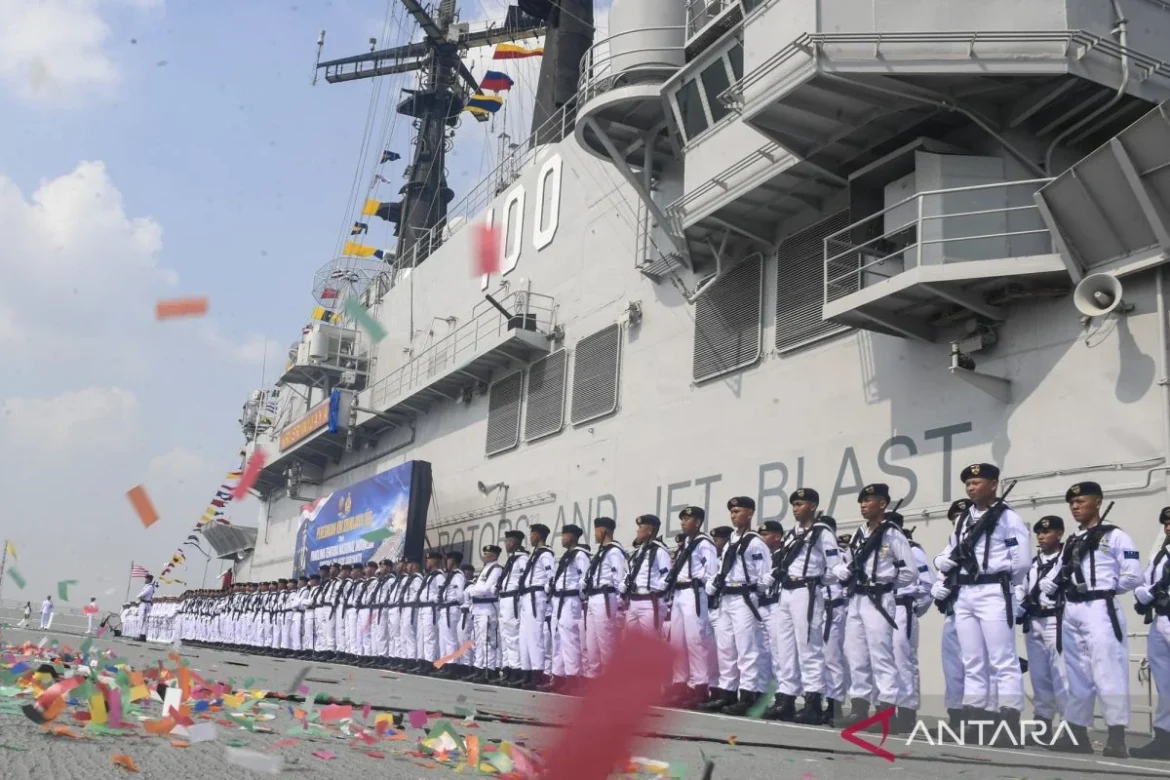
The modernization of the Indonesian National Armed Forces (TNI) reached a historic milestone on Friday, September 18, 2026, with the arrival of the former Italian Navy aircraft carrier ITS Giuseppe Garibaldi at Pier 107 of Tanjung Priok Port in North Jakarta. This momentous event marks the official entry of a light aircraft carrier into the inventory of the Indonesian Navy (TNI AL), transforming the strategic landscape of Southeast Asia’s maritime defense architecture.
The vessel, previously bearing the hull number C551 during its decades-long service under the Italian flag, is slated to undergo a formal commissioning and flag-transfer ceremony on September 24, 2026. Upon completion of this handover protocol, the vessel will be officially christened as KRI Sriwijaya, honoring the historic maritime empire that once dominated the regional waters of the archipelago. While the ship’s arrival has ignited widespread public interest and renewed national debates regarding the conceptual definition and strategic utility of an aircraft carrier, military leadership has outlined a pragmatic vision tailored to Indonesia’s unique geographic realities. Rather than functioning strictly as a blue-water power projection platform for offensive combat, KRI Sriwijaya is initially designated to serve as a versatile mobile command hub, logistics base, and floating platform for humanitarian assistance and disaster relief (HADR).
Chronology and Strategic Milestones
The integration of the Italian carrier into the Indonesian fleet is the culmination of extensive bilateral defense diplomacy and technical evaluations between Jakarta and Rome. Preliminary discussions regarding the transfer of the decommissioned Italian asset began years prior, driven by TNI AL’s long-term strategic blueprint to enhance maritime domain awareness and power projection across its vast archipelagic territory.
Following formal agreements, the vessel embarked on its lengthy transit voyage from Italy to Indonesian waters, navigating critical global maritime chokepoints before docking at Tanjung Priok Port on September 18, 2026. The coming days will see rigorous administrative and technical preparations leading up to the official commissioning ceremony on September 24, 2026, where the Indonesian Red and White flag will be permanently hoisted.
Following the flag-changing ceremony, the vessel will not immediately enter active combat deployment. Instead, Chief of Staff of the Navy (KSAL) Admiral Muhammad Ali has confirmed that KRI Sriwijaya will undergo a comprehensive phase of physical remediation, structural evaluations, and engine overhaul. These engineering works are critical to aligning the vessel’s legacy systems with the operational standards, logistical support networks, and specific strategic needs of the TNI AL.
Anatomy of a Floating Airbase
The acquisition of KRI Sriwijaya has brought the term "aircraft carrier" back into the public discourse, prompting a clearer understanding of what distinguishes this class of warship from conventional naval vessels. At its core, an aircraft carrier is a specialized, large-scale warship designed with a primary mission: serving as a mobile airfield on the open ocean.
Unlike standard surface combatants such as frigates, corvettes, or destroyers—which rely primarily on surface-to-air missiles, anti-ship missiles, and naval guns as their main offensive and defensive capabilities—an aircraft carrier centers its tactical utility around an expansive flight deck, an aircraft hangar, aviation maintenance bays, and specialized aviation fuel storage systems. This architecture allows the vessel to launch, recover, house, and service fixed-wing aircraft or rotary-wing assets far from land-based airfields.
While size is an unmistakable visual identifier, naval architects emphasize that hull dimensions alone do not define a carrier. The defining characteristics lie in the specialized infrastructure required to manage flight operations at sea. Modern military doctrines, including those outlined by the United States Navy, view aircraft carriers not merely as weapons platforms, but as multi-mission expeditionary hubs capable of executing sea control, power projection, maritime security enforcement, and rapid disaster response.
Understanding the Design and Operational Profile of Giuseppe Garibaldi
Originally commissioned into the Italian Navy in 1985, the ITS Giuseppe Garibaldi was constructed primarily as a light aircraft carrier tailored for anti-submarine warfare (ASW) and the operation of vertical/short take-off and landing (V/STOL) aircraft. Displacing approximately 13,850 tons standard and around 14,150 tons fully loaded, the ship measures roughly 180 meters in length with a beam of nearly 33.4 meters.
Historically, the vessel has operated fixed-wing tactical aircraft such as the AV-8B Harrier II, alongside a diverse complement of anti-submarine and utility helicopters, including the Agusta-Bell AB-212 and Agusta EH-101. Its ski-jump ramp—angled at roughly 6.5 degrees—was specifically engineered to assist V/STOL aircraft in achieving airborne capability with heavier payload capacities.
Despite its fixed-wing heritage, the TNI AL has signaled a pragmatic approach regarding the aviation complement for KRI Sriwijaya. While military officials have expressed long-term aspirations for aircraft capable of vertical or short take-off, current operational plans emphasize a rotary-wing heavy configuration. The ship’s expansive flight deck and hangar facilities are ideally suited to accommodate medium and heavy-lift helicopters, maritime surveillance assets, and unmanned aerial vehicles (UAVs) or drones.
Operational Doctrine: Prioritizing Military Operations Other Than War (OMSP)
The integration of KRI Sriwijaya into the Indonesian fleet represents a calculated shift toward addressing the nation’s specific security and infrastructural vulnerabilities. As the world’s largest archipelagic state—comprising more than 17,000 islands spanning three time zones—Indonesia faces persistent logistical challenges during national emergencies.
Chief of Staff of the Navy Admiral Muhammad Ali emphasized that the vessel will play a pivotal role in Military Operations Other Than War (OMSP, Operasi Militer Selain Perang). Given Indonesia’s geographic location along the volatile Pacific Ring of Fire and the equatorial typhoon belt, natural disasters such as earthquakes, tsunamis, volcanic eruptions, and severe flooding present recurring threats.
During catastrophic events, traditional land-based infrastructure—including roads, bridges, and regional airports—is frequently compromised, severely delaying humanitarian relief efforts. KRI Sriwijaya offers a strategic solution to this vulnerability. Operating as a sovereign floating base, the carrier can position itself safely off a disaster-affected coastline, deploying a fleet of heavy-lift helicopters and drones to ferry emergency medical supplies, potable water, food rations, and rescue personnel directly into isolated zones. Furthermore, the ship’s internal medical facilities and command-and-control infrastructure provide a mobile headquarters for coordinating multi-agency disaster response operations.
Diplomatic Engagement and International Context
The transfer of the Italian aircraft carrier has also drawn significant diplomatic attention. Reports from state news agency ANTARA indicate high-level government involvement, including confirmations from the Ministry of State Secretariat regarding upcoming high-level meetings between the Indonesian President and visiting representatives of the Italian Navy and defense industry.
Defense analysts note that the acquisition serves as a testament to strengthening bilateral relations between Jakarta and Rome. For Italy, transferring a legacy asset to a rising regional power like Indonesia provides a pathway for sustained defense industrial cooperation, maintenance partnerships, and future procurement dialogues. For Indonesia, acquiring a pre-owned, combat-proven hull offers a cost-effective shortcut to gaining critical operational experience in fixed-deck aviation management without incurring the exorbitant costs associated with commissioning a newly built supercarrier.
Comparative Advantage Over Standard Surface Combatants
To fully appreciate the strategic value of KRI Sriwijaya, defense experts point to the fundamental differences between an aircraft carrier and conventional surface warships. While modern Indonesian frigates and missile corvettes routinely embark a single naval helicopter for utility or anti-submarine tasks, their primary design parameters focus on surface-to-air missile defense, torpedo countermeasures, and anti-surface warfare.
These warships lack the extensive aviation fuel reserves, dedicated ordnance magazines, multi-tier maintenance hangars, and flight control architecture necessary to sustain high-tempo air operations involving multiple aircraft simultaneously. By contrast, KRI Sriwijaya functions essentially as an offshore, floating air station. This capability drastically expands the operational radius of embarked helicopters and drones, removing the tether of fixed-range land bases and allowing the TNI AL to maintain persistent aerial surveillance over remote maritime boundaries, exclusive economic zones (EEZs), and critical sea lanes of communication (ALKI).
Implications for Indonesia’s Regional Defense Posture
The arrival of KRI Sriwijaya marks a psychological and structural turning point for Indonesia’s defense posture. While skeptics frequently debate the utility of light carriers in modern anti-access/area-denial (A2/AD) threat environments, naval strategists argue that the vessel’s primary utility for Indonesia lies not in power-projecting fleet battles, but in multi-domain command, humanitarian resilience, and comprehensive maritime domain awareness.
By serving as a mobile command and control platform, KRI Sriwijaya enhances the Indonesian Navy’s capacity to orchestrate complex joint operations across dispersed maritime theaters. The ability to deploy vertical-lift assets and unmanned systems rapidly from a sovereign platform provides unprecedented flexibility in both peacetime security patrols and crisis management scenarios.
As the final preparations for the September 24 commissioning ceremony progress at Tanjung Priok, the defense establishment and the public alike look toward a new chapter in Indonesian naval history. With the Red andSoon-to-be-christened KRI Sriwijaya set to fly the Indonesian flag, the nation stands poised to integrate its first-ever aircraft carrier into a defensive doctrine that balances regional security with humanitarian readiness.