NEW YORK, NY – July 20, 2026 – The jubilant celebrations of Spain’s hard-fought victory in the 2026 FIFA World Cup were unexpectedly overshadowed by the conspicuous actions of United States President Donald Trump, who remained on the winner’s podium during the trophy presentation, drawing significant global attention and a mixed reaction from the assembled crowd. La Furia Roja secured their historic championship with a dramatic 1-0 win over Argentina in the final match, a tightly contested affair that was decided in extra time.
The prestigious final, held at the New York New Jersey Stadium, saw Spain clinch the coveted World Cup trophy following a single, decisive goal by Ferran Torres in the latter stages of the additional period. While the on-field performance of the Spanish national team was the primary focus of the tournament’s conclusion, the post-match ceremony presented a starkly different narrative, one dominated by the presence and actions of the sitting U.S. President.
A Ceremonial Standoff on the Podium
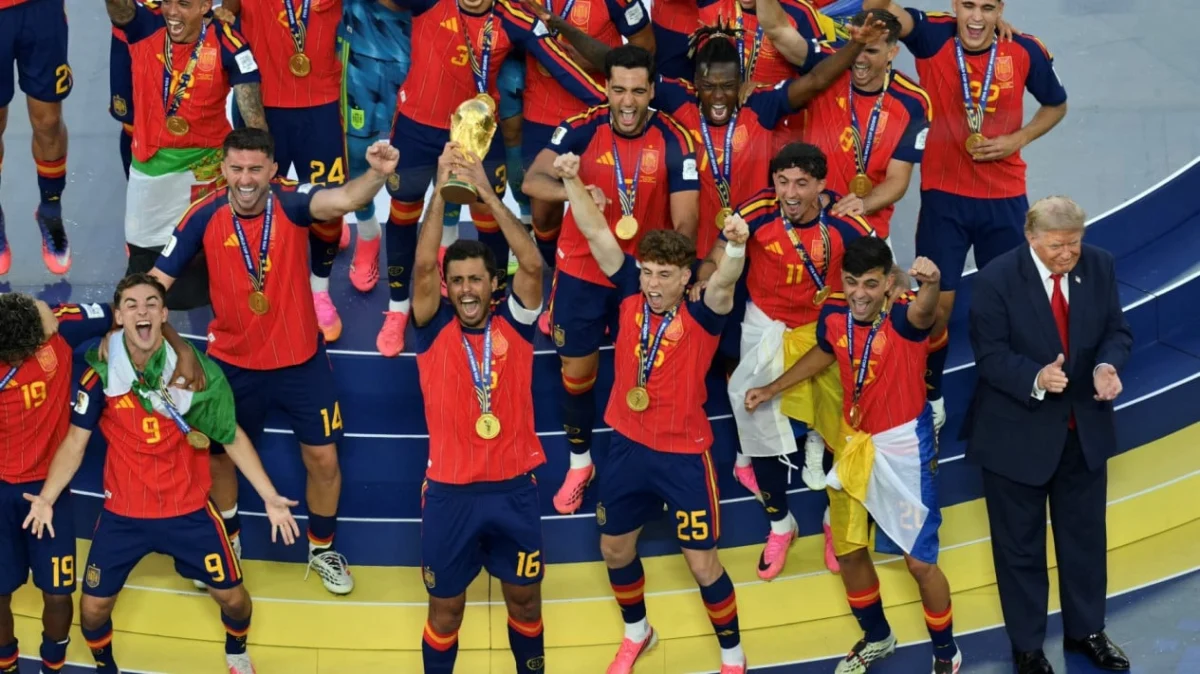
The pivotal moment of the tournament’s conclusion unfolded as President Trump, accompanying FIFA President Gianni Infantino, took to the podium to present the World Cup trophy to the victorious Spanish captain, Rodri, who was also recognized as the tournament’s best player. As the Spanish squad gathered, anticipating the customary moment of lifting the trophy, video footage clearly shows Infantino attempting to gesture for President Trump to step aside, creating space for the players to fully embrace their historic achievement. However, President Trump remained steadfastly in his position, a decision that immediately altered the dynamics of the ceremony.
Eyewitness accounts and broadcast replays indicate that President Trump, rather than vacating the central space, engaged in what has been colloquially described as his signature "Trump dance." This impromptu display occurred directly in front of the Spanish players as they prepared to hoist the trophy. FIFA President Infantino, caught in an awkward situation, was observed to offer a strained smile, his efforts to discreetly guide the President away from the focal point of the team’s celebration evidently unsuccessful. This incident drew immediate comparisons to a similar situation at the FIFA Club World Cup final held at the same venue the previous year, where President Trump’s continued presence during Chelsea’s celebrations also sparked widespread discussion and commentary.
A Stadium Divided: Cheers and Boos for the President
The presence of President Trump at the World Cup final was met with a palpable division among the thousands of spectators filling the New York New Jersey Stadium. As the cameras panned to President Trump and President Infantino as they made their way onto the field for the trophy presentation, a wave of reactions rippled through the stands. A cacophony of cheers and boos echoed from various sections of the stadium, underscoring the polarized public sentiment surrounding the U.S. President.
Reports from esteemed media outlets, including The New York Times, detailed President Trump’s initial gestures of waving to the crowd. However, as his image was broadcast on the stadium’s giant screens, the negative reactions intensified, with the sound of disapproval audibly overpowering the stadium’s ambient music. This visual and auditory reception highlighted the deeply divided political landscape within the United States and its reverberations on an international stage.
President Trump arrived at the stadium via the presidential helicopter, Marine One, underscoring the significant security apparatus accompanying his attendance. Throughout the match, he occupied a prime viewing position in the honorary box, alongside First Lady Melania Trump and FIFA President Gianni Infantino, under a heightened security presence.
Pre-Match Predictions and Post-Match Acceptance
In the hours leading up to the final, President Trump had publicly expressed his inclination towards Argentina, citing the exceptional talent of Lionel Messi and his reportedly close relationship with Argentine President Javier Milei. Despite this pre-match endorsement, the outcome of the game saw Spain emerge victorious. Following the final whistle, President Trump proceeded with his scheduled duties, participating in the trophy presentation ceremony through to its conclusion, regardless of the match’s result. This adherence to protocol, even after his stated preference for the opposing team, demonstrated a commitment to fulfilling his role as a dignitary at the event.
Contextualizing the 2026 FIFA World Cup Final
The 2026 FIFA World Cup, a quadrennial international men’s football championship contested by the senior national teams of the member associations of FIFA, represented a landmark event for North America, with matches hosted across the United States, Canada, and Mexico. The final, a culmination of over a month of intense competition, drew an estimated global television audience of over one billion viewers, making it one of the most-watched sporting events on the planet.
Spain’s journey to the final was marked by a strong defensive record and efficient attacking play, propelling them through the knockout stages. Argentina, led by the iconic Lionel Messi in what was widely speculated to be his final World Cup appearance, had also displayed formidable skill and determination throughout the tournament. The final itself was a testament to the high caliber of both teams, with neither side willing to concede an inch. The extra-time goal by Ferran Torres was the decisive moment, etching Spain’s name into football history and denying Argentina a second consecutive World Cup title.
Broader Implications and Reactions
The incident involving President Trump’s presence on the podium has sparked broader discussions about the intersection of politics and international sporting events. While heads of state and dignitaries are often invited to present trophies at major tournaments, their role is typically to honor the athletes and their achievements. President Trump’s decision to remain in the center of the celebration, and his subsequent actions, have been interpreted by some as a bid for personal attention, diverting focus from the athletes’ monumental accomplishment.
Political analysts have suggested that the event could be viewed as a strategic move by President Trump to leverage a globally significant platform for his political brand, even amidst a moment dedicated to international sportsmanship. The mixed reactions from the crowd underscore the polarized nature of his public image, with supporters likely seeing his presence as a display of American engagement, while critics may perceive it as an act of self-aggrandizement.
FIFA, the governing body of international football, has yet to issue an official statement regarding President Trump’s actions during the trophy ceremony. However, the organization’s commitment to the spirit of the game and the celebration of athletic excellence would suggest a preference for ceremonies that unequivocally place the focus on the winning team. The precedent set by this incident may lead to future discussions regarding protocol and the expected conduct of dignitaries at such high-profile international events.
The 2026 FIFA World Cup will undoubtedly be remembered for Spain’s triumphant victory, but the indelible image of President Trump on the podium, seemingly prioritizing his own presence over the players’ unfettered celebration, will also be a significant part of the tournament’s enduring legacy, prompting ongoing debate about the appropriate boundaries between politics and sport on the global stage. The financial investment in hosting such a tournament is substantial, with estimates for the 2026 World Cup projected to be in the billions of dollars, encompassing infrastructure upgrades, security measures, and logistical operations across three host nations. The economic impact, while significant, is often intertwined with national pride and international relations, making events like these multifaceted in their significance.