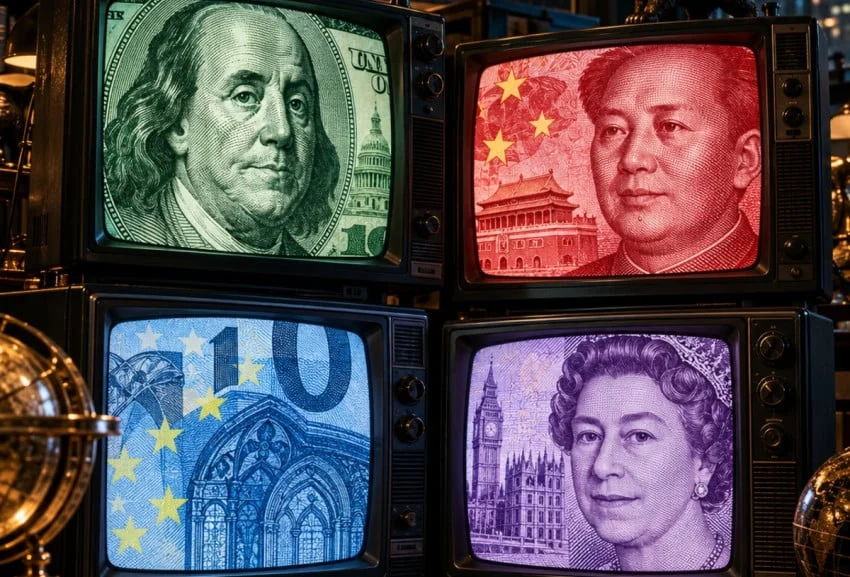
The BRICS economic bloc, comprising Brazil, Russia, India, China, and South Africa, alongside its recent expansion members, has officially signaled a strategic shift in its approach to international trade and global finance. While earlier discourse surrounding the bloc suggested an aggressive pursuit of total "dedollarization"—the complete abandonment of the U.S. dollar—the current consensus reflects a more pragmatic, incremental transition toward local currency settlements. This evolution follows persistent resistance from key member states, most notably India, which has prioritized sovereign monetary flexibility over the creation of a singular, adversarial anti-dollar mechanism.
The confirmation of this stance came during the NDTV Defense Summit, where Denis Alipov, the Russian Ambassador to India, clarified the bloc’s long-term objectives. Alipov explicitly rejected the narrative that BRICS functions as an anti-Western entity. Instead, he framed the group as an alternative platform for international cooperation, functioning alongside established global institutions like the G20 rather than in direct opposition to them. This development marks a maturation of the bloc’s economic policy, moving away from speculative rhetoric and toward structural financial integration.
The Evolution of the Dedollarization Narrative
For years, the prospect of a BRICS-led "de-dollarization" effort has been a primary concern for international markets and Western policymakers. The narrative gained momentum following the 2022 imposition of comprehensive financial sanctions on Russia, which saw the country excluded from the SWIFT international payment system. Many observers interpreted the subsequent push for a common BRICS currency or a gold-backed settlement mechanism as a defensive shield against potential future sanctions.
However, the internal reality of the bloc is far more complex. India, a critical pillar of BRICS, has consistently maintained a stance of "strategic autonomy." New Delhi has been vocal in its refusal to adopt any policy that could undermine its own currency or tie its economic fate to a collective mandate that restricts its trade with Western partners. By advocating for the use of local currencies (LCS) rather than a replacement for the dollar, India has effectively steered the group toward a multi-polar financial framework that facilitates bilateral trade without necessitating a total break from the U.S.-led global financial architecture.
Chronology of BRICS Financial Policy Shifts
The trajectory of this policy shift can be traced through several key milestones over the past three years:
- August 2023 (Johannesburg Summit): The bloc invited six new members (though not all proceeded with membership) and formally tasked central bank governors with exploring the use of local currencies and payment instruments to facilitate trade between member states.
- Early 2024: Discussions regarding a "BRICS Currency" peaked, with widespread speculation about a gold-backed digital asset. However, skepticism from central bankers regarding the logistical challenges of such a project began to temper public expectations.
- Mid-2024: The implementation of various Local Currency Settlement (LCS) agreements between nations like Indonesia (a prospective member) and BRICS countries demonstrated that trade could indeed be settled in currencies like the Indian Rupee, the Chinese Yuan, or the Russian Ruble without the involvement of the U.S. dollar.
- October 2026 (NDTV Defense Summit): Ambassador Denis Alipov provides the most transparent diplomatic acknowledgment to date, confirming that the bloc is not an anti-Western entity and that the U.S. dollar remains an acceptable, if not primary, medium of exchange for members.
Data-Driven Perspective on Currency Usage
Despite the noise surrounding dedollarization, the U.S. dollar remains the dominant force in global trade. According to data from the Society for Worldwide Interbank Financial Telecommunication (SWIFT), the dollar continues to account for nearly 47-50% of global payments, followed by the Euro and the British Pound. The Chinese Yuan has seen a marginal increase in its share, moving into the 4-6% range, but it remains far from displacing the dollar as a global reserve currency.
The total volume of trade conducted in local currencies within BRICS remains a small, albeit growing, fraction of global GDP. For instance, Indonesia has targeted a transition toward local currency transactions reaching the equivalent of Rp999 trillion. While this is a significant figure in local terms, it represents a diversification of risk rather than an abandonment of global standards. The reality is that for most BRICS members, the U.S. dollar is too deeply embedded in supply chains, energy markets, and sovereign debt instruments to be removed without incurring massive economic volatility.
Official Stances and Diplomatic Clarifications
The clarification by Ambassador Alipov serves as a de-escalation tactic. By stating that "no one is refusing to use U.S. currency," the bloc is effectively signaling to international investors that it is not looking to collapse the global financial system, but rather to expand the toolkit available to emerging economies.
This position aligns with the broader goals of the "Global South," a demographic that BRICS aims to represent. These nations seek to reduce the "exorbitant privilege" of the dollar, which allows the U.S. to export inflation and impose sanctions that affect third-party nations. By encouraging trade in local currencies, members can protect themselves against the fluctuations of the U.S. Federal Reserve’s interest rate policy, which historically has caused capital flight and currency devaluation in emerging markets.
Implications for Global Markets
The pivot from an "anti-dollar" agenda to a "pro-local currency" agenda has profound implications for global market stability:
- Increased Financial Flexibility: Countries will now have the option to settle trade in their own currencies, which reduces transaction costs and exchange rate risks for bilateral trade partners.
- Reduced Systemic Fragility: By diversifying the currencies used in international trade, the global financial system becomes less dependent on the health of a single national economy, potentially lowering the impact of localized financial shocks.
- Institutional Cooperation: The assertion that BRICS is an alternative to—not an opponent of—the G20 suggests a future of "co-opetition." These institutions will likely work in parallel, with BRICS focusing on the specific developmental and infrastructural needs of the Global South, while the G20 maintains its focus on broad-based macroeconomic coordination.
Analysis: The Pragmatism of BRICS
The retreat from the more radical forms of dedollarization is not a sign of failure, but a sign of the bloc’s evolution into a more serious economic actor. Radical policies are often easy to propose but impossible to implement in a globalized economy. By focusing on the practicalities of local currency settlements, the bloc has chosen a path that is sustainable and less likely to trigger a global financial crisis.
The challenge for BRICS remains internal consistency. With the addition of new members and the differing economic interests of nations like India, China, and Brazil, achieving a unified monetary policy was always going to be an uphill battle. The decision to emphasize local currency use allows the bloc to move forward without requiring every member to agree on a single, restrictive financial framework.
Ultimately, the U.S. dollar is likely to remain the world’s primary reserve currency for the foreseeable future. However, the rise of a multi-currency trading system—facilitated by the BRICS initiative—means that the era of absolute dollar hegemony is being superseded by a more complex, multi-layered financial landscape. Investors and policymakers should view this not as the end of the current order, but as the beginning of a more pluralistic era in international finance.
The BRICS model of regional integration, when decoupled from the hyper-politicized rhetoric of "anti-Westernism," appears to be a logical response to the imbalances inherent in a unipolar financial system. As the bloc continues to grow, its success will depend on its ability to manage the competing interests of its members while providing tangible benefits, such as reduced transaction costs and increased financial resilience, rather than pursuing ideological objectives that might prove detrimental to their own economic health.
As the international community watches these developments unfold, the focus will likely shift from the symbolic "death of the dollar" to the technical success of local currency clearinghouses and the development of alternative payment systems. In this new landscape, the U.S. dollar will remain a vital component, but it will no longer be the only tool in the box.