The Indonesian National Police’s Criminal Investigation Department (Bareskrim Polri), specifically the Directorate of Narcotics Crimes (Dittipidnarkoba), has successfully dismantled a clandestine laboratory and distribution hub dedicated to the production of illegal Nitrous Oxide (N2O) canisters. Operating under the brand name "Whip Pink," the illegal facility located in Jakarta was reportedly generating a staggering monthly turnover in the billions of rupiah. This high-profile raid marks a significant escalation in the government’s efforts to curb the recreational abuse of "laughing gas," which has recently surged in popularity across urban centers and social media platforms.
The operation was spearheaded by Brigadier General Eko Hadi Santoso, Director of Narcotics Crimes at Bareskrim Polri. According to official reports, the breakthrough came after an intensive investigation into the supply chain of the "Whip Pink" brand, which had become ubiquitous in certain nightlife circles and online marketplaces. The police utilized a "controlled purchase" or "undercover buy" strategy to trace the movement of the canisters from retail points back to their source. This methodical approach eventually led investigators to a non-descript shophouse (ruko) in Jakarta that served as both a refilling station and a distribution warehouse for the hazardous substance.
The Undercover Operation and the Raid on the Jakarta Shophouse
The investigation into the Whip Pink syndicate began following reports of widespread distribution of N2O canisters that lacked the necessary permits from the Ministry of Health and the Food and Drug Monitoring Agency (BPOM). Brigadier General Eko Hadi Santoso explained that the Sub-Directorate III of the Dittipidnarkoba Bareskrim Polri initiated the sting operation by posing as potential bulk buyers. Through these interactions, the team was able to identify the logistics network and the specific location where the canisters were being filled and packaged.
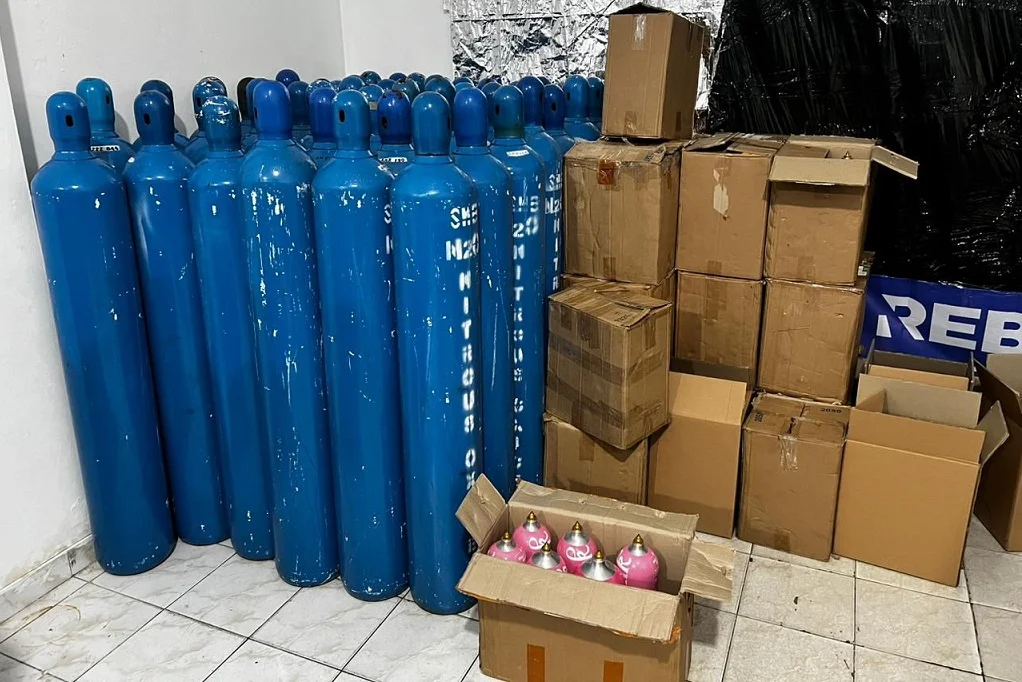
Upon securing sufficient evidence and identifying the operational headquarters, the police moved in for the raid on Wednesday, April 15, 2026. The facility was found to be a sophisticated operation, equipped with large-scale industrial tanks used to decant N2O into smaller, consumer-ready canisters. The "Whip Pink" branding, characterized by its distinctive pink color and stylized font, was applied on-site to make the product more appealing to a younger demographic.
During the penggerebekan (raid), law enforcement officers seized more than 2,000 canisters of Whip Pink. The inventory included a variety of sizes, ranging from small "chargers" to large industrial-sized tanks. Specifically, the police confiscated filled canisters ready for distribution, thousands of empty canisters awaiting processing, and the specialized machinery used for the high-pressure filling of the gas. The sheer volume of the seized goods underscores the industrial scale of the operation and the high demand for the product in the local market.
Scale of Operations and Seizure of Evidence
The financial scale of the illegal enterprise is one of the most alarming aspects of the case. Initial estimates by Bareskrim Polri suggest that the facility was clearing billions of rupiah in profit every month. This revenue was driven by a sophisticated distribution model that combined direct sales to entertainment venues with aggressive marketing on e-commerce platforms. By bypassing legal regulations and safety standards, the operators were able to maintain high profit margins while undercutting legitimate suppliers who adhere to strict industrial or medical-grade protocols.
The evidence seized at the Jakarta shophouse provides a clear picture of the syndicate’s operational capacity. In addition to the 2,000 canisters, police found ledgers detailing a vast network of distributors and regular clients. The presence of specialized filling equipment suggests that the gas was likely sourced in bulk—possibly under the guise of legitimate industrial use—and then diverted into the illegal "Whip Pink" canisters for recreational consumption.
Understanding Nitrous Oxide: Between Culinary Utility and Recreational Hazard
Nitrous Oxide, commonly known as N2O or "laughing gas," is a colorless, non-flammable gas with a slightly sweet odor and taste. In legitimate industries, it serves two primary purposes: medical and culinary. Medically, it is used as an anesthetic and analgesic, particularly in dentistry and emergency medicine. In the food industry, it is used as a propellant for whipped cream and in "molecular gastronomy" to create foams and infusions.
However, the substance has a long history of recreational abuse. When inhaled, N2O induces a short-lived state of euphoria, relaxation, and dissociation. It is this "high" that has made it a popular "party drug" globally. In Indonesia, the brand "Whip Pink" has become synonymous with this trend. Unlike medical-grade N2O, which is administered with oxygen to prevent hypoxia, the gas sold in illegal canisters is often concentrated and inhaled directly from balloons or the canisters themselves, posing severe health risks.
The Rise of Whip Pink in Indonesian Social Media Circles
The "Whip Pink" brand gained significant notoriety in Indonesia after appearing in various viral social media posts. The product’s aesthetic—bright pink canisters that look more like a lifestyle accessory than a chemical container—helped it penetrate youth culture. The involvement of social media influencers and celebrities has further complicated the narrative. For instance, recent viral footage allegedly showing "Whip Pink" canisters at the residence of prominent figure Reza Arap sparked intense public debate.
The reaction from other public figures, such as Awkarin, whose "surprising" response to the footage went viral, highlighted the normalization of the substance in certain affluent circles. This cultural visibility has made the task of law enforcement more urgent, as the perception of N2O as a "harmless" substance contradicts the clinical reality of its long-term effects. Bareskrim’s raid on the production facility is a direct response to this growing trend, aiming to cut off the supply at its root before it becomes a full-blown public health crisis.

Health Risks: The Silent Danger of N2O Inhalation
The enrichment of this news report requires a deep dive into why the illegal production of Whip Pink is a matter of national security and public health. Medical experts warn that chronic inhalation of Nitrous Oxide can lead to devastating neurological consequences. One of the primary mechanisms of injury is the inactivation of Vitamin B12 in the body. Vitamin B12 is essential for the maintenance of the myelin sheath, which protects nerve fibers.
Prolonged abuse can lead to subacute combined degeneration of the spinal cord, a condition that manifests as numbness in the extremities, loss of balance, and in severe cases, permanent paralysis. Furthermore, because the gas displaces oxygen in the lungs, users run the risk of hypoxia (oxygen deprivation), which can cause sudden fainting, heart attacks, or brain damage. The illegal nature of "Whip Pink" means there is no quality control; the gas could be contaminated with industrial impurities that further increase the toxicity of the substance.
Legal Ramifications and Regulatory Oversight in Indonesia
The legal status of N2O in Indonesia exists in a complex regulatory framework. While it is not classified as a "narcotic" under the restrictive Law No. 35 of 2009 on Narcotics, its distribution for recreational use falls under several other legal violations. The operators of the Jakarta factory are likely to face charges under the Health Law (Undang-Undang Kesehatan), which prohibits the distribution of pharmaceutical or chemical substances without proper permits and for purposes other than their intended use.
Furthermore, the lack of BPOM certification for "Whip Pink" makes its sale a violation of consumer protection laws. Bareskrim Polri has indicated that they are working closely with the Ministry of Health to evaluate whether tighter controls or a reclassification of N2O are necessary. The "billions of rupiah" in turnover also opens the door for investigations into money laundering (TPPU), as the syndicate sought to hide the proceeds of their illegal trade.
Economic Scale of the Illegal N2O Market
The illegal N2O market in Indonesia is part of a broader global trend. In countries like the United Kingdom and the Netherlands, the "silver bullet" canisters (small N2O chargers) became so prevalent that they were eventually banned or strictly regulated. In Indonesia, the "Whip Pink" model represents an evolution of this market, moving toward larger, more profitable canisters that offer a higher volume of gas per unit.
The economic incentive for the syndicate was immense. A single large canister can be sold for several hundred thousand rupiah, while the cost of bulk industrial N2O is relatively low. By marketing the product as a "lifestyle" brand, the perpetrators were able to command premium prices. The closure of this factory is expected to cause a significant supply shock in the illegal market, at least in the Greater Jakarta area.

Future Preventative Measures and Public Safety Warnings
Following the successful raid, Bareskrim Polri has issued a stern warning to both distributors and consumers. Brigadier General Eko Hadi Santoso emphasized that the police will continue to monitor online marketplaces and social media platforms for any signs of "Whip Pink" or similar illicit products. There is also an ongoing effort to identify the source of the raw N2O gas, as the factory required a steady supply of industrial-grade tanks to function.
Public health advocates are calling for an educational campaign to inform the youth about the dangers of N2O. "The problem with ‘laughing gas’ is that its name makes it sound benign," said one health analyst. "But the neurological damage we are seeing in hospitals is very real and often irreversible."
The dismantling of the "Whip Pink" factory is a landmark case in Indonesia’s fight against emerging chemical threats. It demonstrates the agility of the Dittipidnarkoba Bareskrim Polri in tackling non-traditional drug trends that exploit regulatory gaps. As the investigation continues, the police are expected to track down the broader network of distributors, including those who facilitated the "undercover buy" that led to the raid. For now, the message from the authorities is clear: illegal chemical production facilities, regardless of their branding or celebrity associations, will be found and shut down to protect the Indonesian public.