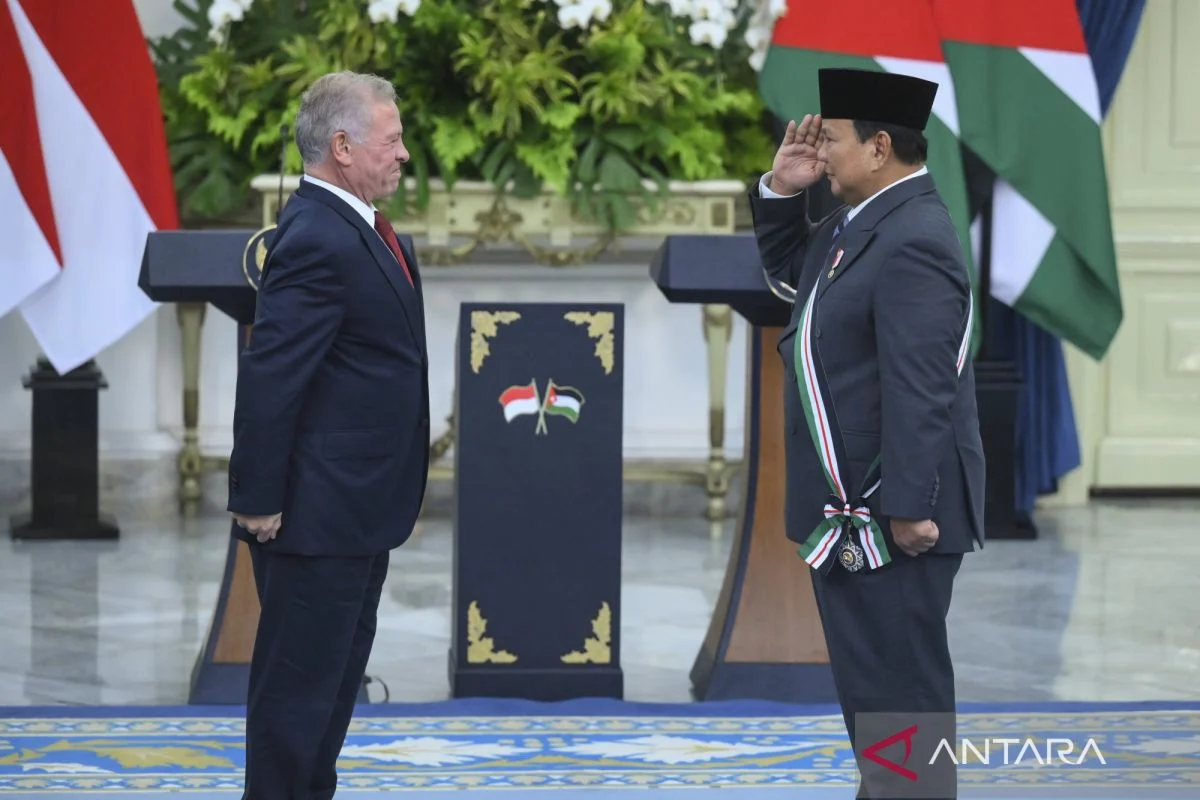
King Abdullah II bin Al-Hussein of the Hashemite Kingdom of Jordan arrived in Jakarta on Friday afternoon for a high-profile state visit, marking a significant milestone in the deepening diplomatic and economic ties between the two nations. The visit, which includes a formal meeting with Indonesian President Prabowo Subianto and representatives from the newly established Indonesian Investment Authority, Danantara, underscores a shared commitment to enhancing bilateral cooperation across multiple strategic sectors. Following their private discussions, the two leaders are scheduled to witness the signing of several Memoranda of Understanding (MoU) aimed at solidifying partnerships in trade, investment, and industrial development.
The arrival of the Jordanian monarch is part of an extensive Asian tour that includes stops in Japan, Vietnam, Singapore, and Pakistan, according to official statements from the Royal Hashemite Court. This diplomatic circuit reflects Jordan’s "Pivot to Asia" strategy, seeking to diversify its economic partnerships and strengthen ties with emerging global powers in the East. For Indonesia, the visit serves as a reciprocal gesture following President Prabowo Subianto’s state visit to Amman on April 14, 2025, where he held an intimate one-on-one meeting with King Abdullah II at the Al Husseiniya Palace.
A Foundation of Personal Brotherhood and Military Camaraderie
The relationship between King Abdullah II and President Prabowo Subianto is unique in the realm of international diplomacy, rooted in a personal friendship that spans several decades. Both leaders share extensive military backgrounds and are alumni of prestigious international training institutions. Their paths famously crossed at the United States Army’s Fort Benning (now Fort Moore), where they underwent rigorous officer training. This shared experience in the elite circles of military leadership has fostered a level of mutual trust and "soldier-to-soldier" rapport that often transcends formal diplomatic protocols.
Throughout the 1990s, when both were rising figures in their respective nations’ military hierarchies—Prabowo in the Indonesian Special Forces (Kopassus) and Abdullah in the Jordanian Special Forces—they maintained a close connection. This bond was famously highlighted when Prabowo spent a period of time in Jordan during the late 1990s. The King’s current visit is seen not only as a state-level engagement but also as a reunion of two leaders who view each other as "brothers-in-arms," a sentiment that is expected to facilitate smoother negotiations on sensitive security and economic issues.
Strategic Economic Synergy: Phosphate and Food Security
A central pillar of this visit is the exploration of enhanced economic cooperation, specifically regarding the phosphate industry. Foreign Minister Retno Marsudi and other high-ranking officials have indicated that the discussions with Danantara (Daya Anagata Nusantara), Indonesia’s consolidated investment management agency, will focus heavily on securing a steady supply of phosphate from Jordan.
Jordan possesses some of the world’s largest reserves of high-grade phosphate, a critical raw material for the production of NPK (nitrogen, phosphorus, and potassium) fertilizers. For Indonesia, an agrarian nation with a massive demand for agricultural inputs to ensure national food security, Jordan is a vital strategic partner. By securing direct investment and long-term supply agreements with Jordanian state-owned enterprises, Indonesia aims to stabilize domestic fertilizer prices and boost agricultural productivity.
The involvement of Danantara signifies Indonesia’s shift toward a more centralized and proactive investment strategy. As the sovereign wealth fund-like entity seeks to manage Indonesia’s strategic assets, the partnership with Jordan could involve joint ventures in manufacturing facilities, where Jordanian raw phosphate is processed in Indonesia to serve the wider Southeast Asian market. This "downstreaming" approach aligns with President Prabowo’s economic vision of transforming Indonesia from a raw material exporter into an industrial hub.
Timeline of the Bilateral Engagement
The current state visit is the culmination of a series of diplomatic exchanges and strategic planning sessions held over the past year. The chronology of the recent rapprochement includes:
- April 14, 2025: President Prabowo Subianto conducts a state visit to Jordan. He is received with full military honors at Al Husseiniya Palace. The two leaders discuss regional stability in the Middle East and Southeast Asia, as well as the potential for increased defense cooperation.
- May 2025: Technical delegations from the Indonesian Ministry of Trade and the Ministry of State-Owned Enterprises visit Amman to conduct feasibility studies on joint phosphate ventures.
- June 2025: The Royal Hashemite Court announces King Abdullah II’s Asian tour, placing Indonesia as a primary destination due to the historical ties and economic potential.
- Friday Afternoon, Current Date: King Abdullah II touches down at Halim Perdanakusuma International Airport, Jakarta, proceeding immediately to the Merdeka Palace for a bilateral summit and subsequent meetings with investment heads.
Profile of a Modern Reformer: King Abdullah II
King Abdullah II bin Al-Hussein was born in Amman on January 30, 1962. As the eldest son of the late King Hussein bin Talal and Princess Muna Al Hussein, he is a 41st-generation direct descendant of the Prophet Muhammad, a lineage that affords him significant religious and moral authority within the Islamic world.
His education reflects a global upbringing, beginning at the Islamic Educational College in Amman before moving to St. Edmund’s School in Surrey, England. He completed his secondary education at the prestigious Deerfield Academy in the United States. His military and academic credentials are exceptionally high, including:
- 1980: Royal Military Academy Sandhurst, UK.
- 1982: Pembroke College, University of Oxford, UK (Special Studies in Middle Eastern Affairs).
- 1987-1989: Georgetown University, USA (Master of Science in Foreign Service).
King Abdullah II’s military career was not merely ceremonial. He served in the Royal Jordanian Army from 1981 to 1993, eventually commanding the country’s Special Forces. His expertise as a qualified pilot and elite skydiver has earned him respect within global defense circles. He ascended to the throne on February 7, 1999, following the passing of his father, and has since been recognized for his efforts to modernize Jordan’s economy and maintain the country as an "oasis of stability" in a volatile region.
The King is married to Queen Rania Al Abdullah, a global advocate for education and human rights. Together they have four children: Crown Prince Hussein, Princess Iman, Princess Salma, and Prince Hashem. Beyond his state duties, the King is known for his diverse interests, including car racing, scuba diving, and a world-renowned collection of antique weaponry.
Geopolitical Implications and Regional Stability
Beyond economic MoUs, the meeting between King Abdullah II and President Prabowo carries significant geopolitical weight. Jordan occupies a critical role as the custodian of the Muslim and Christian holy sites in Jerusalem and remains a key mediator in the Israeli-Palestinian conflict. Indonesia, as the world’s most populous Muslim-majority nation, has been a steadfast supporter of Palestinian independence and a vocal critic of humanitarian crises in the region.
The two leaders are expected to issue a joint statement regarding the situation in Gaza and the broader Middle East, calling for a cessation of hostilities and a return to the two-state solution framework. By aligning their diplomatic stances, Jordan and Indonesia can exert greater influence within the Organization of Islamic Cooperation (OIC) and the United Nations.
Furthermore, the visit signals Indonesia’s growing role as a diplomatic bridge between the Middle East and the Indo-Pacific. As President Prabowo seeks to elevate Indonesia’s profile on the global stage, fostering deep ties with traditional Middle Eastern powers like Jordan provides a counterbalance to the nation’s relationships with major Western and East Asian powers.
Analysis of the "Danantara" Factor
The inclusion of Danantara in the official itinerary is perhaps the most telling sign of the visit’s modern economic focus. Unlike traditional ministerial meetings, the involvement of a sovereign-style investment body suggests that the two nations are looking at "capital-to-capital" cooperation.
Analysts suggest that Danantara may be looking to co-invest with the Social Security Investment Fund (SSIF) of Jordan or the Jordan Investment Fund. Potential areas of collaboration include:
- Infrastructure: Leveraging Indonesian construction expertise for projects in Jordan.
- Defense Industry: Joint production of tactical vehicles and small arms, building on the existing cooperation between Indonesia’s PT Pindad and Jordanian defense firms.
- Renewable Energy: Exchanging technical knowledge on solar energy, an area where Jordan has made significant strides and Indonesia has vast untapped potential.
Conclusion and Future Outlook
The visit of King Abdullah II to Jakarta is more than a routine diplomatic encounter; it is a strategic alignment of two nations with complementary needs and a shared history of leadership. The combination of the "Fort Benning connection" between the two heads of state and the tangible economic synergy in the phosphate and investment sectors creates a robust foundation for a long-term partnership.
As the MoUs are signed and the delegations conclude their talks, the focus will shift to the implementation of these agreements. If successful, the partnership could serve as a blueprint for "South-South cooperation," demonstrating how middle powers can collaborate to secure their resources, stabilize their economies, and project a unified voice in a complex global landscape. The residents of both Jakarta and Amman will be watching closely as this "diplomacy of brothers" translates into real-world economic benefits and enhanced regional security.