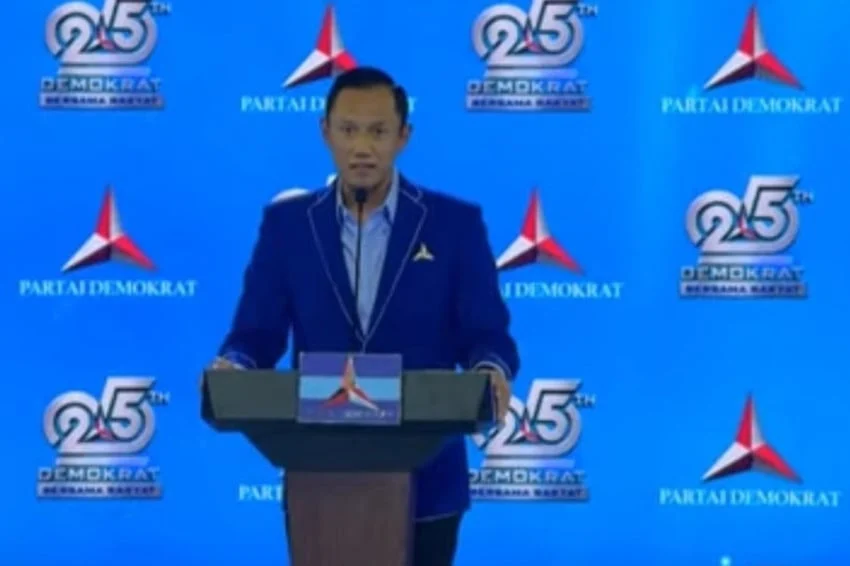
JAKARTA — In a striking call for political harmony and national solidarity, Democratic Party Chairman Agus Harimurti Yudhoyono underscored that despite the rich mosaic of political colors across Indonesia, only the Red and White of the national flag ultimately matters when serving the interests of the nation and state. Addressing a packed arena of dignitaries, party members, and supporters, Yudhoyono delivered a keynote address that resonated well beyond partisan lines during the grand celebration of the Democratic Party’s silver jubilee.
The high-profile event, held at the Indonesia Arena in Central Jakarta on Wednesday, September 9, 2026, brought together prominent figures from across the political spectrum. Among the most notable attendees was President Prabowo Subianto, whose presence highlighted the strengthening ties between the ruling administration and the Democratic Party. Yudhoyono’s remarks were crafted to bridge historical political divides, offering a vision of cooperative governance where electoral competition gives way to collaborative nation-building.
The Celebration of the Democratic Party’s Silver Jubilee
The commemoration marked a significant milestone for the Democratic Party, commonly known as Partai Demokrat, celebrating 25 years since its founding in 2001. Over a quarter of a century, the party has experienced the entire spectrum of Indonesia’s democratic journey—from an emerging opposition movement to a ruling party under founder and former President Susilo Bambang Yudhoyono, subsequent years in opposition, and its current status as a key component of the governing coalition.
The choice of the Indonesia Arena, one of the capital’s premier indoor venues, reflected the scale and ambition of the anniversary celebrations. Thousands of cadres dressed in the party’s signature blue attire filled the stands, creating an electric atmosphere. However, the overarching theme of the evening was not exclusivity or partisan triumph, but rather national inclusivity.
During his speech, Yudhoyono drew attention to the diverse political landscape of contemporary Indonesia, pointing out the various colors associated with the country’s numerous political organizations. He used this visual metaphor to address the inherent plurality of the world’s third-largest democracy.
"Of course, we each have our respective colors," Yudhoyono stated from the podium. "There is red, there is green, there is yellow, there is also blue, orange, white, and even different shades of light and dark blue. And I believe Mr. President is an expert at bringing all these colors together so they can sit at the same table."
This metaphorical nod to President Prabowo Subianto was met with applause from the audience. It served as an acknowledgment of the administration’s ongoing efforts to build a "Red and White Cabinet" and a broad-based coalition that transcends the strict boundaries of electoral alliances. Yudhoyono emphasized that while political parties naturally compete for votes and influence during election cycles, governance requires a synthesis of these diverse perspectives for the greater public good.
Defining the True Essence of Democracy
A central pillar of Yudhoyono’s address was a reflection on the health and maturity of Indonesian democracy. Moving beyond procedural definitions that reduce democracy merely to the mechanics of holding periodic elections, he argued that true democratic resilience is measured by post-election behavior and societal cohesion.
"Maintaining democracy is not just about elections," Yudhoyono told the audience. "Democracy is also about how we respect differences, maintain brotherhood, and continue to move forward. I repeat, remaining capable of working together after the competition has ended."
This sentiment carries significant weight within the context of recent Indonesian political history. The 2024 general elections were marked by intense competition among various ideological and pragmatic factions. However, the subsequent formation of Prabowo Subianto’s broad coalition government marked a departure from the stark polarization that characterized previous electoral cycles. Yudhoyono’s remarks reinforced this strategic shift, framing post-election reconciliation not merely as a political necessity, but as a moral imperative for national development.
By emphasizing the ability to work together after the ballots are counted, the Democratic Party leader sought to position his organization as a constructive, stabilizing force within the national legislature and executive branch. Analysts note that this rhetoric aligns closely with President Prabowo’s frequent calls for national reconciliation and "gotong royong" (mutual cooperation) among all elements of society.
Mutual Respect and Political Maturity
The anniversary event was also notable for the warm exchanges between the current administration and the leadership of the Democratic Party. Earlier in the proceedings, President Prabowo Subianto took the stage to deliver remarks that praised the Democratic Party and its founder, Susilo Bambang Yudhoyono (SBY).
President Prabowo specifically highlighted the constructive opposition demonstrated by the Democratic Party during the decade when it was outside the ruling coalition (2014–2024). He commended SBY and the party leadership for maintaining political ethics, noting that even when they were not in power, they refrained from malicious mudslinging or undermining the legitimate government out of bitterness.
This mutual appreciation underscores a maturing political culture in Indonesia, where historical rivalries are increasingly supplanted by pragmatic cooperation. The acknowledgment from the head of state served to validate the Democratic Party’s strategic trajectory—from a decade of watchful opposition to an active partner in the current administration’s development agenda.
The presence of representatives from various other political parties at the Indonesia Arena further illustrated this theme of inclusivity. Leaders and delegates from both coalition and non-coalition backgrounds attended the silver jubilee, signaling a tacit agreement that national stability remains a shared responsibility.
Broader Implications for Indonesia’s Political Landscape
Yudhoyono’s speech and the overarching tone of the Democratic Party’s 25th-anniversary celebration carry several important implications for the future of Indonesian politics:
-
Institutionalization of Coalition Politics: The emphasis on bringing different "colors" together reflects the structural reality of Indonesia’s multi-party presidential system. No single party can govern effectively without building extensive legislative coalitions. By framing this necessity as an ethical virtue of unity, leaders like Yudhoyono help legitimize compromise and coalition-building in the eyes of the electorate.
-
Positioning for the Future: As the Democratic Party looks past its 25th anniversary, establishing an identity as a unifying, statesmanlike party rather than a purely parochial or oppositional entity is crucial for its long-term electoral prospects. AHY’s rhetoric projects national leadership ambitions while supporting the current administration’s stability.
-
Democratic Resilience: Amid global concerns regarding democratic backsliding and political polarization, Indonesian political elites continue to signal a commitment to procedural continuity paired with substantive reconciliation. The ability of former rivals to share a stage and celebrate institutional milestones together reinforces the resilience of Indonesia’s democratic framework.
Conclusion
As the silver jubilee celebrations concluded at the Indonesia Arena, the prevailing takeaway was one of cautious optimism for Indonesia’s political trajectory. Agus Harimurti Yudhoyono’s address successfully connected the party’s historical journey with the contemporary imperative of national unity. By reminding the audience that the "Red and White" supersedes all partisan hues, the Democratic Party positioned itself as a champion of inclusive governance, setting a tone of cooperative statesmanship as the nation navigates its ongoing economic and social development goals.