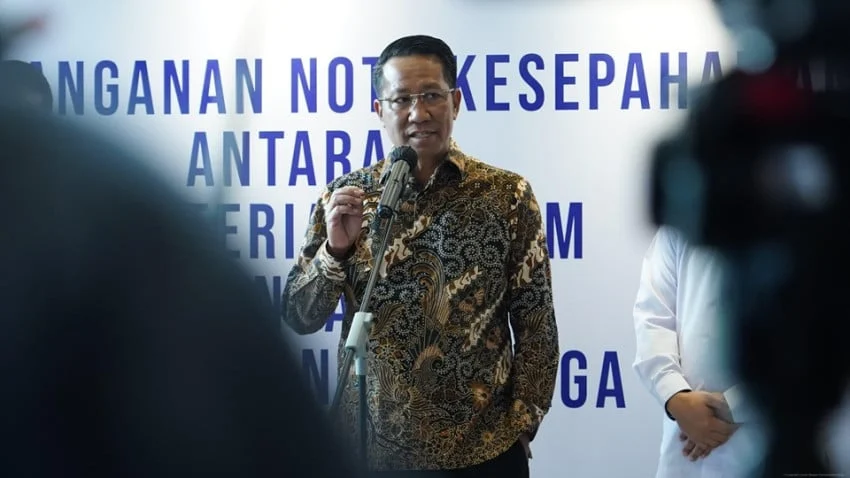
Jakarta, CNN Indonesia — The ongoing battle against forest and land fires, commonly known in Indonesia as karhutla, requires a fundamental shift in strategy that places local communities at the forefront of prevention and conservation efforts. According to Minister of Forestry Raja Juli Antoni, the active participation, environmental awareness, and direct involvement of grassroots populations serve as the most effective defense mechanisms against the perennial threat of widespread fires that regularly afflict vulnerable regions across the archipelago.
Speaking on the critical role of civil society in environmental stewardship, Minister Raja Juli highlighted that sustainable forest management cannot rely solely on top-down governmental interventions or emergency response measures deployed after disasters strike. Instead, he pointed to empirical successes on the ground, arguing that when local populations are genuinely empowered and given a vested interest in protecting their surrounding ecosystems, the incidence of destructive fires drops precipitously.
The minister’s remarks shed light on an ongoing national discourse regarding how Indonesia manages its vast tropical rainforests, carbon-rich peatlands, and critical mangrove ecosystems. As the Ministry of Forestry continues to refine its environmental policies under evolving national leadership, the integration of community-based resource management with stringent legal enforcement has emerged as a cornerstone of the administration’s forestry roadmap.
A Beacon of Hope in Jambi: The Bujang Raba Landscape
To illustrate the tangible benefits of community-led conservation, Minister Raja Juli pointed to the Bujang Raba landscape in Jambi Province as a shining example of successful grassroots environmental defense. Amidst exhausting mitigation efforts required to combat fires in regions historically prone to severe burning—such as West Kalimantan, Central Kalimantan, South Kalimantan, and South Sumatra—the ecological stability observed in Bujang Raba functions as a crucial oasis of best practices.
The Bujang Raba landscape stands as proof that empowering indigenous and local communities yields resilient ecological buffers. For years, regions in Kalimantan and southern Sumatra have battled severe dry seasons exacerbated by climate anomalies, resulting in thick transboundary haze, significant economic disruption, and severe public health crises. In stark contrast, the Bujang Raba area has managed to largely insulate itself from similar ecological catastrophes due to the vigilant stewardship of local residents organized into dedicated fire-care communities, locally known as Masyarakat Peduli Api (MPA).
Minister Raja Juli noted that the presence of these organized community groups within rural villages is an indispensable asset for forest preservation. When villagers are integrated into the formal framework of fire prevention and land management, they act as early warning systems, immediate first responders, and active monitors against illegal encroachment or slash-and-burn agricultural practices. Building upon this success, the Ministry of Forestry is actively formulating plans to institutionalize this participatory model through the establishment of a village-based National Peatland and Mangrove Management Agency, known natively as Badan Pengelola Gambut dan Mangrove Nasional (BPGMN). By embedding resource management at the village level, the government hopes to replicate the Bujang Raba success story nationwide.
Pioneering Carbon Trading and Economic Incentives for Local Stewards
Beyond immediate fire mitigation, the Bujang Raba landscape holds historical significance for Indonesia’s evolving green economy. Minister Raja Juli highlighted that Bujang Raba holds the distinction of being the country’s very first social forestry group to secure official approval to engage in the forestry sector’s carbon trading market.
This milestone represents a crucial paradigm shift in how carbon credits are distributed and monetized in Indonesia. Historically, lucrative carbon offset projects and large-scale conservation concessions have been dominated by major corporate entities and industrial conglomerates. However, the integration of social forestry schemes into the carbon market ensures a more equitable distribution of economic benefits.
The Ministry of Forestry has stressed that the financial windfalls generated from carbon trading must not remain concentrated exclusively among corporate concession holders. Communities that actively patrol, protect, and restore forest tracts—such as customary law communities (masyarakat hukum adat) and forest-edge villages—deserve direct economic access to these market mechanisms. By tying forest conservation to tangible financial rewards, the government aims to create a sustainable economic loop where protecting the environment directly translates into improved local livelihoods, thereby removing the economic incentives that might otherwise drive illegal deforestation.
The Dual Approach: Balancing Community Empowerment with Strict Law Enforcement
While community empowerment forms the empathetic and participatory pillar of the Ministry of Forestry’s strategy, Minister Raja Juli firmly asserted that this approach must run in parallel with unyielding law enforcement. Grassroots participation alone cannot deter organized criminal syndicates or commercial actors seeking to bypass environmental regulations through illegal land-clearing practices.
To address illicit activities within forest zones, the Ministry of Forestry maintains active, continuous coordination with national law enforcement agencies. Specifically, the Directorate General of Law Enforcement (Gakkum) within the ministry routinely conducts targeted patrols and joint operations to detect, investigate, and prosecute environmental crimes. According to the ministry, sustainable forest governance requires a two-pronged mechanism: fostering high levels of community awareness and empowerment on one side, and maintaining a credible, active deterrent through rigorous legal enforcement on the other. When these two elements operate in tandem, illegal land conversion, unauthorized logging, and deliberate fire-setting are systematically choked off.
Recent Progress and Hotspot Monitoring in Jambi
The efficacy of this combined strategy is currently reflected in recent environmental data coming out of Jambi Province. Minister Raja Juli shared encouraging updates regarding the containment of forest and land fires in the region, noting a dramatic reduction in thermal anomalies.
Based on official monitoring data recorded up to September 27, 2026, the number of hotspots detected across Jambi has plummeted from hundreds of active points during peak vulnerability periods down to a mere five localized spots. This sharp decline underscores the immediate practical dividends of proactive ground monitoring, rapid local response units, and effective inter-agency coordination.
Nevertheless, the forestry ministry remains acutely aware of the fragility of these gains. Weather anomalies driven by global climate change patterns mean that environmental conditions can shift rapidly, making vigilance a continuous requirement. Minister Raja Juli reiterated that maintaining this positive trajectory demands ongoing gotong royong—a traditional Indonesian ethos of mutual cooperation—bridging the gap between central government agencies, local governments, and everyday citizens.
Implications for Indonesia’s National Climate Goals
The developments in Jambi and the broader policy shifts articulated by the Ministry of Forestry carry profound implications for Indonesia’s international climate commitments. As a nation hosting some of the world’s most expansive tropical rainforests and carbon-dense peatlands, Indonesia plays a pivotal role in global efforts to curb carbon emissions and mitigate the worst impacts of global warming.
Historically, forest and land fires have constituted the single largest source of Indonesia’s greenhouse gas emissions, occasionally eclipsing the industrial and transportation sectors during severe El Niño years. By prioritizing localized fire prevention—anchored by empowered village groups like the Masyarakat Peduli Api—the country can significantly reduce the frequency and scale of catastrophic carbon releases.
Furthermore, integrating social forestry initiatives into the global carbon market signals to international partners, investors, and carbon standard bodies that Indonesia is serious about combining environmental integrity with social justice. Ensuring that indigenous peoples and local communities directly benefit from carbon revenues helps secure long-term tenure rights, reduces land-use conflicts, and aligns economic development with ecological preservation.
As Indonesia looks toward the future of its forestry sector, the model demonstrated in Bujang Raba offers a scalable blueprint. By proving that local populations can simultaneously act as guardians of the forest, beneficiaries of the green economy, and partners in legal enforcement, the Ministry of Forestry is laying the groundwork for a more resilient, participatory, and sustainable environmental future.