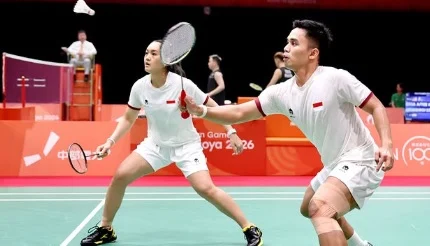
The Indonesian badminton contingent experienced a rollercoaster of emotions on Friday, September 25, 2026, during the individual round-of-16 matches at the Asian Games Aichi-Nagoya 2026. Held at the Ichinomiya City Municipal Gymnasium in Aichi, Japan, the day proved to be a defining moment for the national team’s mixed doubles campaign. While the duo of Amri Syahnawi and Nita Violina Marwah displayed remarkable resilience to secure a spot in the quarter-finals, their compatriots, Nikolaus Joaquin and Siti Fadia Silva Ramadhanti, saw their journey in the tournament come to a premature end.
The intensity of the competition in Aichi reflects the high stakes of the 2026 Asian Games, an event that has garnered significant attention following a historic period for Indonesian sports. As the continent’s elite athletes converge in Japan, the pressure to maintain Indonesia’s reputation as a global badminton powerhouse remains a central theme for the coaching staff and the players alike.
The Gritty Comeback of Amri Syahnawi and Nita Violina Marwah
The match between the Indonesian pair of Amri Syahnawi and Nita Violina Marwah and the Japanese home favorites, Maya Taguchi and Yuta Watanabe, was undoubtedly the highlight of the afternoon session. The atmosphere inside the Ichinomiya City Municipal Gymnasium was electric, with the local crowd providing vocal support for Taguchi and Watanabe.
The encounter began in a concerning fashion for the Indonesian representatives. During the opening game, Amri and Nita struggled to find their rhythm, falling victim to a series of unforced errors and a relentless attacking pace set by the Japanese duo. The disparity in momentum was reflected in the scoreline, with the Indonesians dropping the first game decisively at 9-21. This lopsided opening left many observers questioning whether the duo could recover from such a significant deficit against a formidable host-nation pair.
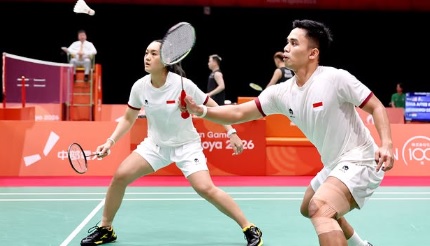
However, the second game signaled a dramatic shift in tactical execution. Amri and Nita adjusted their defensive formation and began to dictate the pace of the rallies, forcing Taguchi and Watanabe to commit errors at the net. By maintaining composure under pressure, the Indonesian pair clawed their way back, securing the second game 21-18.
With the match tied at one game apiece, the decider became a contest of mental fortitude. Both pairs traded points in the early stages, but Amri and Nita pulled away in the mid-game interval. Their defensive coverage improved significantly, allowing them to counter-attack with precision. Eventually, the Indonesians closed out the third game 21-15, completing a stirring comeback that propelled them into the quarter-finals.
Mixed Fortunes for the Indonesian Contingent
While Amri and Nita celebrated their advancement, the day was not without its disappointments. The elimination of Nikolaus Joaquin and Siti Fadia Silva Ramadhanti highlighted the unforgiving nature of the Asian Games, where any lapse in concentration against elite opposition can result in an early exit.
The loss of Joaquin and Fadia serves as a reminder of the depth of the field in the mixed doubles category. Throughout the 2026 season, the Badminton World Federation (BWF) circuit has seen increased parity among the top 20 nations, making the path to an Asian Games medal more difficult than in previous cycles. For the Indonesian coaching staff, the analysis of these matches will be crucial as they look to refine the performance of the remaining athletes in the individual categories.
Historical Context and Strategic Implications
The 2026 Asian Games hold a unique place in the history of Indonesian sports. Earlier in the tournament, the contingent celebrated a milestone victory that ended a 28-year drought for a major regional gold medal in certain disciplines. This success, underscored by the optimism expressed by Chef de Mission (CdM) Todotua Pasaribu, has set a high bar for all participating Indonesian athletes.

The Badminton Association of Indonesia (PBSI) has invested heavily in the transition of younger players to the senior stage. Amri and Nita’s progression in Aichi is a validation of the current training programs, which prioritize long-game endurance and adaptability. In the context of the 2026 games, every match win contributes to the overall medal tally, which is a key performance indicator for the Indonesian Ministry of Youth and Sports.
Technical Analysis: The Path Forward
Looking ahead to the quarter-finals, Amri and Nita will face an even stiffer challenge. The standard of play in the latter stages of the Asian Games often sees a rise in intensity, with top-seeded pairs from China, South Korea, and Thailand waiting in the next bracket.
Data from the first few days of the tournament indicates that the courts in Aichi are playing relatively fast, favoring players who can execute quick-fire net exchanges. Amri’s ability to control the mid-court and Nita’s defensive stability have been their strongest assets thus far. However, to advance to the podium, the pair will need to address their slow starts, as evidenced by their initial 9-21 loss on Friday.
The Broader Impact on Indonesian Badminton
The individual events at the Asian Games are often seen as a litmus test for the upcoming World Championships and the qualification cycles for future Olympic Games. The success of players like Amri and Nita provides much-needed momentum for the national team.
From a broader perspective, the performance of Indonesian athletes in Japan reflects the country’s ongoing commitment to sports science and holistic athlete development. The integration of mental health support, nutritional oversight, and advanced tactical analysis has become a cornerstone of the national training camp in Cipayung. As the tournament progresses into the final weekend, the expectations on the remaining Indonesian shuttlers to maintain their consistency will only increase.

Reaction and Outlook
While there were no official press conferences immediately following the round-of-16 matches, the mood within the Indonesian camp remained focused. The coaching staff is reportedly conducting video reviews of the day’s matches to identify defensive vulnerabilities that were exposed during the first-game loss in the mixed doubles.
For the fans back in Indonesia, the journey of Amri and Nita remains a beacon of hope. Their ability to overcome a massive first-game deficit demonstrates a "never-say-die" attitude that is synonymous with the spirit of the national team. As the tournament moves into the quarter-final stages, the focus will shift from simple progression to the technical mastery required to defeat the world’s elite.
Conclusion
The results from the Ichinomiya City Municipal Gymnasium on Friday serve as a microcosm of the 2026 Asian Games experience—a mix of triumph and heartbreak. As the tournament continues, the focus for the Indonesian badminton team is clear: capitalize on the momentum gained by the successful pairs and learn from the tactical failures that led to earlier exits.
With the quarter-finals approaching, the pressure will mount. However, for Amri Syahnawi and Nita Violina Marwah, the goal remains the same. Having survived a high-pressure test against a home-grown pair in Japan, they have proven they have the technical skill and the mental resilience to compete at the highest level of international badminton. The nation now turns its eyes toward the next round, where every smash, net kill, and defensive return will be vital in the pursuit of Asian Games glory.
The badminton competition in Aichi-Nagoya is far from over, and if the intensity of the round-of-16 is any indication, the road to the podium will be decided by the smallest of margins. Indonesia remains firmly in the hunt, fueled by the hope of bringing home more medals to add to an already historic campaign in 2026.