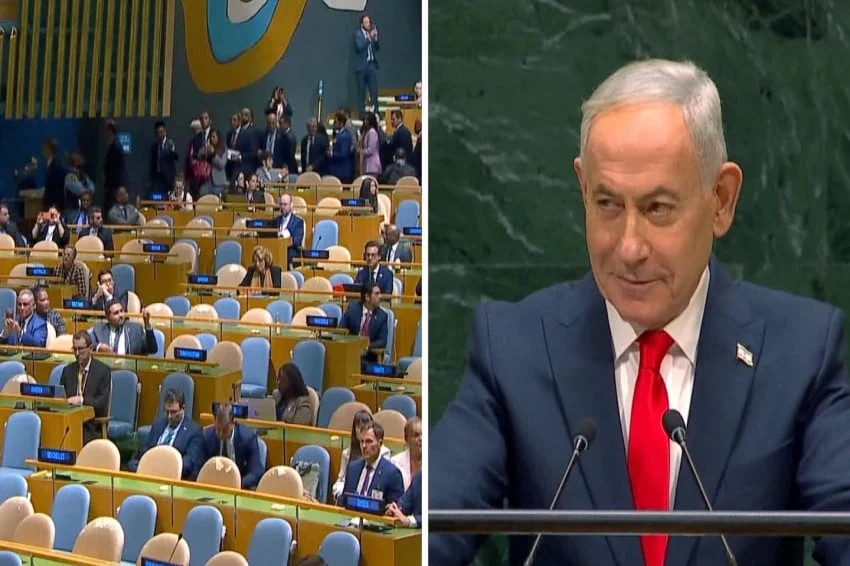
The 81st Session of the United Nations General Assembly in New York witnessed a historic display of diplomatic isolation on Thursday, September 24, 2026, as dozens of international delegates staged a mass walkout moments before Israeli Prime Minister Benjamin Netanyahu began his scheduled address. The protest, which left the grand chamber of the United Nations headquarters noticeably sparse, serves as a stark visual representation of the deepening fracture between Israel and a significant portion of the international community regarding the ongoing military operations in the Gaza Strip.
As Prime Minister Netanyahu approached the podium, the exodus of diplomats was immediate and coordinated. Observers noted that representatives from various nations, including several from the Global South and certain Western states, exited the hall in a silent but powerful rebuke. The scene, captured by global news outlets and corroborated by footage from the UN’s internal broadcast, showed rows of empty blue seats—a rare sight during a speech by a head of state of a major U.S. ally.
A Chronology of Diplomatic Tensions
The walkout was the culmination of months of deteriorating relations between Israel and the international diplomatic corps. The following timeline provides context for the events leading up to this moment:
- October 2023: The onset of the current conflict in Gaza following the Hamas-led attacks on southern Israel.
- May 2024: The International Criminal Court (ICC) prosecutor filed applications for arrest warrants against senior Israeli and Hamas officials, including Prime Minister Netanyahu, citing war crimes and crimes against humanity.
- September 2026: The lead-up to the UN General Assembly saw intense lobbying by civil society groups in New York to prevent Netanyahu from speaking at the podium.
- September 24, 2026: Protests intensified across Manhattan as thousands of demonstrators gathered near the UN headquarters, carrying placards denouncing the "architect of genocide."
- September 24, 2026, Afternoon: The mass walkout occurs, followed by a combative speech from the Prime Minister that lasted approximately 45 minutes.
The Staged Protest and Internal Reactions
The atmosphere inside the chamber was reportedly tense. While the Prime Minister had anticipated protests, the scale of the walkout appeared to visibly rattle his delegation. Upon taking the stage, Netanyahu paused, appearing momentarily stunned by the sheer number of delegates exiting the room.
In an unscripted moment that deviated from his prepared remarks, Netanyahu lashed out at the departing officials, labeling them "moral cowards." He argued that the protest was not merely against him, but against the "truth" of Israel’s security concerns. "You may try to silence me, but you cannot silence the truth," he declared, pivoting to defend his administration’s policies as a necessary defense against existential threats.
However, the protest extended beyond the diplomats. Outside the UN gates, a diverse coalition of groups—ranging from Jewish Orthodox anti-Zionist organizations to Palestinian advocacy groups and American progressive activists—maintained a constant roar of opposition. The involvement of Jewish organizations in the protests added a layer of complexity to the narrative, as these groups argued that the Israeli government’s actions in Gaza do not reflect the values of the Jewish faith or the global Jewish diaspora.
Fact-Based Analysis of the ICC Status
A critical element of the controversy surrounding Netanyahu’s visit is his standing with international legal bodies. Since the 2024 issuance of the ICC pursuit, the Prime Minister’s diplomatic maneuverability has been severely constrained. While the United States and several other nations do not recognize the jurisdiction of the ICC, the political optics of a head of state under investigation for war crimes addressing the UN General Assembly created an unprecedented diplomatic dilemma for the United Nations.
The legal arguments regarding the conflict in Gaza have centered on the principle of proportionality and the humanitarian crisis in the enclave. According to data provided by international aid organizations, the death toll in Gaza, combined with the displacement of nearly the entire population, has prompted human rights experts to argue that the actions constitute a systematic violation of international law. Conversely, the Israeli government maintains that it is exercising its right to self-defense, accusing international bodies of having an inherent bias against the state of Israel.
Broader Implications for Global Governance
The events of September 24 are likely to have long-term implications for the efficacy of the United Nations. The institution is designed to be a forum for dialogue, even among adversaries. The mass walkout signals a shift where diplomacy is increasingly replaced by performative protest, reflecting a growing disillusionment with the UN’s ability to resolve the conflict in the Middle East.
Political analysts suggest that the walkout could lead to:
- Increased Diplomatic Isolation: The visual of a near-empty hall makes it difficult for Israel to build new alliances, particularly in the Global South, where public sentiment remains heavily critical of the Gaza war.
- Strained Relations with Western Allies: Several European nations have expressed growing frustration with the trajectory of the Israeli military strategy. The walkout serves as a signal to the Israeli government that the patience of traditional allies is reaching a breaking point.
- Domestic Political Pressure: Within Israel, the international reaction is being framed in two distinct ways: the government’s supporters view it as a persecution of the Jewish state, while the opposition views it as a failure of Netanyahu’s leadership and his inability to maintain international standing.
Escalation of Rhetoric
In his speech, Netanyahu did not shy away from conflict. He specifically targeted local American figures, including New York City officials like Zohran Mamdani, who had been vocal in their criticism. By engaging in a public spat with local politicians and international leaders alike, the Prime Minister framed his address as a "battle for the soul of the West."
He accused Qatar and Turkey of being conduits for "lies and antisemitism," further alienating nations that have historically acted as intermediaries in hostage negotiations and ceasefire talks. This aggressive posture has left many diplomatic observers concerned that the prospect of a negotiated settlement is further away than ever.
Data and Humanitarian Reality
The humanitarian data remains the backdrop for these political developments. As of late 2026, the humanitarian situation in Gaza remains catastrophic. Reports from UN agencies indicate that the infrastructure is largely decimated, with millions of civilians dependent on international aid that is frequently delayed by the ongoing conflict. The divergence between the political discourse at the UN and the reality on the ground highlights a widening gap between diplomatic rhetoric and the urgency of the humanitarian crisis.
The UN General Assembly, while intended to be a place of unity, served on Thursday as a theater for the deepest divisions of the 21st century. The walkout was not just an act of protest; it was a manifestation of a global consensus that is increasingly uncomfortable with the status quo in the Middle East.
Conclusion
The images of a near-empty General Assembly hall will likely endure as a defining moment of the 2026 UN summit. Whether or not the Prime Minister’s defiant rhetoric will succeed in rallying his domestic base remains to be seen. However, the international message was clear: the traditional avenues of diplomacy are failing to account for the intensity of global outrage regarding the Gaza conflict. As the world watches, the rift between Israel and the international community continues to widen, leaving the future of regional peace efforts in a state of profound uncertainty. The events of this week demonstrate that in an era of global connectivity, actions on the ground in Gaza resonate instantly and powerfully within the halls of global governance, regardless of any attempts to control the narrative.